
The ocean covers 71 percent of Earth’s surface, yet fewer than 20 percent of recreational divers ever venture beyond their home region. That number matters, because the six dive frontiers earning global attention in 2026 represent a category of underwater experience that local reefs simply cannot replicate.
These aren’t just pretty reefs. They are ecosystems of staggering complexity, historical resonance, and biological density. Fiji, Mexico, French Polynesia, Indonesia, the United States, and Japan each bring a radically different underwater world to the table.
This is the full countdown, ranked by the depth and diversity of experience each destination delivers. Start planning before peak season books solid.
| Destination | Region | Signature Experience | Best Season |
|---|---|---|---|
| Mexico | Americas | Whale shark aggregations, cenotes | Nov–Mar |
| United States | Americas / Pacific | Kelp forests, WWII wrecks | Year-round (varies) |
| French Polynesia | Pacific | Shark passes, manta rays | May–Oct |
| Japan (Okinawa) | Asia | Wrecks, subtropical coral, hammerheads | Apr–Jun |
| Indonesia | Asia / Pacific | Coral Triangle, manta circuits | Apr–Nov |
| Fiji | Pacific | Soft coral density, shark dives | Jul–Sep |
Positions 6 Through 4: Mexico, the United States, and French Polynesia
6. Mexico: Cenotes, Whale Sharks, and the Yucatan’s Dual Underwater World
Mexico earns its place through sheer variety. The Yucatan Peninsula alone contains two entirely different dive ecosystems within driving distance of each other. The Caribbean side delivers world-class reef diving along the Mesoamerican Barrier Reef, the second longest on the planet.
But the real distinction is underground. Mexico’s freshwater cenote system stretches for hundreds of kilometers beneath the jungle floor. These flooded limestone cave networks offer visibility exceeding 100 meters in places, with geological formations that took millions of years to form. Cave diving here requires certification and serious preparation.
Then there are the whale sharks. Between November and March, aggregations of whale sharks gather off Isla Holbox and the waters near Isla Mujeres. Snorkeling or diving alongside animals reaching 12 meters in length is an experience that rewrites your understanding of scale. Mexico sits at number six only because the sheer density of competition above it is extraordinary.
5. United States: Channel Islands Kelp Cathedrals and Pacific Wreck Fields
Most divers overlook the United States entirely, defaulting to tropical destinations. That is a significant mistake. California’s Channel Islands National Park protects some of the most biologically rich cold-water diving in the world.
Giant kelp forests here grow to 30 meters tall, creating underwater canopies that filter sunlight into green-gold columns. Sea lions use these forests as playgrounds. Giant black sea bass, some exceeding 200 kilograms, cruise the deeper ledges. The cold Pacific water keeps visibility high and marine life unusually dense.
The Hawaiian Islands add a tropical Pacific dimension. Maui and the Big Island host manta ray night dives that appear on nearly every serious diver’s bucket list. The islands also preserve dozens of WWII-era wrecks at recreational depths. The US earns fifth place for its breadth across two completely different dive environments within a single country.
4. French Polynesia: The World’s Most Dramatic Shark Passes
French Polynesia is approximately 3.5 times more expensive than Fiji overall, according to travel cost comparisons. But for divers, that premium buys something genuinely irreplaceable: the passes of Fakarava and Rangiroa.
During certain tidal cycles, hundreds of grey reef sharks gather in these narrow coral channels as fish funnel through on the current. The density of sharks in a single pass is among the highest recorded anywhere on Earth. Fakarava’s South Pass in particular has been documented with over 700 sharks in a single dive window.
Beyond sharks, French Polynesia hosts consistent manta ray encounters across multiple atolls. The remoteness adds to the experience; reaching some of the best sites requires inter-island flights or liveaboards, and the 10-plus hour flight from Fiji underscores just how far into the Pacific these islands sit.
Positions 3 and 2: Indonesia’s Coral Triangle and Japan’s Okinawa Wrecks
3. Indonesia: The Coral Triangle’s Biological Heart
Indonesia contains more marine species than any other nation on Earth. The Coral Triangle, a region spanning parts of Indonesia, the Philippines, Papua New Guinea, and several neighboring nations, holds roughly 76 percent of all known coral species and more than 3,000 species of fish.
Indonesia’s Raja Ampat archipelago sits at the very core of this biological richness. Survey data from marine researchers consistently places Raja Ampat among the highest coral cover and fish density sites measured anywhere globally. A single dive here can include pygmy seahorses, walking sharks, multiple manta ray species, and schooling fish in numbers that obscure visibility.
Komodo National Park adds a second layer of world-class diving further south. Strong currents in Komodo’s channels attract pelagic species including whale sharks, thresher sharks, and large schools of hammerheads. The diving is more demanding technically, but the payoff is enormous. Indonesia earns third place because of raw biological density, though its geographic scale means quality varies significantly by site and season.
2. Japan’s Okinawa: WWII History Beneath Subtropical Seas
Okinawa is one of the most underrated dive destinations in all of Asia. Most Western divers have never considered it. That oversight is genuinely puzzling once you understand what sits beneath the surface.
The Ryukyu Islands chain, where Okinawa anchors the dive scene, hosts subtropical coral reefs that support a remarkable number of endemic species. Species found here exist nowhere else on Earth. Water temperatures sit comfortable year-round, averaging around 23 degrees Celsius in winter and 28 in peak summer.
The wrecks are the defining feature. The waters around Okinawa hold some of the most historically significant WWII dive sites outside of Truk Lagoon in Micronesia. Massive warships, aircraft, and military vehicles rest at recreational dive depths, encrusted in coral and inhabited by dense fish populations. The Himeyuri Peace Museum context surrounding the Battle of Okinawa adds a sobering historical dimension that many divers find profoundly moving. Japan ranks second because Okinawa combines ecological richness, endemic species, world-class wreck diving, and historical weight in a package that very few destinations can match.
Number 1: Fiji’s Soft Coral Density and the Beqa Lagoon Shark Corridor
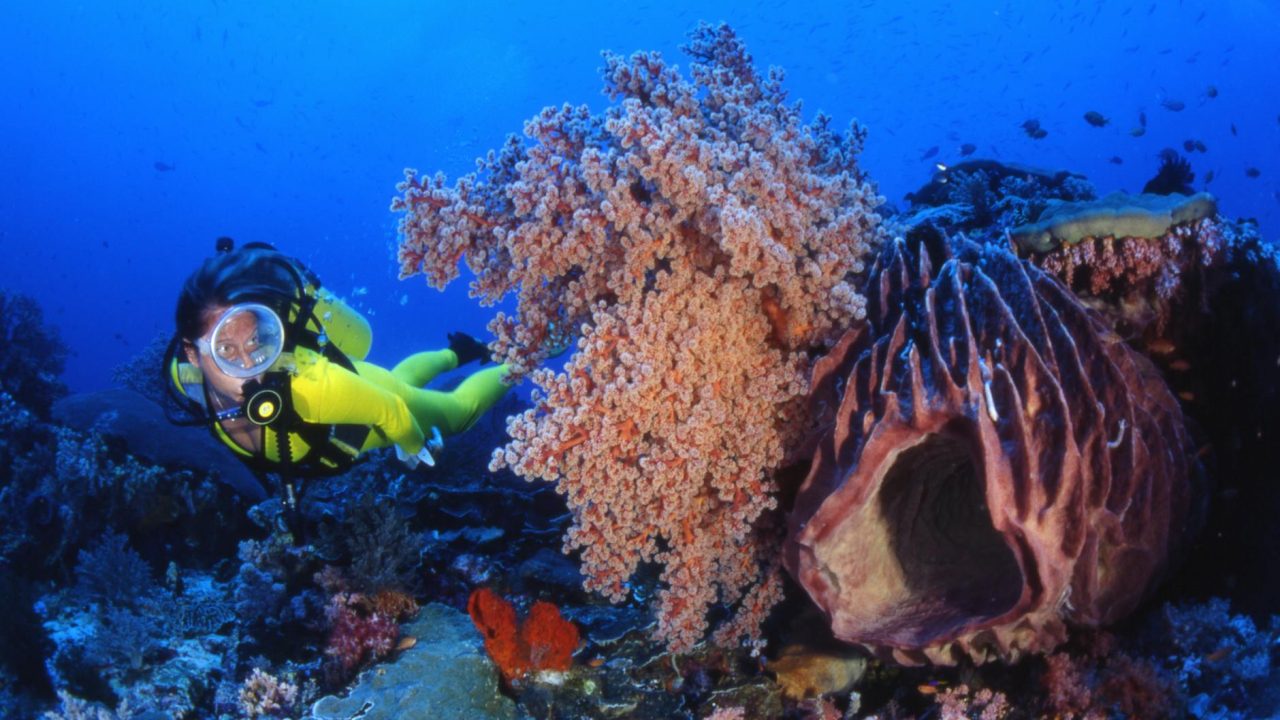
Fiji earns the top position for a reason that surprises many divers: soft coral. While hard coral reefs get most of the global attention, Fiji’s reef systems host extraordinary concentrations of soft coral that transform underwater walls into living tapestries of color.
The Great Astrolabe Reef, one of the largest barrier reefs in the world, surrounds Kadavu Island in the southern Viti Levu group. Visibility in these waters regularly exceeds 30 meters. The soft coral density on certain walls at sites like Nigali Passage is dense enough that the reef itself is barely visible beneath the biological growth covering it.
“Fiji, Indonesia, French Polynesia — we’re diving the world once again. But nothing prepared us for the soft coral walls of Kadavu. They look like someone set the reef on fire with color.”
— Undercurrent, July 2022
Then there is Beqa Lagoon. The shark diving operation here is one of the most sophisticated and closely studied in the world. Bull sharks, tiger sharks, nurse sharks, and multiple reef shark species gather at regular feed sites in the lagoon. Certified shark feeder divers work with animals that approach closely and predictably. The protocol has been running for over two decades, and the data gathered has contributed measurably to Pacific shark conservation research.
What truly separates Fiji from the other five destinations is consistency. Indonesia’s best sites require liveaboards and significant travel between islands. French Polynesia demands careful seasonal timing for shark passes. Okinawa’s peak wreck visibility is seasonal. Fiji delivers exceptional diving across multiple distinct environments within a compact geographic area, accessible from a single base on Viti Levu.
Fiji is also significantly more affordable than French Polynesia for equivalent quality. For divers budgeting seriously, that cost difference across a week-long trip can fund an entire additional dive vacation.
What This Ranking Means for Your 2026 Dive Calendar
The gap between these six destinations and the broader dive tourism market is widening, not narrowing. Climate pressures are affecting coral health globally, and several sites on this list face documented bleaching risk in coming years. Diving them now, during windows of optimal health, is not premature enthusiasm. It is sound timing.
The practical implication is straightforward. If your 2026 budget allows one major international dive trip, Fiji and Indonesia offer the highest combined value per dollar spent. If budget is secondary, French Polynesia’s Fakarava South Pass and Okinawa’s wreck circuit belong on the short list of dives that genuinely cannot be replicated elsewhere.
And if you are already planning multiple trips, the Americas bookends, Mexico’s cenotes and California’s kelp forests, offer experiences so different from Pacific island diving that they function as entirely separate categories of underwater travel rather than mere alternatives.
The world’s best reefs are not waiting indefinitely. The divers who regret these trips most are the ones who kept moving them to next year.


Leave a Reply