SNAP Payment Dates June 2026: What You Could Get Each Month, Who May Qualify, and How to Apply, With Current Official Figures and Step-by-Step Help — Up to $2,430 a Month

If you’ve ever looked at the SNAP income table and assumed your family earns too much, this guide is for you. The table is only…

If you’ve ever looked at the SNAP income table and assumed your family earns too much, this guide is for you. The table is only the starting point. Deductions for rent, utilities, and child care can bring your countable income down significantly — and most families never claim them. Read on to find out what June 2026 payment dates look like, how the math actually works, and what you could receive.

Sarah’s household qualifies for six programs at once — the breakdown below shows each one and its estimated monthly value, totaling $2,429.97 a month in combined support.

Your estimated monthly benefits by program

  • snap$820eligible
  • medicaid$690eligible
  • ssi$0not eligible
  • wic$59eligible
  • tanf$0not eligible
  • eitc$400eligible
  • ctc$367eligible
  • aca_ptc$0not eligible
  • acp$0not eligible
  • cdcc$0not eligible
  • aoc$0not eligible
  • free_school_meals$94eligible
  • reduced_price_school_meals$0not eligible
  • lifeline$0not eligible
  • tx_tanf$0not eligible

Total monthly: $2,430

The cliff visualizer maps Sarah’s benefit package from $12,000 to $60,000 in annual income, showing where support holds steady and where it drops sharply at the $57,000 cliff marker.

Benefit cliff: monthly benefits as income rises

  • $12,000$2,430
  • $27,000$2,340
  • $42,000$2,912
  • $57,000$1,541
  • $60,000$1,393

Cliff at: 57000

The cascade shows how SNAP, Medicaid, WIC, free school meals, EITC, and CTC layer together into $2,429.97 a month — and how a single application can start the process for all of them.

Programs you may be able to stack together

  • ctc
  • eitc
  • free_school_meals
  • medicaid
  • snap
  • wic

Combined monthly: $2,430

The eligibility checker runs the same deduction math described in Sarah’s story — enter your household size, income, rent, and child care costs to see your own estimated benefit.

Check what your household may qualify for

  • State: TX
  • Household size: 4
  • Annual income: 12000
  • snapmay qualify
  • medicaidmay qualify
  • ssimay not qualify
  • wicmay qualify
  • tanfmay not qualify
  • eitcmay qualify
  • ctcmay qualify
  • aca_ptcmay not qualify
  • acpmay not qualify
  • cdccmay not qualify
  • aocmay not qualify
  • free_school_mealsmay qualify
  • reduced_price_school_mealsmay not qualify
  • lifelinemay not qualify
  • tx_tanfmay not qualify

One Family’s Story

Sarah is a single mom with two kids. Her household of three brings in $3,300 a month. She looked up the SNAP gross income limit for a family of three — $2,888 a month — and figured she was over the line. She assumed her benefit would be $0 and moved on.

Here’s what she missed. Sarah pays $1,250 a month in rent, $330 in utilities, and $550 for child care. Those costs are deductible under SNAP rules. Once the shelter and dependent-care deductions are applied, her countable net income drops to $1,241.50 a month. Her computed benefit comes out to $412 a month — or $4,944 over a full year. That money was available the whole time.

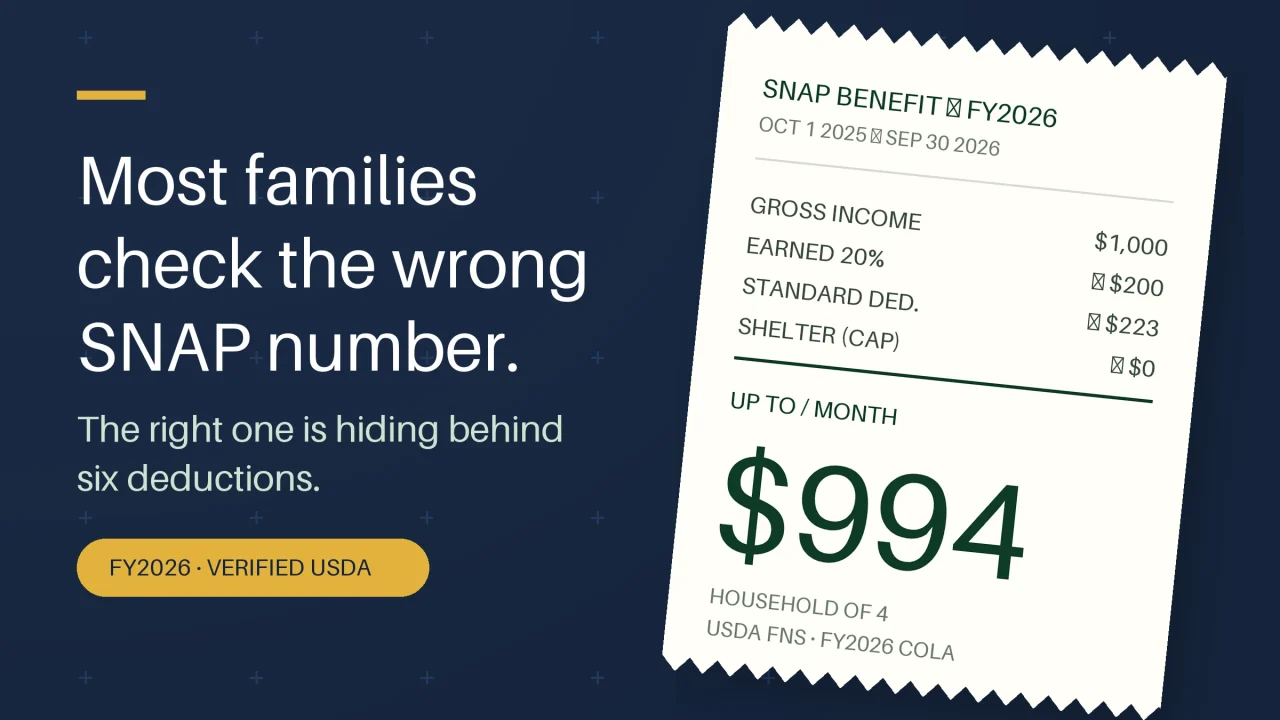
The gross income figure on the table is a starting screen, and deductions do the real work of determining your benefit. That’s why most families check the wrong SNAP number. They stop at gross income and never reach the deduction step where the actual benefit is calculated.

How SNAP Payment Dates Work in June 2026

SNAP benefits in June 2026 are loaded onto your EBT card on a schedule set by your state. Most states spread payments across the first 10 to 28 days of the month, assigning your date based on your case number, last name, or the date you enrolled. Your state’s benefits agency will have your exact date.

A few things to keep in mind for June 2026:

  • Benefits are available at midnight on your assigned date — you do not need to wait until a office opens.
  • If your date falls on a weekend or holiday, most states load benefits on the prior business day.
  • You can check your balance any time through your state’s EBT app, a participating retailer’s PIN pad, or your state agency’s website.

How Your Benefit Amount Is Calculated

SNAP uses a two-step process. First, your household’s gross income is compared to the gross limit for your household size. For a family of three in FY2026, that published limit is $2,888 a month. If you use the broad-based categorical eligibility rules your state may have adopted, the limit can be higher.

Second — and this is the step most people skip — deductions are subtracted from your gross income to find your net income. SNAP then figures your expected food contribution at 30% of net income and subtracts that from the maximum benefit for your household size. The deductions that matter most are:

  • Earned income deduction: 20% of all earned income is automatically excluded.
  • Standard deduction: A flat amount subtracted for every household.
  • Dependent care deduction: Child care or other dependent care costs you pay so you can work or attend school.
  • Shelter deduction: Rent or mortgage plus utilities above a threshold, up to a cap for most households.
  • Medical deduction: For households with a member who is elderly or disabled, out-of-pocket medical costs above $35 a month.

Sarah’s $550 in child care and $1,250 in rent plus $330 in utilities together pushed her shelter excess to $639.50 — deductions the table alone would never show you.

What Else You May Qualify For

A SNAP application often opens the door to other programs at the same time. The benefit breakdown widget below shows the programs available to a household like Sarah’s, including Medicaid, WIC, free school meals, the Earned Income Tax Credit, and the Child Tax Credit. Checking one program at a time means leaving money on the table.

How Income Changes Affect Your Benefits

Getting a raise or a new job does not always mean losing benefits. The cliff visualizer below maps out how total monthly benefits shift as annual income rises. Notice that the benefit curve does not drop straight down — there are ranges where a higher income still supports a strong benefit package, and one sharp cliff point at $57,000 a year where a specific combination of programs changes quickly.

Programs That Work Together

The cascade widget shows the six programs most relevant to families in Sarah’s situation: SNAP, Medicaid, WIC, free school meals, the Earned Income Tax Credit, and the Child Tax Credit. Together they add up to $2,429.97 a month in combined support. Each program has its own rules, but many share the same application or use the same income information, so applying for one often speeds up the others.

Find Out What Your Household Qualifies For

The eligibility checker below lets you enter your own household size, income, and expenses. It runs the same deduction math described in Sarah’s story and shows you an estimated benefit within seconds. You do not need to share your name or any identifying information to use it.

A Few Common Questions

Does overtime or a second job count as income? Yes. All earned income counts before deductions. The 20% earned income deduction then reduces the amount that is counted.

What if my income changes month to month? Report changes to your caseworker as required by your state. Many states allow you to report changes within 10 days of a significant income shift.

Can I use SNAP at farmers markets? Many farmers markets now accept EBT, and some offer matching programs that double your purchasing power on fresh produce. Ask at your local market or check with your state agency.

What if I was denied before? Rules change each year, and a denial in a prior year does not affect a new application. If your expenses have gone up or your household size has changed, it is worth applying again.

How to Apply

You can apply for SNAP online through your state’s benefits portal, in person at your local SNAP office, or by mail. Most states process applications within 30 days, and households in urgent need may qualify for expedited benefits within 7 days. Bring documentation of your income, rent or mortgage costs, utility bills, and any child care expenses — these are the numbers that drive your deduction calculation.

Sarah is an illustrative composite. Every number in this story was computed by this page’s rules engine or cited from the public record — nothing was estimated by a writer.

What changed in this guide

  1. Lifeline income limit 2026 — household of 1 source
  2. Lifeline income limit 2026 — household of 2 source
  3. Lifeline income limit 2026 — household of 3 source
  4. Lifeline income limit 2026 — household of 4 source
  5. Lifeline income limit 2026 — household of 5 source

Start with the prize

Before any forms, see the number this page is built around — the most a household your size can get each month.

What a yes is worth

Now run your own numbers

Sarah’s case shows the shape of the math. Your case has its own shape. The same four-stage test a caseworker runs is live right here.

Run your own numbers — the same four-stage test a caseworker runs

What you might be leaving unclaimed

Most small awards trace back to deductions nobody claimed. This score shows where your case stands and what each missed lever is worth.

You may be leaving money on the table

The cost of walking away

Skipping the claim has a price. Here is what a year of walking away looks like for a case like yours.

What walking away from this page costs

One door opens others

An approval here often unlocks other help automatically. Check what else your numbers may qualify you for.

What else am I eligible for?

Take it with you

Turn this page into paperwork: a case file you can print, save, and bring to the interview.

Take it with you

The six levers in the formula

Two deductions happen on their own. Four only count when you claim them. Each card below is one lever.

The six deductions — two run themselves, four you must claim

automatic

Earned-income deduction

20% off the top

20% of every wage and self-employment dollar comes off before any test is run. Applied automatically — you cannot forget it and the office cannot skip it.

automatic

Standard deduction

$209–$299/month

Every household gets one, by size: $209 for one to three people, $223 for four, $261 for five, $299 for six or more. Automatic.

claim it

Excess shelter deduction

capped at $744

Housing costs above half your adjusted income count against your net — up to $744/month, with NO cap when a member is 60+ or disabled. The single most under-claimed deduction: report your real rent.

claim it

Utilities — the Standard Utility Allowance

$430–$877 by state

Pay heating or cooling separately? Your state's SUA is added to shelter costs whether your actual bills are higher or lower. Ask for it by name — it is often worth more than the bills themselves.

claim it

Dependent care

no cap

Childcare or adult-day care that lets you work, train, or study comes off your income dollar for dollar — federally uncapped. Most families never report it.

claim it

Medical expenses (60+/disabled)

above $35/month

Members who are 60+ or disabled deduct every medical dollar above $35/month — premiums, prescriptions, transport to appointments, even over-the-counter items a provider recommends.

Does it count as income?

Some money counts against you and some never did. Tap each item to see the ruling before you assume the worst.

Does it count? The income classifier

Five households, five answers

The formula bends differently for each family. Find the story closest to yours and start from it.

Five households, computed live

Households exactly like yours

Same rent, same bills, different paychecks. Watch how the benefit changes as income climbs.

The benchmark: households exactly like yours

When life changes, the number moves

A raise, a baby, a lease renewal. Tap an event to see how your benefit responds and what to report.

When life changes, the number moves with you

If the notice says no

A denial is a document you can answer. Decode the reason before you give up.

Denied? Decode the notice before you give up

What EBT actually buys

The rules at the register surprise most people. Test yourself on the real rulings.

Can I buy it with EBT?

When the deposit is late

Three taps to the most likely cause and the fastest way to fix it.

Deposit late? Three taps to the likely cause

Filing to first deposit

Five steps stand between today and the card in your hand. Here is the road.

Filing to first deposit — the five steps

  1. File the application — today

    Online, by phone, or on paper. Benefits run from the FILING date, not the approval date — every day you wait is a day you cannot get back. You can file with nothing but a name, address, and signature and send the rest later.

  2. The interview

    A phone call in most states. Miss it? Reschedule — within 30 days of filing you usually keep your original filing date. Bring the prep card from your case file above.

  3. Verification

    Send the documents the notice lists — typically within 10 days. If something is hard to get, say so: the agency is required to help you obtain it.

  4. The decision

    Federal law: 30 days maximum from filing. Very low income and resources? Expedited service applies — a decision within 7 days. Ask for it at filing if money is critically short.

  5. EBT card and first deposit

    Your card arrives by mail; benefits load back to your filing date. After that, deposits follow your state's monthly schedule — the deposit decoder above shows yours.

Need food before the decision?

Call 211 (or visit 211.org) for food banks and pantries near you today — no eligibility test, no waiting period. SNAP and food banks are designed to work together, not as alternatives.

The edge cases

Students, mixed-status families, gig workers. The myths say no. The rules often say yes.

The edge rules — myths, corrected

College students

“Students can't get SNAP.”

Half-time-plus students need an exemption — and the list is long: working 20 hrs/week, work-study, caring for a child under 12 (under 6 if a spouse is home), or unable to work. Many eligible students never apply because of this myth.

Mixed-immigration-status households

“Applying puts the whole family at risk.”

Citizen children qualify even when parents do not. A parent can apply FOR the children without applying for themselves, and only applicants' status is verified. SNAP for your citizen kids is not a public-charge problem under current rules.

Able-bodied adults (post-2025 law)

“The new work rules cut everyone off.”

The 2025 law extended work requirements to age 64 — but the exemptions still stand: a child in the household, medical unfitness, pregnancy, veteran status (verify current rules), and working 20+ hrs/week all satisfy or exempt. Check before assuming you are out.

No fixed address

“You need an address to apply.”

You do not. The office must accept an application without a fixed address — a shelter, a general-delivery post box, or the office's own address works. A homeless shelter deduction may also apply to your math.

Gig and self-employment income

“Gig income disqualifies you.”

Gig income counts NET of expenses — mileage, fees, supplies — and then the earned-income deduction comes off what remains. Track expenses: most gig workers over-report their countable income and under-claim their benefit.

How your state runs it

The federal formula is the frame. Your state fills in the numbers that matter.

How SNAP works in your state

CA

Gross-income line (BBCE)200%
Standard Utility Allowance$663/mo
Deposit schedule1st–10th of the month, staggered by the last digit of the case number
AgencyCalifornia Department of Social Services (CDSS; county-administered CalFresh)
Apply atBenefitsCal — https://benefitscal.com
Restaurant Meals Programparticipating

TX

Gross-income line (BBCE)165%
Standard Utility Allowance$445/mo
Deposit schedule1st–15th of the month, staggered by the last digit of the EDG number
AgencyTexas Health and Human Services Commission (HHSC)
Apply atYourTexasBenefits — https://www.yourtexasbenefits.com

NY

Gross-income line (BBCE)150%
Standard Utility Allowance$877/mo
Deposit scheduleOver the first 9 banking days of the month, staggered by case number
AgencyNew York State Office of Temporary and Disability Assistance (OTDA)
Apply atmyBenefits — https://mybenefits.ny.gov
Restaurant Meals Programparticipating

FL

Gross-income line (BBCE)200%
Standard Utility Allowance$430/mo
Deposit schedule1st–28th of the month, staggered by the 9th and 8th digits of the case number
AgencyFlorida Department of Children and Families (DCF)
Apply atMyACCESS — https://myaccess.myflfamilies.com

OH

Gross-income line (BBCE)130%
Standard Utility Allowance$766/mo
Deposit schedule2nd–20th of the month, staggered by the last digit of the case number
AgencyOhio Department of Job and Family Services (ODJFS)
Apply atOhio Benefits Self-Service Portal — https://ssp.benefits.ohio.gov

The questions behind the questions

What people actually ask once the forms get real.

The questions behind the questions

I'm over the gross income limit. Am I automatically denied?+
Not necessarily. States using broad-based categorical eligibility set the gross limit at 165%, 185%, or 200% of poverty instead of 130%. Households with an elderly or disabled member skip the gross test entirely — only the net test applies. Run your real numbers with your state selected before assuming anything.
What counts as my household?+
People who live together and buy and prepare food together. Roommates who shop and cook separately can be separate SNAP households. Spouses and most children under 22 living with a parent are counted together regardless.
Do my savings or my car disqualify me?+
FY2026 asset limits are $3,000 for most households and $4,500 where a member is elderly or disabled — and most states have waived the asset test. Most vehicles, your home, and retirement accounts are typically excluded even where a test applies.
How is the benefit amount actually calculated?+
Maximum allotment for your household size, minus 30% of net monthly income (the 30% is rounded up). Zero net income means the full maximum. Qualifying one- and two-person households receive at least the $24 minimum benefit.
How long does approval take?+
Federal law requires a decision within 30 days. If gross monthly income is under $150 and resources under $100 — or income plus resources fall below your rent and utilities — expedited service applies: a decision within 7 days.
Did the 2025 law change anything?+
The One Big Beautiful Bill Act of 2025 modified work requirements and non-citizen eligibility rules. The FY2026 dollar figures on this page are unaffected, but work-requirement rules may apply to you — confirm current rules with your state agency.
Do my benefits expire if I don't spend them this month?+
No. Unused benefits roll over and stay on your EBT card for 274 days — nine months. You lose nothing by saving part of one month's allotment for the next.
Can I use EBT online or at restaurants?+
Online: yes — SNAP EBT works for grocery purchase and delivery at major retailers including Walmart, Target, and Amazon, and on some delivery apps (benefits cover the food; fees and tips need another payment method). Restaurants: only in states running the Restaurant Meals Program, for qualifying recipients such as elderly, disabled, or homeless members.

What this page is — and is not

Read this before you act on any number above.

What this page is — and is not

This guide is independent journalism. We are not affiliated with USDA, FNS, or any state agency, and nothing here is a determination of eligibility.

Figures cover the 48 contiguous states and D.C. Alaska and Hawaii use separate, higher tables — check your state agency.

Your state's verified determination is the only number that binds. Everything on this page is an estimate built from the published federal formula and your own inputs.

State rules vary within the federal frame — broad-based categorical eligibility, utility allowances, and deposit schedules on this page carry their own effective dates and sources.

Built on the record, not on vibes

acf.gov · tier A
Maximum income eligibility
Maximum income eligibility: Greater of 150% of federal poverty guidelines OR 60% of state median income
federalregister.gov · tier A
Wic ieg 2026 4
WIC income eligibility guideline — household of 4: WIC income eligibility (July 1, 2026 – June 30, 2027), household of 4: $61,050 per year ($5,088 per month, $1,175 per week), 48 contiguous states (Federal Register, FR Doc 2026-08323).
nasfaa.org · tier A
Sai pell ineligibility threshold 2x max award
SAI Pell ineligibility threshold (2x max award): $14,790 (SAI at/above this disqualifies; new under OBBBA)
fsapartners.ed.gov · tier A
Maximum pell grant award 2026 27
Maximum Pell Grant award (2026-27): $7,395
usac.org · tier B
Lifeline ieg 2026 4
Lifeline income limit 2026 — household of 4: Lifeline income limit (135% of the 2026 federal poverty guidelines), household of 4: $44,550 per year (48 contiguous states, DC, and territories; USAC consumer eligibility table, current June 2026).
ecfr.gov · tier A
Ssi pack exclusion general
SSI general income exclusion: SSI does not count the first $20 of any unearned income in a month (20 CFR 416.1124(c)(12)); any unused part of the $20 exclusion reduces countable earned income.
ecfr.gov · tier A
Lifeline rule 135
Lifeline income eligibility rule: A consumer qualifies for Lifeline if household income is at or below 135% of the Federal Poverty Guidelines for a household of that size (47 CFR 54.409(a)(1)).
ecfr.gov · tier A
Ssi pack exclusion earned
SSI earned income exclusion: SSI does not count the first $65 of earned income in a month, plus one-half of remaining earned income (20 CFR 416.1112(c)).
huduser.gov · tier A
Us median family income national baseline
US median family income (national baseline): $106,800 (FY2026)
huduser.gov · tier A
Income limit categories published
Income limit categories published: 30% (Extremely Low), 50% (Very Low), 80% (Low) of Area Median Income by family size
federalregister.gov · tier S
Hhs fpl 2026 8
HHS poverty guideline 2026 — household of 8: HHS poverty guideline 2026, household of 8: $55,720 per year (48 contiguous states and DC; Federal Register annual update).
aspe.hhs.gov · tier S
Poverty guideline 1 person alaska hawaii
Poverty guideline — 1 person (Alaska / Hawaii): $19,950 (AK) / $18,360 (HI)
irs.gov · tier A
Child tax credit refundable portion additional ctc
Child Tax Credit refundable portion (Additional CTC): $1,700 (TY2026)
irs.gov · tier A
Child tax credit maximum per qualifying child
Child Tax Credit maximum per qualifying child: $2,200 (permanent + inflation-indexed from 2026 under OBBBA)
healthcare.gov · tier A
Aca medicaid expansion income eligibility ceiling
ACA Medicaid expansion income eligibility ceiling: 138% of federal poverty level (states that expanded)
congress.gov · tier A
Enhanced arpa ira premium tax credits
Enhanced (ARPA/IRA) premium tax credits: EXPIRED December 31, 2025 — subsidies reverted to pre-2021 ACA structure (400% FPL subsidy cliff returns); avg net premiums est. +114%
fns.usda.gov · tier A
Restaurant meals program
Restaurant Meals Program participation — Florida: No — not participating (as of FY2026)

Leave a Reply

Your email address will not be published. Required fields are marked *