
Knowing your exact payment date helps you plan bills, groceries, and everything in between. This guide covers every Social Security and SSI payment date for July 2026. It also explains who falls into each payment group and what to do if your money is late.
The July 2026 Payment Schedule
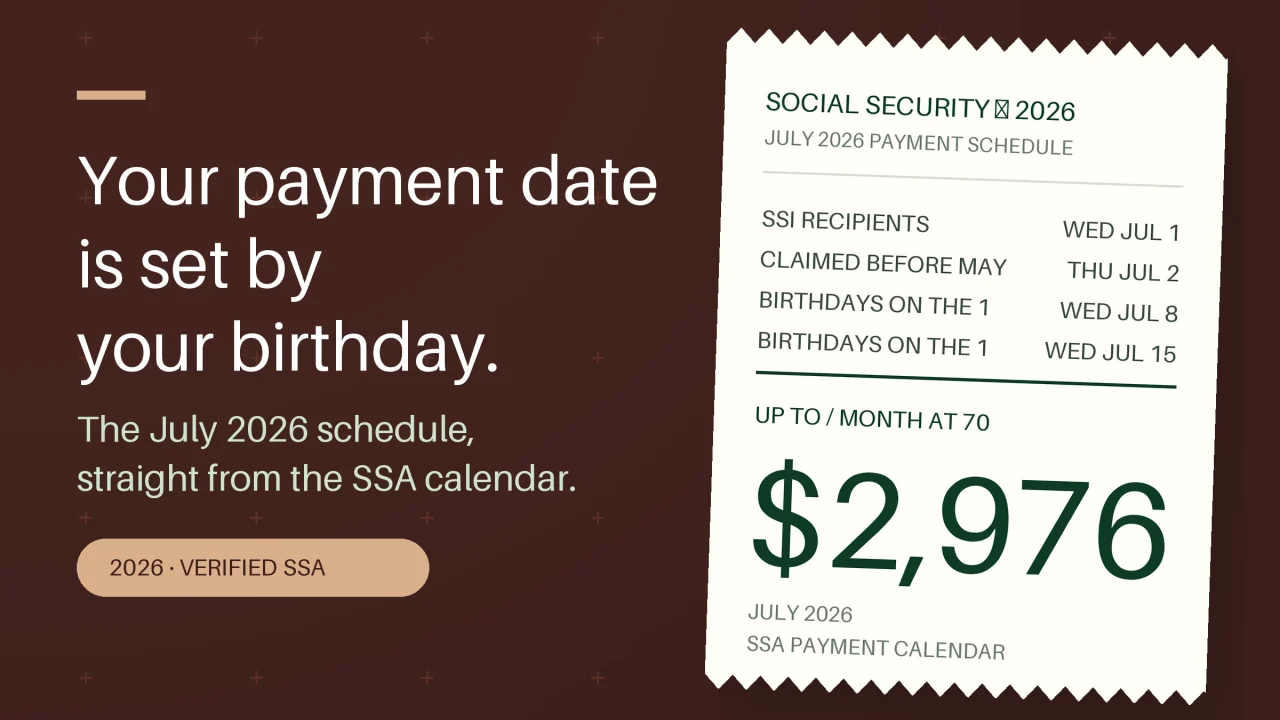
SSA sends payments on five separate dates in July 2026. Your date depends on which group you belong to. The widget below shows every group and its exact date.
SSA has five official payment dates in July 2026, shown here exactly as published in SSA Publication EN-05-10031-2026.
Each date is official and comes directly from SSA Publication EN-05-10031-2026. Keep this schedule somewhere easy to find.
Who Gets Paid on July 1
SSI recipients receive their payment on Wednesday, July 1, 2026. SSI stands for Supplemental Security Income. It is a needs-based program for people with limited income and resources. The SSI federal benefit rate for an individual is $994 per month in 2026. For a couple, the rate is $1,491 per month. SSI payments land on the first of the month as a general rule. July 2026 is no exception.
SSI has resource limits worth knowing. An individual may have no more than $2,000 in countable resources. A couple may have no more than $3,000. Funds held in an ABLE account are excluded up to $100,000. Burial funds get a separate exclusion of $1,500 per person. These limits have stayed the same since 1989.
SSI also has income exclusions that help recipients keep more of what they earn. SSA sets aside the first $20 of most income each month — that amount is simply excluded from the count. On top of that, there is a $65-per-month earned income exclusion. Half of any earnings above $65 is also excluded. These rules can make a real difference for people who work part time while receiving SSI.
Who Gets Paid on July 2
Some Social Security recipients receive their payment on Thursday, July 2, 2026. This group includes two sets of people. The first set claimed Social Security before May 1997. The second set receives both Social Security and SSI at the same time. If either description fits you, your July payment arrives on July 2.
This earlier date is a holdover from an older payment system. SSA kept it in place for long-time beneficiaries. If you fall into this group, you do not move to a Wednesday schedule.
The Wednesday Birthday Groups
Everyone else receives payment on one of three Wednesdays in July 2026. SSA assigns your Wednesday based on the day of the month you were born. This system has been in place since May 1997.
If your birthday falls on the 1st through the 10th of any month, your payment arrives on Wednesday, July 8, 2026. This is the second Wednesday of July.
If your birthday falls on the 11th through the 20th of any month, your payment arrives on Wednesday, July 15, 2026. This is the third Wednesday of July.
If your birthday falls on the 21st through the 31st of any month, your payment arrives on Wednesday, July 22, 2026. This is the fourth Wednesday of July. A person born on the 21st of any month falls into this group, as does anyone born on the 31st.
Your birth year does not matter for this assignment. Only the day of the month counts. A person born on July 5 and a person born on March 9 both fall into the first group. They both receive payment on Wednesday, July 8, 2026.
What to Do If Your Payment Is Late
Give SSA three business days after your scheduled date before calling. Banks and credit unions sometimes take a day or two to post deposits. If three full business days have passed and your payment has not arrived, contact SSA directly.
You can call the SSA national line at 1-800-772-1213. The line is open Monday through Friday. If you are deaf or hard of hearing, call the TTY line at 1-800-325-0778. You can also visit your local SSA office in person.
Missing payments are often caused by a change in your bank account information. If you recently switched banks or changed account numbers, update your direct deposit details with SSA right away. Outdated account information is one of the most common reasons a payment does not arrive on time.
How Your Claiming Age Affects Your Monthly Amount
Your payment date in July 2026 is fixed by your birthday window. Your payment amount, on the other hand, depends on when you claimed. Claiming earlier means a smaller monthly check. Claiming later means a larger one. The dashboard below shows how the monthly amount changes by age.
Your claiming age determines your monthly amount — this dashboard shows the range from age 62 through age 70.
The difference between claiming at 62 versus 70 is significant over a lifetime. The crossover chart below shows the age at which waiting pays off more than claiming early.
The crossover age of 80.37 shown here is the point at which waiting to claim produces more total lifetime income than claiming early.
The Earnings Test and Working While Collecting
Some people claim Social Security before their full retirement age and keep working. SSA applies an earnings test in that situation. If you earn more than $24,480 per year and are under full retirement age all year, SSA withholds $1 for every $2 you earn above that limit. In the year you reach full retirement age, the limit rises to $65,160 per year, and the withholding rate drops to $1 for every $3 over the limit.
The widget below shows how the earnings test works with a specific earnings example.
With $35,000 in earnings, SSA would withhold $5,260, leaving $29,740 kept — this widget shows how that calculation works.
Money withheld under the earnings test is not lost forever. SSA adds it back to your benefit once you reach full retirement age. Your monthly payment goes up at that point to reflect the withheld amounts.
Taxes on Your Social Security Benefit
Depending on your total income, part of your Social Security benefit may be taxable. SSA uses a figure called “combined income” to determine how much is taxed. For single filers, combined income above $25,000 can trigger taxes on up to 50% of your benefit. Above $34,000, up to 85% may be taxable. For joint filers, the thresholds are $32,000 and $44,000. The tax tier widget below explains where your income falls.
With provisional income of $41,600, this widget shows which tax tier applies and how much of your benefit may be taxable.
Other Programs That May Help
Your Social Security payment is one piece of your overall income picture. Several other programs may be available to you depending on your income level. The eligibility screen below gives a quick look at programs worth exploring.
At 113% of the federal poverty level, this screen shows which assistance programs are likely available to you.
Programs like Extra Help can reduce prescription drug costs. SNAP can help with groceries. LIHEAP can help with energy bills. These programs do not reduce your Social Security payment. Applying for them is always worth checking out.
Overpayments and Offsets to Know About
Sometimes SSA pays more than it should. When that happens, SSA will try to recover the overpayment. For Title II benefits — retirement, disability, and survivor — the default recovery rate is 100% of your monthly benefit for new overpayments after March 27, 2025. You can request a lower rate using Form SSA-632. There is no time limit for filing that form. For SSI, the recovery rate is 10% of your monthly SSI payment.
If you receive an overpayment notice, you have 60 days to appeal it using Form SSA-561. Acting quickly protects your rights.
If you have a defaulted federal student loan, the Treasury can offset your Social Security payment. The offset is capped at 15% of your monthly benefit. SSA will never reduce your payment below $750 per month due to this offset.
A Note for Widow and Widower Beneficiaries
A recent SSA audit found that 8,618 widow(er)s were underpaid because SSA did not apply the correct calculation. The spouse in each case had died before age 62. The total underpayment across those cases was $50.4 million. If you are a surviving spouse and believe your benefit may be too low, contact SSA to ask for a review. It is always appropriate to ask questions about your benefit amount.
SSA also pays a one-time lump-sum death payment of $255 to an eligible surviving spouse or child. You apply using Form SSA-8. You must apply within two years of the death.
The 2026 Cost-of-Living Adjustment
All Social Security benefits received a 2.8% cost-of-living adjustment effective January 2026. About 71 million beneficiaries saw this increase. SSI recipients saw the adjustment effective December 31, 2025. This adjustment is already reflected in your July 2026 payment amount.
Quick Reference for July 2026
Here is a plain summary of every July 2026 payment date. SSI recipients are paid on Wednesday, July 1, 2026. People who claimed before May 1997, or who receive both Social Security and SSI, are paid on Thursday, July 2, 2026. People with birthdays on the 1st–10th are paid on Wednesday, July 8, 2026. People with birthdays on the 11th–20th are paid on Wednesday, July 15, 2026. People with birthdays on the 21st–31st are paid on Wednesday, July 22, 2026.
If your payment does not arrive within three business days of your scheduled date, call SSA at 1-800-772-1213. TTY users can call 1-800-325-0778. SSA staff can trace your payment and help resolve the issue.



Leave a Reply