
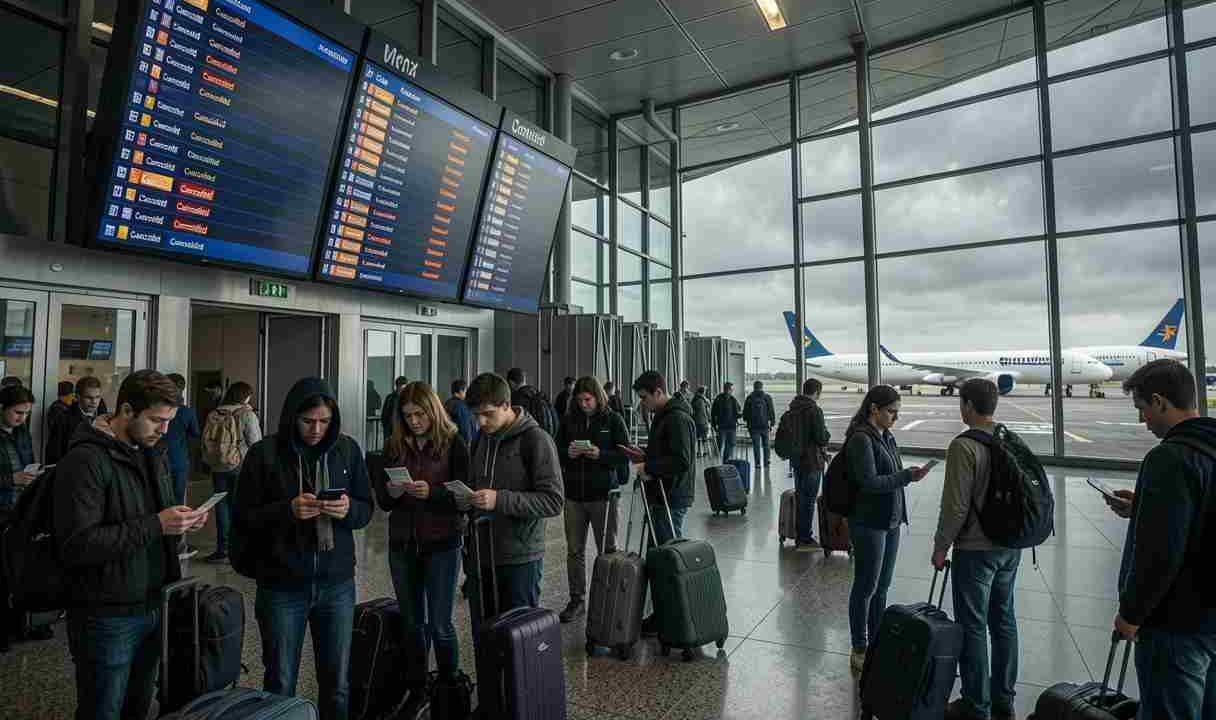
Flights out of Heydar Aliyev International Airport in Baku are being cancelled across some of the busiest routes connecting Azerbaijan to the Middle East and Europe — and the pattern of disruptions suggests this is far from a one-day problem.
Analysis of the cancelled departures points to a systemic issue rather than isolated bad weather or a single mechanical failure. The same flight numbers are appearing on cancellation lists repeatedly, across multiple days, affecting routes that tens of thousands of passengers depend on for both direct travel and long-haul connections.
If you have a flight booked through Baku in the coming days, this is what you need to know.
What Is Actually Happening at Baku Airport Right Now
Heydar Aliyev International Airport is experiencing what aviation analysts would describe as an operational meltdown — a sustained wave of cancellations that has disrupted connectivity to two of the world’s most significant aviation hubs: Dubai International Airport and Hamad International Airport in Doha.
The disruptions are not random. The same routes and the same flight numbers are being cancelled repeatedly, which strongly indicates the problem is rooted in deeper operational challenges rather than a temporary blip.
Among the hardest-hit routes, the Baku–Dubai corridor stands out as the most commercially significant. Flights FDB710 and FDB734 have seen multiple cancellations, cutting off one of the busiest links between Azerbaijan and the Gulf region.
Doha is also heavily affected. Flights QTR352 and QTR354 — operated by Qatar Airways — have been cancelled repeatedly. These are not just point-to-point routes. Hamad International is a global transit hub, meaning that passengers booked on these flights were likely connecting onward to destinations across Asia, Africa, and the Americas. A cancellation here doesn’t just strand you in Baku — it can unravel an entire multi-leg journey.
Regional connectivity has also taken a hit, with repeated cancellations reported on routes to Tbilisi, Georgia — a key short-haul corridor for the South Caucasus region.
The Flights Most Affected: A Breakdown
Here is what the data on cancelled departures from Baku currently shows:
| Flight Number | Destination | Airport | Status |
|---|---|---|---|
| FDB710 | Dubai | Dubai International Airport | Repeatedly Cancelled |
| FDB734 | Dubai | Dubai International Airport | Repeatedly Cancelled |
| QTR352 | Doha | Hamad International Airport | Repeatedly Cancelled |
| QTR354 | Doha | Hamad International Airport | Repeatedly Cancelled |
| Multiple | Tbilisi | Tbilisi International Airport | Repeatedly Cancelled |
The fact that these cancellations are appearing across different days for the same flight numbers is the most telling detail. It rules out a single-event cause and points toward something more persistent — whether that involves staffing, scheduling, aircraft availability, or infrastructure issues has not yet been officially confirmed.
Why These Routes Matter Beyond Baku
It would be easy to look at this story as a regional inconvenience. It is considerably more than that.
Dubai International is consistently ranked among the world’s busiest airports by international passenger traffic. The Baku–Dubai route is not just popular with leisure travellers — it serves a significant business and expatriate community, and it feeds passengers into Emirates’ vast global network.
Hamad International in Doha plays a similar role for Qatar Airways, which operates one of the world’s most extensive long-haul networks. A passenger cancelled off QTR352 or QTR354 isn’t simply delayed on a short hop — they may have missed connections to cities in Southeast Asia, sub-Saharan Africa, or North America. The knock-on effect of these cancellations extends far beyond Azerbaijan’s borders.
The Tbilisi cancellations add another layer of concern. Tbilisi is a regional hub in its own right, and disruptions on this corridor affect travellers moving through the South Caucasus — a region where overland alternatives are not always practical.
Who Is Most at Risk and What You Should Do
Travellers most exposed to this disruption include:
- Passengers booked on direct Baku–Dubai flights, particularly those on FDB710 or FDB734
- Anyone transiting through Doha on QTR352 or QTR354 with onward connections to Asia, Africa, or the Americas
- Business travellers and tourists on the Baku–Tbilisi regional route
- Passengers who booked multi-leg journeys that begin or pass through Heydar Aliyev International Airport
If your travel falls into any of these categories, the most important thing you can do right now is check your flight status directly with your airline — not just through third-party apps, which can lag behind real-time updates. Contact your airline’s customer service line and ask specifically about rebooking options, since most carriers are obligated to offer alternatives when they cancel a flight.
Travel insurance holders should also review their policies. Repeated, systemic cancellations of this kind — rather than one-off weather events — can sometimes complicate claims, so documenting everything from the moment you receive a cancellation notice is essential.
What Happens Next
The duration and root cause of these disruptions has not yet been officially confirmed by airport authorities or the airlines involved. What the pattern of repeated cancellations does confirm is that this is not resolving itself quickly.
Passengers travelling through Baku in the near term should build in contingency time, consider whether alternative routing is available, and stay in close contact with their airline for updates. The situation at Heydar Aliyev International Airport remains fluid, and the list of affected flights may expand before it contracts.
Anyone with travel planned to or through Baku — whether the destination is Dubai, Doha, Tbilisi, or a connecting city beyond — should treat their itinerary as uncertain until they receive direct confirmation from their carrier.
Frequently Asked Questions
Which flights out of Baku are being cancelled?
The most frequently cancelled flights include FDB710 and FDB734 to Dubai, QTR352 and QTR354 to Doha, and multiple flights to Tbilisi.
Is this a short-term disruption or something longer?
The same flight numbers have been cancelled across multiple days, which suggests a prolonged operational issue rather than a one-off event.
Why do the Doha cancellations affect passengers going to other continents?
Hamad International Airport is a major global transit hub for Qatar Airways, meaning passengers cancelled off Doha-bound flights may lose onward connections to Asia, Africa, and the Americas.
What should I do if my Baku flight is cancelled?
Check your flight status directly with your airline, ask about rebooking options, and document all communications — especially if you plan to make a travel insurance claim.
Has the cause of the Baku airport disruptions been officially confirmed?
The specific root cause has not yet been officially confirmed by airport authorities or the airlines involved.
Are flights to Tbilisi also affected?
Yes, repeated cancellations on the Baku–Tbilisi route have been reported as part of the broader disruption at Heydar Aliyev International Airport.




Leave a Reply