
Fewer than 5% of the world’s indigenous cultures have successfully transitioned their most sacred funerary traditions into publicly accessible heritage spaces without triggering significant community backlash. That statistic makes what is happening in Tenom, Sabah, all the more remarkable — and contested.
Deep in Malaysian Borneo, a newly established institution is doing something quietly radical. The Murut Cultural Centre in Tenom, Sabah, has opened its doors to the public with a centerpiece that stops visitors cold: a Skull House. Real ancestral skulls, preserved within a traditional grave hut structure, displayed as the beating heart of a living cultural museum.
The reaction has been anything but uniform. Anthropologists, travel writers, indigenous rights advocates, and Murut community members themselves are split. Is this courageous cultural preservation, or does putting ancestral remains on display for tourists cross a line that should never be crossed?
The Controversy at the Heart of Tenom’s Skull House
The Murut people are among Sabah’s oldest indigenous communities. Historically celebrated as skilled hunters and fierce warriors, they built their identity around elaborate traditions: blowpipe craftsmanship, communal longhouse living, and — critically — a relationship with ancestral remains that outsiders often misread as macabre.
The Skull House tradition emerged from a belief that the skulls of ancestors carried protective spiritual energy. Keeping them close was not morbid. It was reverent. Communities believed those skulls guarded villages from harm and ensured agricultural abundance.
Now those same skulls sit inside a purpose-built cultural centre on the outskirts of Tenom, viewable by anyone with an entry ticket. That shift from private communal sacred space to public attraction has cracked the conversation wide open.
Side A: Why Public Display Is Essential to Murut Survival
The case for displaying the Skull House openly is, at its core, a case for cultural survival. The Murut are not a thriving majority culture with institutions, media, and political representation to protect their traditions. They are a minority indigenous group whose practices risk disappearing within a generation if not actively documented and promoted.
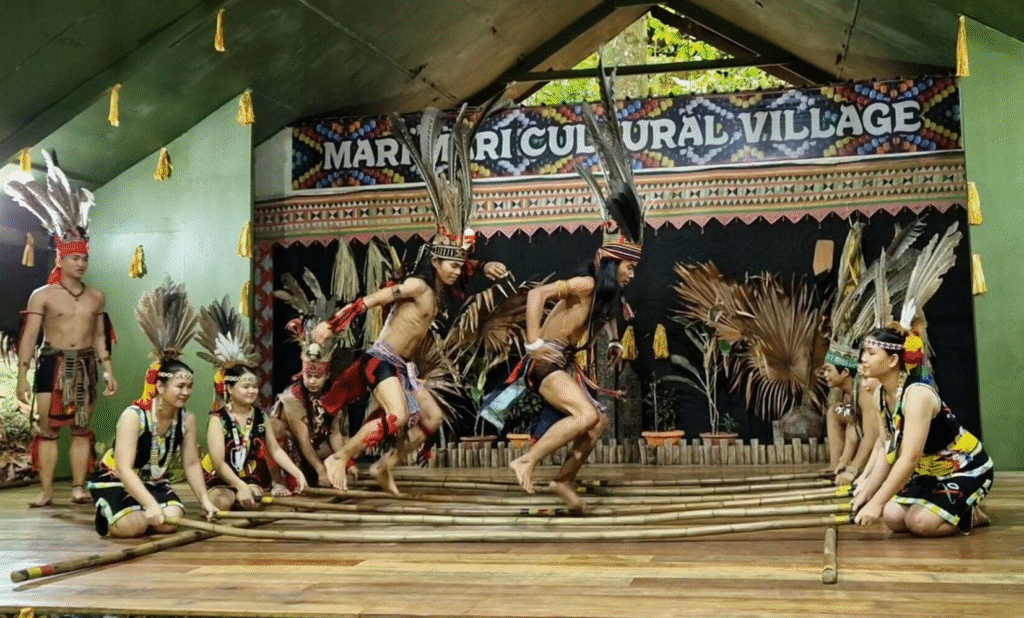
Proponents point to the model working elsewhere in Sabah. The Mari-Mari Cultural Village outside Kota Kinabalu has demonstrated that immersive cultural tourism, when community-led, can sustain heritage rather than erode it. As one observer noted about that site, it “helps preserve fading traditions and showcases the soul of Borneo.” The Murut Cultural Centre is applying that same logic, but with higher stakes material.
Display also generates funding. Museum admission, guided tours, and associated craft sales channel money directly back into communities. That revenue supports language programs, apprenticeships for young Murut artisans, and documentation projects that might otherwise go unfunded.
There is also a representation argument. For decades, Murut heritage was curated by outsiders: colonial administrators, anthropologists, and travel writers who filtered Borneo through their own frameworks. The Murut Cultural Centre inverts that. Community members shape the narrative, decide what is shown, and control how it is contextualized. That agency matters enormously.
Side B: What Gets Lost When Skulls Become Attractions
The opposing view is not anti-preservation. It is pro-protocol. Critics argue that displaying ancestral remains in a tourism context fundamentally changes the energy and meaning of those objects, regardless of how respectfully they are framed.
Indigenous scholars across Southeast Asia have long argued that sacred objects removed from their original ceremonial context lose what might be called their functional spiritual integrity. A skull that once protected a longhouse community, tended by specific clan members through specific rituals, becomes something different when strangers photograph it between checking their phones.
“Culture is not a museum piece. It is a living conversation between the past and the present. The moment we fix it behind glass, we risk ending that conversation permanently.”
— Indigenous heritage scholar, frequently cited in regional preservation debates
There is also the commodification risk. Once a cultural element enters the tourism economy, market pressures begin shaping it. The most visually striking elements get amplified. The nuanced, context-dependent, spiritually complex dimensions get smoothed away for digestibility. The Skull House, in this reading, risks becoming a brand: Borneo’s edgiest photo op.
Critics further note that consent within indigenous communities is rarely monolithic. Even if community leaders approved the Murut Cultural Centre’s approach, it does not mean every Murut elder, family clan, or spiritual practitioner agrees. Internal dissent can be invisible to outsiders while running deep.
| Dimension | Pro-Display View | Anti-Display View |
|---|---|---|
| Cultural survival | Visibility protects traditions from vanishing | Display can freeze and distort living culture |
| Economic benefit | Tourism revenue funds preservation programs | Revenue incentives can corrupt curatorial choices |
| Community control | Centre is community-led, not externally imposed | Internal community consent may not be unanimous |
| Spiritual integrity | Context and storytelling preserve meaning | Tourist gaze fundamentally alters sacred objects |
| Broader education | Corrects colonial misrepresentations of Murut culture | Risk of sensationalism overriding education |
What the Data on Indigenous Heritage Tourism Actually Shows
Setting aside ideological positions, the empirical record on indigenous cultural tourism is genuinely complicated. UNESCO’s work on intangible cultural heritage consistently shows that documentation and controlled public engagement slow the rate of tradition loss compared to no engagement at all. Communities that build visitor relationships around their heritage tend to retain more practitioners of traditional crafts and ceremonies over time.
However, the same body of research flags a critical variable: community control. When external tourism operators, government agencies, or NGOs drive the process, outcomes deteriorate. When communities hold the reins — setting access rules, training their own guides, owning the revenue streams — heritage sites function more like living ecosystems than static exhibitions.
The Murut Cultural Centre appears to be designed along the latter model. Its framing as a dedicated space for authentic Murut traditions, crafts, and cultural heritage suggests community authorship rather than external curation. That structural distinction is not minor. It may be the difference between a site that strengthens the Murut people and one that gradually hollows them out.
The grave huts included alongside the Skull House also point to a deliberate educational architecture. Presenting funerary traditions in context, rather than isolating the most dramatic element, signals curatorial intent beyond shock value. Visitors who engage with the full exhibit encounter death as Murut culture understood it: relational, ongoing, protective.
The Verdict: Community Authorship Changes Everything
The debate over the Tenom Skull House is real, and it deserves to be taken seriously by every traveler who visits. But the editorial position here is clear. When an indigenous community builds, funds, staffs, and narrates its own heritage space, the calculus shifts fundamentally.
This is not a colonial museum displaying Borneo exotica for metropolitan audiences. This is the Murut people deciding that the Skull House tradition is worth explaining on their own terms, to a world that has spent centuries either ignoring or caricaturing them. That decision deserves respect, not reflexive discomfort from outsiders.
The risk of commodification is real and must be monitored. Visitor protocols should evolve with community feedback. Photography norms, guide training, and access limits all matter. But those are operational refinements, not reasons to shut the doors.
What This Debate Means for Borneo’s Indigenous Future
The Tenom conversation is not isolated. Across Sabah, Sarawak, and Indonesian Kalimantan, dozens of indigenous communities are making similar decisions. Do they open up, build centres, seek tourists? Or do they close inward, protecting traditions from the distorting pressures of the attention economy?
The Murut Cultural Centre offers a provisional answer. Openness, structured by community control and genuine educational intent, can coexist with sacredness. The Skull House does not have to be either a secret or a spectacle. It can be a teacher, if visitors are willing to be taught.
What happens in Tenom over the next decade will be watched closely by heritage institutions, indigenous rights bodies, and communities across the island of Borneo. The question is not only whether the Skull House should be seen. It is whether the world is capable of seeing it clearly.
Frequently Asked Questions

You Might Also Like

Asia to Alaska Luxury Cruises in 2026 Are Rewriting What Ocean Travel Looks Like
Imagine sailing from the neon-lit harbors of Tokyo or the sun-drenched port of Singapore, then…

5 Reasons Munich Airport’s New T1 Pier Will Transform Arab Travel
Munich Airport's new Terminal 1 Pier opens April 2025, adding 6M passenger capacity. Here's why…

Four Countries Just Issued Travel Advisories as Lufthansa Pilots Strike
Four European countries — Germany, France, the United Kingdom, and Italy — have issued travel…
Leave a Reply