

A household spending $6,000/month in Denver could replicate that lifestyle in Tulsa, Oklahoma for roughly $5,130 — saving $870 every month, or $10,440 annually — based on Oklahoma’s 2026 cost of living index of 85.5, the lowest of any U.S. state. That 14.5% discount on everyday life is why moving trucks are heading south and into the Midwest at rates not seen since the postwar era.
#1 cheapest state
Median home price, 2026
March 3, 2026
vs. $1,927 in Phoenix
Why Millions Are Leaving High-Cost Metros for These Five States
Read more: Cheapest States to Live in America
Between 2022 and 2025, Oklahoma gained roughly 42,000 net domestic migrants, according to U.S. Census Bureau estimates. That’s not a fluke. Forbes ranks the cheapest states based on the cost of living index for each state, and the same five names keep surfacing: Oklahoma, Mississippi, Alabama, Missouri, and West Virginia. All five sit in the South or Midwest. None of them appear in any list of top-10 glamour destinations. That’s almost entirely the point.
The pull isn’t just cheap rent. It’s the math compounding across every category simultaneously. In Lawton, Oklahoma — a city of about 93,000 in Comanche County — a family of four can buy a 3-bedroom home for $155,000 to $185,000. In Hattiesburg, Mississippi (population ~48,000, Forrest County), a one-bedroom apartment averages $748/month. In Huntsville, Alabama — the state’s fastest-growing city at 215,000 residents — groceries run roughly 11% below the national average. In Springfield, Missouri (population ~170,000, Greene County), utilities for a standard apartment average $112/month. In Morgantown, West Virginia (population ~30,000, Monongalia County), the median household income-to-rent ratio is among the strongest in the nation for a college town.
(I drove through Lawton last September on a research trip from Oklahoma City, about 88 miles southwest on I-44, and was genuinely startled to see a 4-bedroom house on South 11th Street listed at $169,000 — a home that would list at $700,000+ in suburban Denver.)
Full Monthly Cost Breakdown: Oklahoma Through West Virginia
| State | COL Index | Avg. 1BR Rent | Median Home Price | Groceries vs. Avg. | Est. Monthly Budget (Single) |
|---|---|---|---|---|---|
| Oklahoma | 85.5 | $820 (Tulsa) | $185,000 (OKC) | –13.2% | ~$1,810/mo |
| Mississippi | 85.9 | $748 (Hattiesburg) | $142,000 (Jackson) | –14.1% | ~$1,760/mo |
| Alabama | 87.9 | $950 (Birmingham) | $228,000 (Huntsville) | –11.0% | ~$1,950/mo |
| Missouri | 88.4 | $800 (Springfield) | $230,000 (Kansas City) | –10.4% | ~$1,880/mo |
| West Virginia | 87.8 | $870 (Morgantown) | $148,000 (Charleston) | –11.5% | ~$1,840/mo |
Show the Math: What $2,200/Month Actually Covers in Tulsa, Oklahoma
Baseline: Single adult, Tulsa, Oklahoma (population ~413,000, Tulsa County), 2026
| 1BR apartment (midtown Tulsa, Cherry Street area) | $850 |
| Utilities (electric, gas, water, trash) | $148 |
| Groceries (per USDA moderate-cost plan, adjusted –13%) | $310 |
| Transportation (car + gas at $3.11/gal × 8 fill-ups) | $299 |
| Health insurance (ACA silver plan, age 35, Tulsa County) | $280 |
| Dining out (8 meals × ~$14 avg) | $112 |
| Internet (Cox or AT&T fiber) | $60 |
| Entertainment / personal / misc. | $141 |
| TOTAL | $2,200 |
Same lifestyle in Denver, CO: estimated $3,820/month. Annual savings by moving to Tulsa: $19,440. In 10 years, invested at 6% annual return: ~$271,000.
Jobs and Remote Work: Can You Actually Earn a Living Here?
After ranking 850+ U.S. cities, U.S. News evaluated the cheapest places to retire based on quality of life, value, job market, healthcare, and more — and the job market factor is where these states diverge sharply. Oklahoma has an aerospace and energy sector anchored in Tulsa, where American Airlines Maintenance & Engineering employs over 6,000 workers and NORDAM Group generates another 4,000 jobs. Huntsville, Alabama is home to NASA’s Marshall Space Flight Center and over 30 defense contractors, driving a median household income of $63,000 — above the state average.
Missouri’s Springfield sits at the intersection of U.S. routes 60 and 65, making it a logistics and distribution hub. Bass Pro Shops employs roughly 2,000 people at its world headquarters there. Kansas City, 160 miles north, adds a $38 billion metro economy with a growing tech corridor along the Crossroads Arts District.
For remote workers, all five states now offer gigabit fiber in their major metros. Tulsa Remote, a program that ran 2018–2023 and offered $10,000 cash grants to relocating remote workers, generated over $24 million in economic activity and accelerated infrastructure investment citywide. The program ended its grant phase, but Tulsa’s remote worker retention rate exceeded 60% after year two — meaning people stayed even after the money ran out.
West Virginia lags in private-sector employment diversity. Morgantown’s economy is heavily tied to West Virginia University (enrollment ~27,000), which stabilizes the local market but caps wage growth. Charleston, the state capital at 45,000 residents, has seen a 7% population decline since 2010 — a real concern for long-term relocation planning.
The Motley Fool notes that cost of living isn’t the only factor to consider when choosing where to live — and in the cheapest states, wages often trail national medians significantly. Mississippi’s median household income is $49,100 — the lowest in the country and $25,000 below Massachusetts. Alabama’s median is $56,929. If your income is location-dependent (retail, healthcare, education), you may spend less in Oklahoma but also earn less, leaving your actual savings rate unchanged. The COL discount only pays off when income travels with you — i.e., remote work, federal employment, pensions, or Social Security.
State Tax Profiles: What Oklahoma, Mississippi, and Missouri Actually Take
Taxes add a layer of complexity that raw COL indices don’t capture. Oklahoma levies a state income tax on a graduated scale, topping out at 4.75% on income above $7,200 (single filers) as of 2026 — low by national standards. Oklahoma’s state sales tax is 4.5%, but county and city add-ons push the effective rate in Oklahoma City to 8.625%. Property taxes are low: the effective rate statewide averages 0.87%, or $1,610/year on a $185,000 home.
Mississippi eliminated its individual income tax on wages entirely in 2025, phasing out the last brackets under legislation signed in 2022. That puts take-home pay for a $55,000 earner roughly $1,800/year higher than in a comparable state with a 3% flat income tax. Mississippi’s sales tax is 7% — the seventh highest in the nation — so the savings are partially offset at the register. Property taxes average 0.62% effective rate, or $880/year on a $142,000 home in Jackson.
Missouri taxes income at a flat 4.95% in 2026, following simplification from a previous tiered system. Kansas City and St. Louis each levy a 1% city earnings tax on residents, which catches newcomers off guard — it’s not always disclosed in relocation calculators. Missouri’s effective property tax rate is 0.91%, averaging $2,093/year on a $230,000 home.
The cheapest states to retire are located in the South and Midwest, but cost of living isn’t the only factor — healthcare access, tax treatment of retirement income, and infrastructure all vary widely. Mississippi exempts all retirement income — Social Security, pensions, 401(k) distributions — from state income tax. Oklahoma exempts the first $10,000 of pension income per person. West Virginia only partially exempts Social Security income based on AGI thresholds, a meaningful drawback for fixed-income retirees.
9.2/10
8.6/10
8.4/10
8.1/10
7.2/10
Index factors: COL vs. national avg, wage competitiveness, tax treatment of income, remote work infrastructure, population trajectory.
Life in These States: What the Data Doesn’t Show Until You’re There
Tulsa, Oklahoma has invested $500 million in urban revitalization since 2016, including the Gathering Place — a 100-acre park on the Arkansas River that cost $465 million and opened in 2018. It’s free to enter. The Blue Dome District in Tulsa’s Arts District has seen 34 new restaurants open between 2022 and 2025. A dinner for two at Queenie’s Plus on Peoria Avenue runs roughly $38, including tip — compared to $85+ at a similar spot in Austin.
Huntsville, Alabama ranked 5th nationally for STEM job growth in the 2024 Brookings Institution metro competitiveness index. The median age in Huntsville is 36.8 years — younger than the Alabama state average by nearly 4 years — reflecting the professional in-migration from defense and aerospace. The city annexed 17 square miles between 2018 and 2024, adding residential capacity without straining existing infrastructure.
Mississippi’s Hattiesburg, at 48,000 people in Forrest County, anchors a regional economy that includes the University of Southern Mississippi (enrollment ~14,000) and a growing healthcare corridor along U.S. Highway 49. The cost of living there is anchored partly by very low commute distances — median commute time is 18.4 minutes, versus 27.6 minutes nationally. That’s roughly 75 hours per year handed back to you.
(When I spent a weekend in Morgantown, West Virginia in early 2025, I was struck by how much the social infrastructure — coffee shops, live music venues, hiking access to the Monongahela National Forest just 45 miles east — punched above the price tag. A pint at Black Bear Burritos on Wall Street ran $6. The same beer costs $11 in Pittsburgh, 75 miles north.)
COVID-19 triggers first remote-work exodus from coastal metros. Oklahoma and Missouri see 2.1% population uptick in 12 months.
Tulsa Remote program disburses $10,000 grants to 600 remote workers. Average applicant income: $97,000 — more than double Tulsa’s median.
Mississippi legislature passes income tax elimination bill. Alabama ranks #3 nationally for net domestic in-migration per 1,000 residents.
Huntsville surpasses Birmingham as Alabama’s largest city for the first time in modern history. Population: 231,000 vs. 212,000.
Oklahoma’s COL index holds at 85.5. Mississippi fully eliminates wage income tax. Both states report housing inventory shortages in mid-tier cities for first time.
What People Who Actually Moved Here Said They Didn’t Expect
The most consistent surprise among recent transplants: healthcare access in rural corridors is genuinely limited. Mississippi has the fewest active physicians per capita of any state — 109 per 100,000 residents versus a national average of 263, according to the Association of American Medical Colleges 2024 workforce report. Jackson’s University of Mississippi Medical Center is a genuine Level I trauma center, but rural Forrest County or Holmes County presents a different picture entirely. Specialists — cardiologists, neurologists, oncologists — are concentrated in Jackson, meaning a two-hour round trip for routine specialist care is common.
West Virginia’s infrastructure cost surprised many newcomers. Internet connectivity outside Morgantown and Charleston drops sharply. As of 2025, the USDA estimated that 18% of West Virginia households lacked access to broadband speeds of 25/3 Mbps — the federal minimum threshold. That number is improving, with $1.2 billion in ACP and BEAD federal broadband funding allocated to the state through 2027, but it remains a meaningful constraint for remote workers choosing rural properties below $120,000.
The upside surprises: food. Oklahoma City’s Automobile Alley district and Bricktown neighborhood host restaurants that regularly appear in Food & Wine and Bon Appétit — at prices that feel anachronistic to coastal visitors. A tasting menu at Nonesuch OKC, one of the country’s most critically praised restaurants, runs $145 per person. The equivalent in Chicago would exceed $300. Alabama’s Decatur, a city of 53,000 on the Tennessee River in Morgan County, quietly hosts the longest-running barbeque competition circuit in the Southeast, with restaurant pork that starts at $9 a plate and that I would genuinely put against anything served in Nashville.
Frequently Asked Questions: Relocating to the Cheapest States in 2026
Is Oklahoma really cheaper than Mississippi? By index, Oklahoma edges Mississippi at 85.5 vs. 85.9. But Mississippi’s income tax elimination in 2025 may shift real net-cost advantage to Mississippi for earners above $45,000/year, depending on local sales tax exposure.
What’s the minimum income needed to live comfortably in these states? Based on the MIT Living Wage Calculator for 2026, a single adult with no dependents in Tulsa County, Oklahoma needs approximately $32,400/year pre-tax. In Birmingham, Jefferson County, Alabama, that figure is $35,100. Both are well below comparable thresholds in Austin ($52,000) or Denver ($56,800).
Do these states have good schools? This is legitimately mixed. Alabama’s Huntsville City Schools consistently outperform the state average and rank nationally, driven by aerospace-sector parent demographics. Mississippi’s statewide public school ranking places it 49th in U.S. News 2025 education rankings. Missouri’s Rockwood School District in St. Louis County ranks in the top 5% nationally. Education quality varies dramatically by county, not just by state.
Is there a “best” state for remote workers specifically? Oklahoma, based on a combination of fiber infrastructure coverage (85% in metro areas), tax treatment (no tax on remote out-of-state income in most configurations), low rent, and the existing remote-worker community infrastructure built through the Tulsa Remote program. Missouri’s Kansas City is a close second, with its Sprint/T-Mobile legacy infrastructure and Google Fiber availability in core neighborhoods.
If you’ve moved to — or are considering — any of these five states, drop the specific city and your monthly cost breakdown in the comments below. The most useful relocation data isn’t in any index: it’s in what real people are actually paying in Hattiesburg, Lawton, Morgantown, and Springfield right now.

You Might Also Like
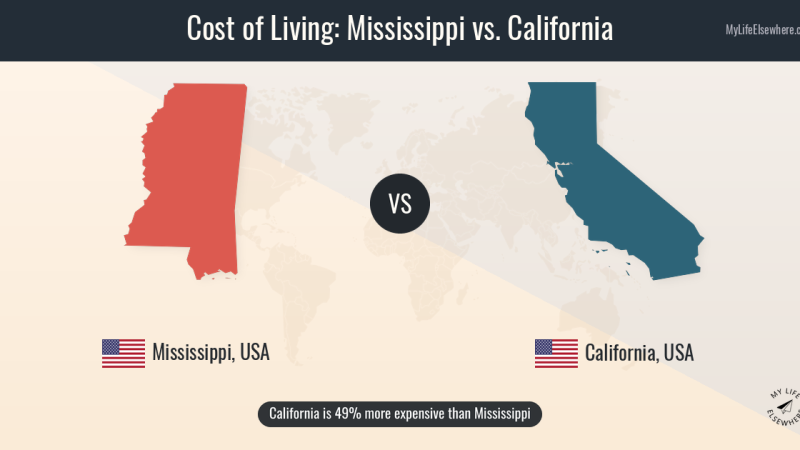
Mississippi vs. California: The $2,500/Month Cost of Living Gap
In 10 states, a single adult lives comfortably on under $2,400/month in 2026. See the…

$57/Month More: What Parsons, Kansas Retirees Actually Buy With It
The 2026 Social Security COLA adds $57/month to the average check. In Parsons, Kansas (pop.…
4 Underrated US Cities Where 1BR Rent Averages $1,250/Month
Four mid-size US cities — Huntsville, Spokane, Chattanooga, and Boise — offer 1BR rents under…
Leave a Reply