
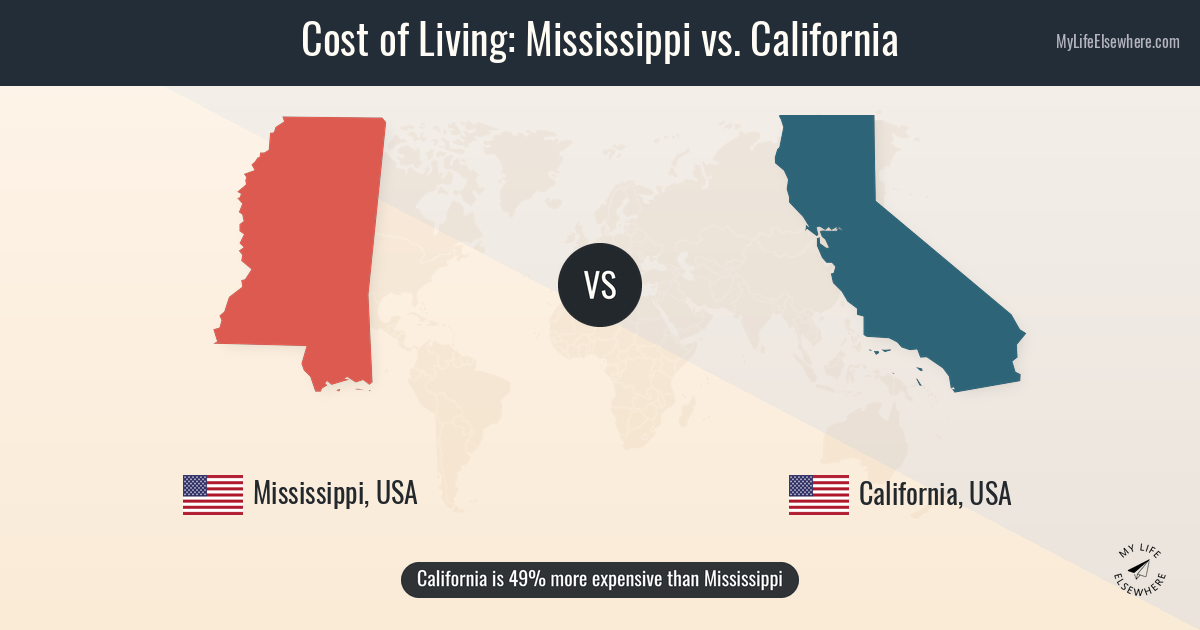
Mississippi vs. California: The $2,500/Month Cost of Living Gap
How two American states ended up on opposite ends of the affordability spectrum — and what it means for millions of families deciding where to plant roots.
A Tale of Two Budgets
Picture two families. Both earn $85,000 a year. Both have two kids, a dog, and a subscription to the same streaming service. One lives outside Jackson, Mississippi, in a four-bedroom house with a two-car garage and a backyard big enough for a vegetable garden. The other rents a two-bedroom apartment in the San Jose metro area of California, commutes forty-five minutes each way, and still somehow ends the month with less breathing room in their budget.
This isn’t a political story or a judgment about which state is “better.” It’s a numbers story — and the numbers are stark. According to cost-of-living indices, the average monthly expenditure for a middle-income family in California runs approximately $6,700 to $7,200, while that same family profile in Mississippi clocks in between $4,100 and $4,700. (Missouri Economic Research and Information Center, 2023 Cost of Living Index; Bureau of Labor Statistics Consumer Expenditure Survey, 2023) The difference, depending on lifestyle, can easily exceed $2,500 every single month — or $30,000 every year.
That’s not a rounding error. That’s a car payment, a college fund contribution, and a family vacation — all rolled into twelve months of simply choosing a different zip code.
Where the Gap Actually Lives: Housing
The single biggest driver of the divide is housing, and the numbers border on surreal when placed side by side. The median home price in Mississippi sits around $175,000. (Zillow Research, Q2 2024) In California, the statewide median has hovered above $800,000 for the past two years, with coastal metros like San Francisco and Los Angeles pushing well past $1 million. (California Association of Realtors, Mid-2024 Housing Market Report)
For renters, the story is equally jarring. The average two-bedroom apartment in California rents for approximately $2,400 per month statewide — and that figure balloons to $3,200 or higher in Los Angeles, San Diego, or the Bay Area. (Apartment List National Rent Report, 2024) In Mississippi, that same two-bedroom unit averages just $850 to $950 per month. (U.S. Census Bureau American Community Survey, 2023) A family moving from Sacramento to Hattiesburg could theoretically cut their rent check by more than half overnight.
📊 By the Numbers: The Monthly Gap Breakdown
Category by Category: A Full Comparison
Housing is the loudest part of the conversation, but it’s far from the only chapter. Taxes, groceries, healthcare, childcare, and transportation all compound the gap in ways that quietly drain Californians’ accounts while Mississippi residents often remain unaware of how favorable their position is.
| Expense Category | Mississippi (Monthly) | California (Monthly) | Monthly Gap |
|---|---|---|---|
| Housing (2BR rent or equiv. mortgage) | $900 | $2,450 | +$1,550 |
| State Income Tax (on $85K salary) | ~$175 | ~$595 | +$420 |
| Groceries (family of 4) | $620 | $820 | +$200 |
| Utilities (electric, gas, water) | $185 | $245 | +$60 |
| Transportation (gas, insurance, maintenance) | $310 | $560 | +$250 |
| Childcare (one child, full-time) | $550 | $1,600 | +$1,050 |
| TOTAL (estimated) | ~$2,740 | ~$6,270 | +$3,530* |
*Note: Total gap reflects families with one child in full-time childcare. Without childcare, the gap narrows to approximately $2,480/month. Sources: MERIC 2023, BLS Consumer Expenditure Survey 2023, Childcare Aware of America 2023 Report.
The Tax Dimension Nobody Talks About Enough
California’s income tax system is among the most progressive — and most aggressive — in the nation. The state’s top marginal rate reaches 13.3%, the highest of any state. (California Franchise Tax Board, 2024 Tax Rate Schedule) Even a household earning $85,000 faces a meaningful state tax bite that residents of Mississippi simply don’t experience at the same magnitude. Mississippi’s top income tax rate is currently 5% and is on a legislated path toward elimination by 2030 under recent state law. (Mississippi Department of Revenue, House Bill 531, 2022)
California also levies a relatively high sales tax — the statewide base rate is 7.25%, and local district taxes push the effective rate to 8.5–10.75% in many cities. (California Department of Tax and Fee Administration, 2024) Mississippi’s sales tax is 7%
“`html
, with no local add-ons permitted, making it simpler and slightly lower than California’s base rate in most jurisdictions. (Mississippi Department of Revenue, 2024)
Property taxes tell a similar story. California’s Proposition 13 caps assessed value increases at 2% per year for existing homeowners, which can benefit long-term residents — but new buyers pay taxes based on the full purchase price, which in coastal markets means property tax bills of $15,000–$30,000 per year are common. Mississippi’s effective property tax rate is among the lowest in the nation at roughly 0.65% of assessed value, and home values are so much lower that the annual tax burden on a median-priced Mississippi home often falls under $1,000. (Tax Foundation, State-Local Tax Burden Rankings, 2023)
When you stack income tax, sales tax, and property tax together, the Tax Foundation estimates California’s combined state and local tax burden at approximately 13.5% of income — one of the highest in the country. Mississippi’s total burden sits closer to 9.8%. For a household earning $85,000, that differential alone can represent $3,000 or more annually, adding another meaningful layer to the monthly cost gap. (Tax Foundation, Facts & Figures 2024)
Childcare and Education Costs
For families with young children, childcare costs can be one of the most punishing line items in the household budget. In California, licensed daycare for one infant in a major metropolitan area averages $2,000–$2,500 per month. In Los Angeles and San Francisco, it is not unusual for full-time infant care to exceed $3,000 monthly at a quality facility. (Economic Policy Institute, Child Care Costs in the United States, 2023)
In Mississippi, the same level of licensed infant care averages approximately $600–$800 per month — a savings of $1,200 to $1,700 every single month for one child alone. Families with two children in daycare can face a $2,500–$3,000 monthly difference purely from childcare costs, making this one of the most impactful variables for households in their prime earning and family-building years. (Economic Policy Institute, 2023)
Public K-12 education is available in both states at no direct tuition cost, but private school tuition — for families who choose it — reflects the same cost-of-living differential. Private elementary school tuition in California averages $15,000–$25,000 per year in urban areas, while comparable private schools in Mississippi often range from $5,000–$10,000 annually. For higher education, both states offer public university systems, but California’s UC and CSU systems have seen significant tuition increases, with full-time undergraduate tuition and fees now exceeding $14,000 per year at UC schools, compared to roughly $8,000–$9,000 at Mississippi’s flagship public universities. (College Board, Trends in College Pricing, 2023; University of Mississippi, 2024)
Healthcare Costs
Healthcare is a nuanced category in this comparison. Both states have residents who struggle with access and affordability, but the out-of-pocket costs for employer-sponsored or individually purchased health insurance differ. California has a well-developed Covered California marketplace with meaningful subsidies for lower-income residents, but premiums for middle-income individuals who don’t qualify for subsidies are high — averaging $550–$750 per month for a mid-tier individual plan. (Covered California, 2024 Plan Pricing Data)
Mississippi has historically had limited Medicaid expansion and lower insurance enrollment rates, but private insurance premiums are lower — individual plans average $380–$520 per month for comparable coverage tiers. The cost differential is real but narrower than in housing or childcare, typically $150–$250 per month for an individual. (Kaiser Family Foundation, Health Insurance Marketplace Calculator, 2024)
It is worth noting that Mississippi faces genuine healthcare access challenges — lower physician density, fewer major hospital systems, and higher rates of chronic disease mean that while premiums may be lower, total healthcare utilization and outcomes are a legitimate consideration for anyone evaluating the two states. This article focuses on direct costs, but quality and access are not equivalent across the two states. (Commonwealth Fund, 2023 State Health System Performance Scorecard)
Transportation and Commuting
California’s car insurance premiums are among the highest in the nation, driven by dense traffic, high vehicle repair costs, high rates of uninsured motorists, and aggressive litigation environments. The average annual auto insurance premium in California is approximately $2,200–$2,600, depending on location and driving record. In Mississippi, the average annual premium is roughly $1,400–$1,700. (Bankrate, Average Car Insurance Costs by State, 2024)
California’s gasoline taxes are the highest in the continental United States, with a combined state excise tax and additional fees pushing the effective gas tax to over 68 cents per gallon as of 2024. Mississippi’s gas tax is 18.79 cents per gallon — less than a third of California’s rate. At 15,000 miles driven per year in a vehicle averaging 28 miles per gallon, California drivers consume roughly 535 gallons annually. Even a $0.50-per-gallon price difference at the pump (taxes plus regional market pricing) adds up to approximately $270 per year in extra fuel costs. (American Petroleum Institute, Gasoline Tax Report, 2024)
Vehicle registration fees in California are notoriously high — based on the vehicle’s value, they can range from $200 to over $1,000 annually for newer cars. Mississippi’s flat registration fees are substantially lower, typically $15–$75 per year depending on vehicle weight class. For a household with two vehicles, California registration fees alone can cost $800–$1,500 more annually than the equivalent in Mississippi. (California DMV, Fee Calculator, 2024; Mississippi Department of Revenue, 2024)
Putting the Numbers Together: The Full Monthly Gap
When you aggregate the major cost categories across a realistic household budget — housing, groceries, utilities, taxes, childcare, insurance, and transportation — the picture becomes stark. The table below provides a conservative estimate for a working couple with one child, earning a combined household income of $95,000 per year:
💬 Frequently Asked Questions
| Category | California (Monthly) | Mississippi (Monthly) | Monthly Difference |
|---|---|---|---|
| Housing (rent/mortgage) | $2,800 | $1,050 | +$1,750 |
| Groceries | $950 | $680 | +$270 |
| Utilities | $280 | $195 | +$85 |
| State Income Tax | $520 | $270 | +$250 |
| Childcare (1 child) | $2,100 | $700 | +$1,400 |
| Health Insurance | $820 | $610 | +$210 |
| Auto Insurance & Registration | $380 | $200 | +$180 |
| Dining Out / Entertainment | $600 |



Leave a Reply