
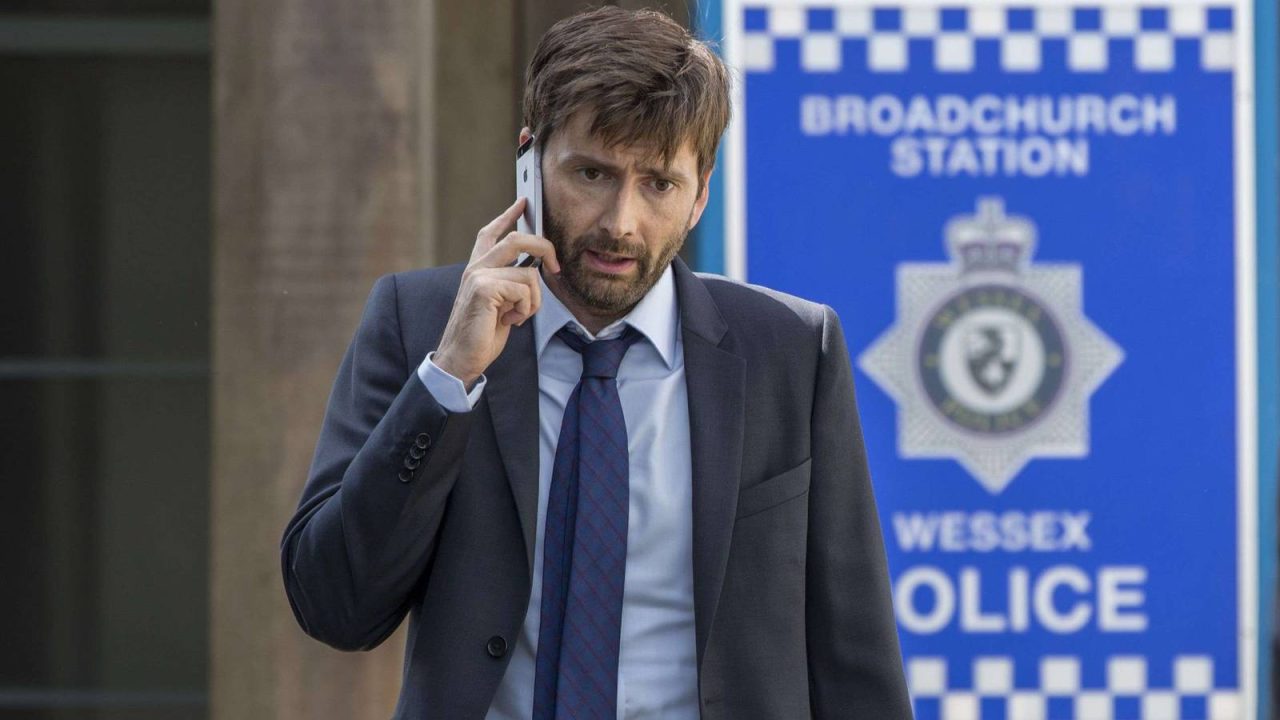
Few British crime dramas have ever landed with the force of Broadchurch — the ITV series that gripped the nation in 2013 and turned David Tennant’s brooding Detective Inspector Alec Hardy into one of the most memorable characters in modern television. But for all the acclaim that first season earned, the show’s legacy is complicated by a simple truth: nothing it did afterward quite matched the heights of where it started.
That’s not an unusual problem for prestige crime dramas. A tightly constructed mystery, resolved completely, leaves little natural room to grow. What made Broadchurch’s situation particularly striking, though, was just how high the bar had been set — and how visible the effort to clear it again became in the seasons that followed.
For fans of David Tennant, Olivia Colman, and the genre of slow-burn British detective fiction, Broadchurch remains essential viewing. The question worth asking is: why does season one feel like a different show entirely from what came after?
What Made Broadchurch Season One So Difficult to Follow
Broadchurch debuted in 2013, created by Chris Chibnall, and told the story of the murder of a young boy named Danny Latimer in a small coastal community in Dorset. The series starred David Tennant as the damaged, secretive DI Hardy, alongside Olivia Colman as DS Ellie Miller — a local officer whose personal connection to the case ran deeper than anyone initially realized.
The show was a phenomenon. It drew massive audiences for ITV and earned widespread critical praise, with particular attention paid to the performances of both leads. Olivia Colman’s work in the series is widely considered among the finest of her career. The finale, which revealed the identity of Danny’s killer, was a genuine television event — the kind that had people talking at work the next morning.
The core reason season one worked so well was structural. It was a closed mystery: one victim, one community, one answer. Every episode tightened the tension. The setting — a small, windswept seaside town where everyone knows everyone — gave the story an almost suffocating intimacy. The emotional weight of the Latimer family’s grief grounded every twist in something real and human.
Once that mystery was solved, the show faced an almost impossible task. The engine that had driven eight episodes of gripping drama was gone. What remained was a cast of characters whose relationships had been permanently altered by what happened — but whose story, in the most fundamental sense, had already been told.
How the Later Seasons Changed the Show’s Identity
Broadchurch returned for a second season in 2015, shifting focus partly to a courtroom drama centered on the legal proceedings following the season one killer’s arrest. It also introduced a separate cold case that Hardy had been haunted by before arriving in Broadchurch. The decision divided audiences. Some appreciated the attempt to explore the aftermath of a conviction in a realistic way. Others felt the courtroom format drained the tension that had made the original so compelling.
The third and final season, which aired in 2017, took a different approach again — introducing an entirely new case involving a sexual assault investigation in the same town. It was, by many accounts, the most socially conscious chapter of the series, tackling difficult subject matter with care. But it still couldn’t replicate the specific alchemy of season one, in part because the mystery format requires a fresh emotional investment that becomes harder to manufacture the second and third time around with the same setting.
| Season | Year | Central Focus | Critical Reception |
|---|---|---|---|
| Season 1 | 2013 | Murder of Danny Latimer | Widespread critical acclaim; considered a landmark drama |
| Season 2 | 2015 | Trial proceedings and Hardy’s cold case | Mixed reviews; seen as a step down from season one |
| Season 3 | 2017 | Sexual assault investigation | Broadly positive but overshadowed by the original’s reputation |
The Problem With Following a Perfect First Season
Broadchurch isn’t alone in this predicament. British crime dramas that build their entire identity around a single case — think of the structural DNA shared with shows like Happy Valley or The Missing — always face a version of this challenge. But Broadchurch’s situation was sharpened by the fact that the first season felt so complete. It didn’t leave loose ends dangling. It answered its central question fully and emotionally.
That completeness, which was a strength artistically, became a structural problem commercially. ITV had a hit. Returning to it was understandable. But the very qualities that made season one resonate — its specificity, its finality, its sense of a community reckoning with one devastating event — couldn’t simply be recycled.
David Tennant’s performance throughout remained a consistent anchor. His portrayal of Hardy as a physically unwell, emotionally closed-off detective who slowly opens up across the series gave viewers a reason to stay invested even when the plots around him became less gripping. Olivia Colman’s presence in the first two seasons added further weight. But talent alone can’t compensate for a format that has structurally exhausted its premise.
Why Broadchurch Still Matters — and What It Left Behind
Whatever its later limitations, Broadchurch earned its place in the canon of great British television. Season one, in particular, demonstrated what the genre could achieve when writing, performance, setting, and pacing all aligned. It helped establish ITV as a serious home for prestige drama and contributed to a broader global appetite for slow-burn British crime series.
Its influence is still felt. The template it helped popularize — tight episode counts, coastal or rural settings, community-wide trauma, morally complex detectives — has shaped countless dramas since. Chris Chibnall went on to become showrunner of Doctor Who, the very franchise where Tennant had made his name before Broadchurch.
The show also launched Olivia Colman into a new tier of mainstream recognition that eventually led to her Oscar win for The Favourite in 2019. That’s not a small legacy for a regional ITV crime drama.
Broadchurch is a show that peaked early and knew it, even if it couldn’t stop itself from trying again. Season one remains genuinely brilliant. The rest is television doing what television does — trying to hold onto something that was, by its very nature, a one-time thing.
Frequently Asked Questions
What is Broadchurch about?
Broadchurch is a British ITV crime drama created by Chris Chibnall, centered on the investigation into the murder of a young boy named Danny Latimer in a small Dorset coastal town.
Who stars in Broadchurch?
The series stars David Tennant as DI Alec Hardy and Olivia Colman as DS Ellie Miller, with both performances widely praised throughout the show’s run.
How many seasons of Broadchurch are there?
Broadchurch ran for three seasons, airing in 2013, 2015, and 2017 respectively, before concluding with its third series.
Why is Broadchurch season one considered the best?
Season one is widely regarded as the strongest because it told a complete, tightly constructed murder mystery with exceptional performances and a genuinely surprising resolution that felt emotionally earned.
Did Broadchurch win any awards?
The series received significant critical recognition, with Olivia Colman’s performance earning particular praise; she later went on to win an Academy Award, though that was for a separate project, The Favourite, in 2019.
Is Broadchurch worth watching beyond season one?
Seasons two and three have their merits, particularly season three’s handling of a sexual assault investigation, but most viewers and critics agree that neither matched the impact of the original series.


Leave a Reply