
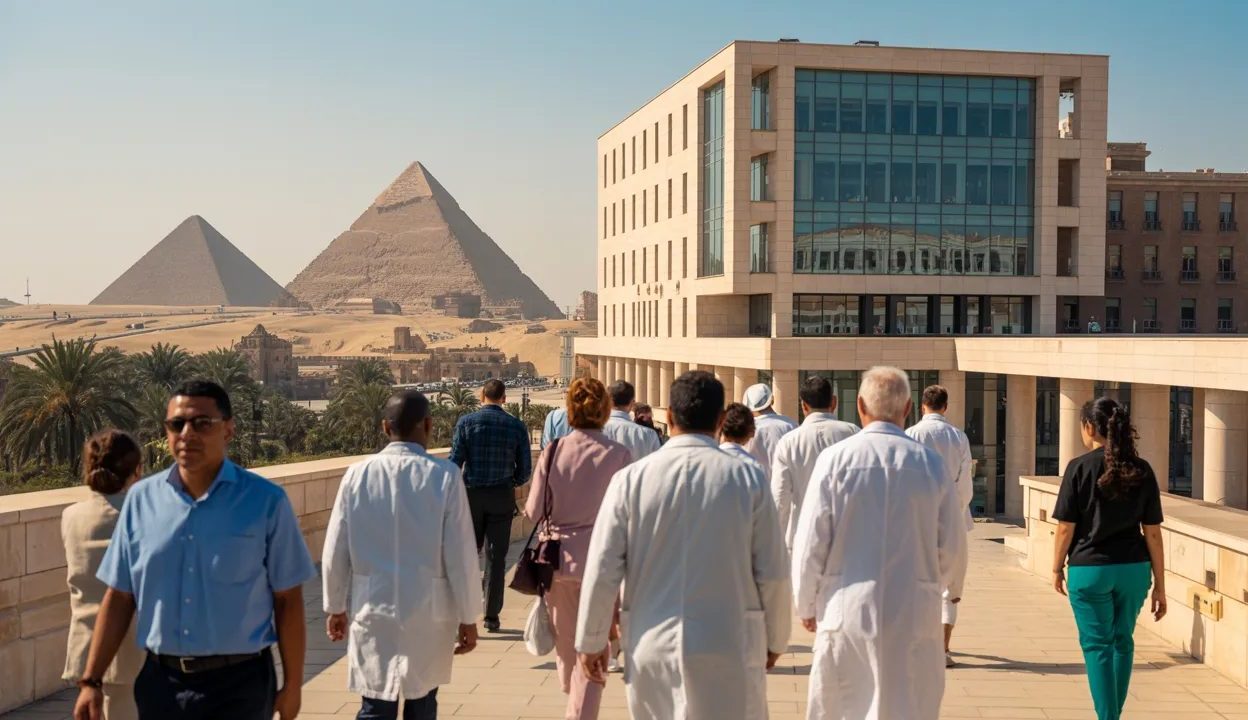
Egypt’s medical tourism sector recorded a 76.7% surge in revenue in 2025 compared to the year before — a number that signals something much bigger than a one-year spike. The country is actively positioning itself as one of the world’s most competitive destinations for patients who want quality healthcare without paying Western prices, and the momentum behind that push is accelerating fast heading into 2026.
What makes this story different from other healthcare tourism trends is the deliberate strategy behind it. Egypt isn’t simply hoping patients show up. The government has built a formal framework, launched a national brand, and set ambitious targets that would transform the country’s healthcare economy over the next several years.
For anyone considering medical travel — whether from the Middle East, Africa, or farther afield — Egypt is increasingly hard to ignore.
(function(){var wrp=document.getElementById(“paap_stat_69cb5f9ec5bbf9.80227506”);if(!wrp)return;var ids=[“paap_stat_69cb5f9ec5bbf9.80227506_c0″,”paap_stat_69cb5f9ec5bbf9.80227506_c1”];var dur=1800;function ease(t){return 1-Math.pow(1-t,3);}function anim(){ids.forEach(function(id){var el=document.getElementById(id);if(!el)return;var tgt=parseFloat(el.getAttribute(“data-target”))||0;var pfx=el.getAttribute(“data-prefix”)||””;var sfx=el.getAttribute(“data-suffix”)||””;var dec=parseInt(el.getAttribute(“data-decimals”))||0;var st=null;function step(ts){if(!st)st=ts;var p=Math.min((ts-st)/dur,1);var v=ease(p)*tgt;el.textContent=pfx+v.toFixed(dec)+sfx;if(p<1)requestAnimationFrame(step);}requestAnimationFrame(step);});}if("IntersectionObserver" in window){var obs=new IntersectionObserver(function(e){e.forEach(function(en){if(en.isIntersecting){anim();obs.disconnect();}});},{threshold:0.2});obs.observe(wrp);}else{anim();}})();
What’s Actually Driving Egypt’s Medical Tourism Boom
The growth isn’t accidental. Egypt’s General Authority for Healthcare has been implementing a coordinated push under the National Tourism Development Strategy 2030, a government-backed initiative designed to make Egypt a genuine regional and global hub for specialized medical care.
At the center of this effort is a brand called “In Egypt We Care” — a campaign that explicitly links clinical quality with leisure. The idea is straightforward but smart: patients traveling for treatment don’t want to fly home the moment they leave the hospital. Egypt offers pyramids, Red Sea resorts, ancient temples, and world-class diving. Combining recovery time with iconic cultural experiences is a genuine selling point that few competitors can match at the same price point.
Geography plays a major role here too. Egypt sits at the crossroads of Africa, the Middle East, and Europe — making it logistically accessible for patients from a wide range of countries. That location advantage, combined with lower treatment costs and an existing tourism infrastructure, gives Egypt a structural edge that newer medical tourism destinations simply don’t have yet.
The Numbers Behind Egypt’s Medical Tourism Push
The scale of the ambition here is worth putting into concrete terms. The 76.7% revenue increase in 2025 represents a dramatic acceleration, and officials have set a target of drawing 200,000 international patients per year as part of the 2030 strategy.
| Factor | Detail |
|---|---|
| 2025 Revenue Growth | 76.7% increase year-over-year |
| Annual Patient Target | 200,000 international patients |
| Governing Strategy | National Tourism Development Strategy 2030 |
| National Brand | “In Egypt We Care” |
| Primary Source Markets | Middle East and Africa |
| Key Advantages | Low costs, geographic location, tourism infrastructure |
| Oversight Authority | General Authority for Healthcare (GAH) |
The primary markets being targeted are neighboring regions — the Middle East and Africa — where Egypt holds a natural advantage in terms of travel distance, cultural familiarity, and cost comparison. Patients from those regions can access treatments in Egypt at significantly lower costs than traveling to Europe or North America, while still receiving care from specialized medical facilities.
Why This Matters for Patients Considering Medical Travel
If you’re someone weighing options for an elective procedure, a specialized treatment, or even a complex surgery, the Egyptian model offers something genuinely compelling. The combination of affordable care with a destination experience means the overall trip — medical costs, accommodation, and travel — can still come in well below what the same procedure would cost domestically in many Western countries.
The “In Egypt We Care” brand is specifically designed to make that value proposition tangible. Rather than positioning Egypt purely as a budget option, the strategy frames it as a premium experience at an accessible price — quality healthcare delivered in a country with an unmatched cultural and natural tourism offering.
For patients from across Africa and the Middle East especially, Egypt represents a realistic and relatively accessible alternative to traveling to Europe or Asia for specialized treatment. The cost savings can be significant, and the recovery period can double as genuine leisure time in one of the world’s most historically rich destinations.
What Egypt’s Strategy Looks Like Going Forward
The direction of travel is clear. Egypt’s government has committed to the 2030 framework, which means the push to attract international patients will continue to intensify over the next several years. The “In Egypt We Care” brand will likely expand its reach into new source markets beyond the Middle East and Africa as infrastructure and international recognition grow.
The General Authority for Healthcare is the central body coordinating these efforts, and the 76.7% growth figure from 2025 gives officials concrete evidence that the strategy is working. That kind of momentum tends to attract further investment — in facilities, in marketing, and in the international accreditations that give patients confidence when choosing a foreign healthcare destination.
Whether Egypt can sustain that trajectory and hit the 200,000 annual patient target remains to be seen. But the foundation being laid right now — combining affordable, specialized care with one of the world’s most compelling tourism destinations — is a serious competitive proposition.
Frequently Asked Questions
How much did Egypt’s medical tourism revenue grow in 2025?
Egypt’s medical tourism revenue increased by 76.7% in 2025 compared to the previous year, according to the General Authority for Healthcare.
What is Egypt’s target for international medical patients?
Under the National Tourism Development Strategy 2030, Egypt aims to attract 200,000 international patients annually.
What is the “In Egypt We Care” brand?
It is a national campaign designed to combine clinical healthcare excellence with leisure tourism, positioning Egypt as a destination where patients can receive treatment and experience the country’s iconic attractions.
Which regions are Egypt’s primary medical tourism markets?
Egypt is primarily targeting patients from the Middle East and Africa, leveraging its geographic proximity, lower costs, and existing tourism infrastructure.
Which government body is overseeing Egypt’s medical tourism growth?
The General Authority for Healthcare (GAH) is the central authority tracking and implementing Egypt’s medical tourism strategy.
What advantages does Egypt offer over other medical tourism destinations?
Egypt’s key advantages include low treatment costs, a central geographic location accessible to multiple regions, and an established tourism infrastructure that supports the combination of healthcare and travel experiences.


Leave a Reply