
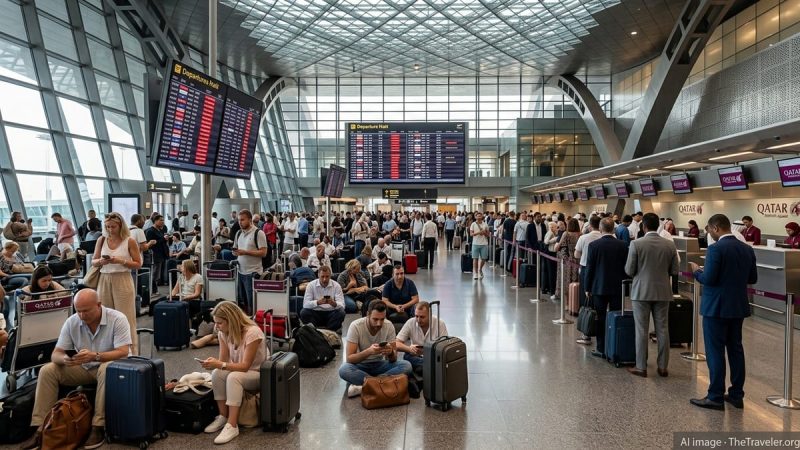
Thousands of travelers across the UAE are stranded, scrambling to rebook, or facing hours-long delays as a brutal combination of severe storms and escalating geopolitical tensions in the region has thrown air travel into serious disarray. The disruption is not limited to one carrier — Emirates, Etihad, flydubai, Qatar Airways, Air France, and Cathay Pacific are all caught in the chaos.
The situation is being driven by two forces hitting at once: powerful storms battering both Dubai and Abu Dhabi, and airspace restrictions linked to rising US-Iran tensions. Either one of those factors alone would stress a major aviation hub. Together, they have created a crisis that is rippling far beyond the Gulf.
For passengers with flights through Dubai International Airport or Abu Dhabi International Airport right now, the practical reality is stark — cancellations, last-minute rebookings, and in many cases, nowhere comfortable to wait. The UAE’s hospitality sector is already feeling the strain, struggling to absorb the surge of displaced travelers who suddenly need accommodation.
Two Crises Colliding Over One of the World’s Busiest Aviation Hubs
The UAE sits at the center of global long-haul aviation. Dubai alone handles an enormous volume of connecting traffic between Europe, Asia, Africa, and the Americas. When something goes wrong there, the effects don’t stay local — they spread across itineraries worldwide.
Right now, something has gone very wrong. The storm system hitting Dubai and Abu Dhabi is severe enough to cause widespread operational disruption on its own. High winds, reduced visibility, and difficult runway conditions have forced airlines to cancel or delay flights that would otherwise have operated normally.
But layered on top of that is a geopolitical problem that is harder to predict and harder to manage. The ongoing conflict between the US and Iran has introduced airspace restrictions in the region, forcing some flights to be rerouted over longer, less efficient paths — and in some cases, grounded entirely. Airlines operating in and around the Gulf are now navigating a flight planning environment that changes rapidly and without much warning.
Which Airlines Are Affected and What That Means for Passengers
The list of carriers impacted covers some of the most heavily traveled routes on the planet. Here is what is confirmed:
- Emirates — facing cancellations and delays at its Dubai hub
- Etihad Airways — disruptions affecting operations out of Abu Dhabi
- flydubai — the low-cost carrier operating from Dubai is also hit
- Qatar Airways — impacted despite operating from Doha, due to regional airspace complications
- Air France — flights to and from the UAE are affected
- Cathay Pacific — routes passing through the region are caught in the disruption
| Airline | Hub Affected | Nature of Disruption |
|---|---|---|
| Emirates | Dubai International Airport | Cancellations and delays due to storm and airspace restrictions |
| Etihad Airways | Abu Dhabi International Airport | Operational disruptions from severe weather |
| flydubai | Dubai International Airport | Cancellations and delays |
| Qatar Airways | Regional airspace | Disruptions linked to US-Iran conflict airspace restrictions |
| Air France | UAE routes | Flights to and from UAE affected |
| Cathay Pacific | Regional transit routes | Routes through the region impacted by disruptions |
What This Means If You Have a Flight Through the Region
If your itinerary touches Dubai, Abu Dhabi, or any connecting route through the Gulf right now, you need to check your flight status before heading to the airport. The disruption is widespread enough that even flights not directly operated by UAE carriers may be affected if they pass through regional airspace.
Passengers who are already stranded are facing a secondary problem: the UAE’s hotels and accommodation options are under pressure as demand from displaced travelers spikes suddenly. Finding a place to stay while waiting for a rebooked flight is proving difficult for many people caught in the middle of this.
The combination of storm disruptions and geopolitical airspace restrictions is also making it harder for airlines to give reliable rebooking timelines. Unlike a standard weather delay — where you can reasonably expect operations to resume once skies clear — the airspace restriction element introduces genuine uncertainty about when normal routing will fully return.
Travelers with flexible ticket options or travel insurance that covers force majeure events are in a significantly better position than those on non-refundable, non-changeable fares. If you are due to travel through the region in the coming days, contacting your airline directly now rather than waiting is the advisable approach.
How Long Could This Last — and What Comes Next
The storm element of this crisis will resolve on its own timeline — severe weather systems over the UAE typically pass within days, though their intensity can cause lasting operational backlogs that take airlines additional time to clear. Catching up on cancellations means rescheduling thousands of passengers, and that process rarely happens overnight.
The geopolitical dimension is less predictable. Airspace restrictions tied to active conflicts can be lifted quickly if tensions de-escalate, or they can persist and expand if the situation worsens. Airlines are monitoring the situation continuously and adjusting routing as conditions evolve.
What travelers should expect in the near term is continued uncertainty, likely more disruptions before the situation stabilizes, and a heavily congested rebooking environment as carriers work through backlogs. Anyone transiting through the Gulf in the next several days should treat their itinerary as subject to change and plan accordingly.
Frequently Asked Questions
Which airlines have been affected by the UAE flight disruptions?
Emirates, Etihad, flydubai, Qatar Airways, Air France, and Cathay Pacific have all reported cancellations, delays, and disruptions linked to the current crisis.
What is causing the flight cancellations in the UAE right now?
Two factors are combining: severe storms hitting Dubai and Abu Dhabi, and airspace restrictions connected to escalating US-Iran tensions in the region.
Are both Dubai and Abu Dhabi airports affected?
Yes, both Dubai International Airport and Abu Dhabi International Airport are experiencing significant disruptions due to the ongoing storm conditions.
Is Qatar Airways affected even though it operates from Doha, not the UAE?
Yes — regional airspace complications linked to the US-Iran conflict are impacting Qatar Airways operations despite its hub being in Doha rather than the UAE.
What should I do if I have a flight through the UAE in the coming days?
Check your flight status immediately and contact your airline directly, as rebooking timelines are uncertain and accommodation in the UAE is under pressure from stranded travelers.
Will hotels in the UAE be able to accommodate stranded passengers?
The UAE’s hospitality sector is reportedly struggling to absorb the sudden surge in displaced travelers, so securing accommodation quickly is advisable if you are stranded.



Leave a Reply