
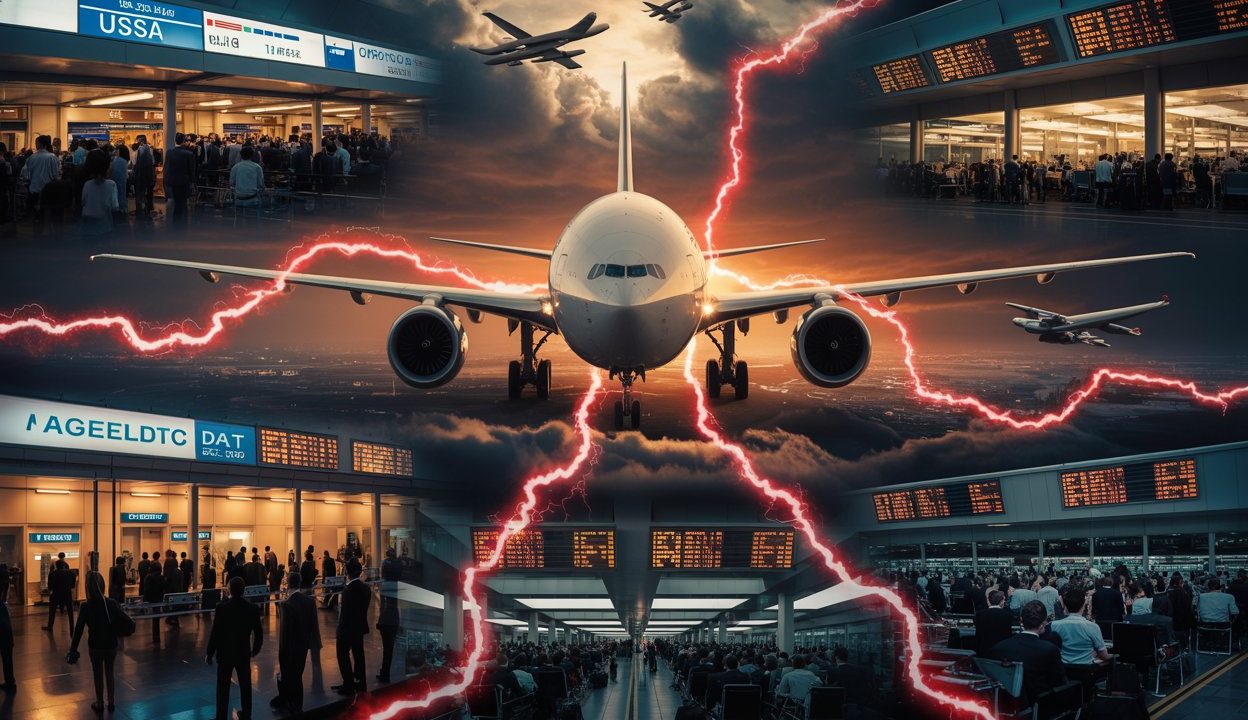
Global aviation is under serious strain right now — and if you have a flight booked in the coming months, that pressure is increasingly likely to affect you. Across the United States, Canada, the United Kingdom, Germany, France, and Japan, travel systems are showing signs of significant stress, with demand proving volatile and airlines struggling to keep operations running smoothly.
This is not a localized problem that one country can fix in isolation. The disruption is spreading across multiple continents simultaneously, touching some of the world’s busiest aviation markets at the same time. For ordinary travelers, that means the turbulence — figuratively speaking — extends well beyond any single airport or airline.
What makes this moment different from typical seasonal travel disruption is the sheer number of major economies experiencing it together, and the compounding effect that has on global tourism more broadly.
What Is Actually Happening Across These Six Countries
The countries caught up in this wave of aviation disruption — the United States, Canada, the United Kingdom, Germany, France, and Japan — collectively represent some of the highest volumes of international air travel on the planet. When their systems experience stress at the same time, the knock-on effects ripple outward to every destination connected to them.
Reports indicate that delays and cancellations are intensifying across these markets. Travel systems are described as breaking under the pressure of unstable demand — a situation that points to a mismatch between what airlines scheduled and what they can actually deliver.
Unstable demand is particularly difficult for airlines to manage. Unlike predictable seasonal peaks, volatile demand creates planning problems that no amount of additional staffing or aircraft can quickly solve. Routes get oversold, then underfilled. Crew scheduling falls apart. Ground operations get caught in cascading delays that spread across an entire day’s worth of flights.
Why Analysts Are Calling This a “Tourism War”
The phrase “worldwide tourism war” reflects something real: when aviation becomes unreliable, destinations compete aggressively for the travelers who do manage to move. Countries and tourism boards that can offer more stable, accessible routes gain a significant advantage over those whose connectivity is disrupted.
This competitive dynamic is already playing out. Destinations with strong domestic aviation infrastructure or well-managed regional carriers are positioning themselves as safer bets for travelers who have grown wary of long-haul international itineraries involving multiple connections through disrupted hubs.
For tourism-dependent economies, the stakes are high. A traveler who can’t get a reliable connection through a major hub in one country may simply reroute — or cancel the trip entirely. That lost spending doesn’t disappear; it either shifts to a competitor destination or evaporates from the tourism economy altogether.
The Countries at the Center of the Global Travel Disruption
| Country | Role in Global Aviation | Reported Status |
|---|---|---|
| United States | World’s largest domestic aviation market | Confirmed experiencing disruption |
| Canada | Major transatlantic and transpacific hub | Confirmed experiencing disruption |
| United Kingdom | Key European aviation gateway | Confirmed experiencing disruption |
| Germany | Central European hub for business and leisure travel | Confirmed experiencing disruption |
| France | Top global tourism destination and transit hub | Confirmed experiencing disruption |
| Japan | Asia-Pacific aviation anchor | Confirmed experiencing disruption |
What This Means for Travelers Planning Trips Right Now
If you are planning international travel through any of these six countries — whether as your origin, destination, or a connecting hub — the current environment calls for extra caution and preparation.
- Build in buffer time. When systems are under strain, tight connections become genuinely risky. Give yourself more time between flights than you normally would.
- Check cancellation and rebooking policies carefully. Knowing your rights before something goes wrong is far more useful than scrambling after the fact.
- Monitor your flights more closely than usual. Disruptions in this kind of environment can happen with little warning, and being ahead of the news gives you more options.
- Consider travel insurance that covers delays and cancellations. The current volatility makes coverage more relevant than it might be in calmer periods.
- Stay flexible on routing where possible. If alternative connections exist, keeping that option open could save a trip that would otherwise be stranded.
The broader issue is that travelers are being asked to navigate a system that is, by multiple accounts, not performing reliably. That is not a reason to cancel travel plans wholesale — but it is a reason to approach bookings with more awareness than usual.
What Comes Next for Global Aviation
Aviation disruptions of this scale — affecting this many major markets simultaneously — do not resolve overnight. They tend to ease gradually as demand stabilizes, operational backlogs clear, and airlines recalibrate their schedules to match reality.
What is clear is that the pressure on global travel infrastructure is real and ongoing. The fact that six of the world’s most significant aviation markets are experiencing stress at the same time suggests this is a structural moment for the industry, not just a bad week at a handful of airports.
Tourism boards, airlines, and travel operators across all six countries will be watching closely to see whether demand stabilizes or continues to behave unpredictably. For travelers, the most useful posture right now is informed flexibility — knowing what you’re booking into and having a plan if things don’t go smoothly.
Frequently Asked Questions
Which countries are currently experiencing global travel disruption?
The United States, Canada, the United Kingdom, Germany, France, and Japan are all reported to be experiencing significant aviation disruption simultaneously.
What is causing the aviation meltdown across these countries?
Reports point to unstable demand and systems under strain, with airlines struggling to cope — though
Is this disruption expected to be temporary?
What does “worldwide tourism war” mean in this context?
It refers to the competitive pressure between destinations as unreliable aviation pushes travelers to reroute or choose more accessible alternatives.
Should I cancel my international travel plans because of this?
The source does not recommend cancellation, but does indicate that travel systems are under significant strain — careful preparation and flexible booking terms are advisable.
Are delays and cancellations confirmed across all six countries?
Yes, delays and cancellations are reported as part of the ongoing disruption affecting all six named countries.



Leave a Reply