
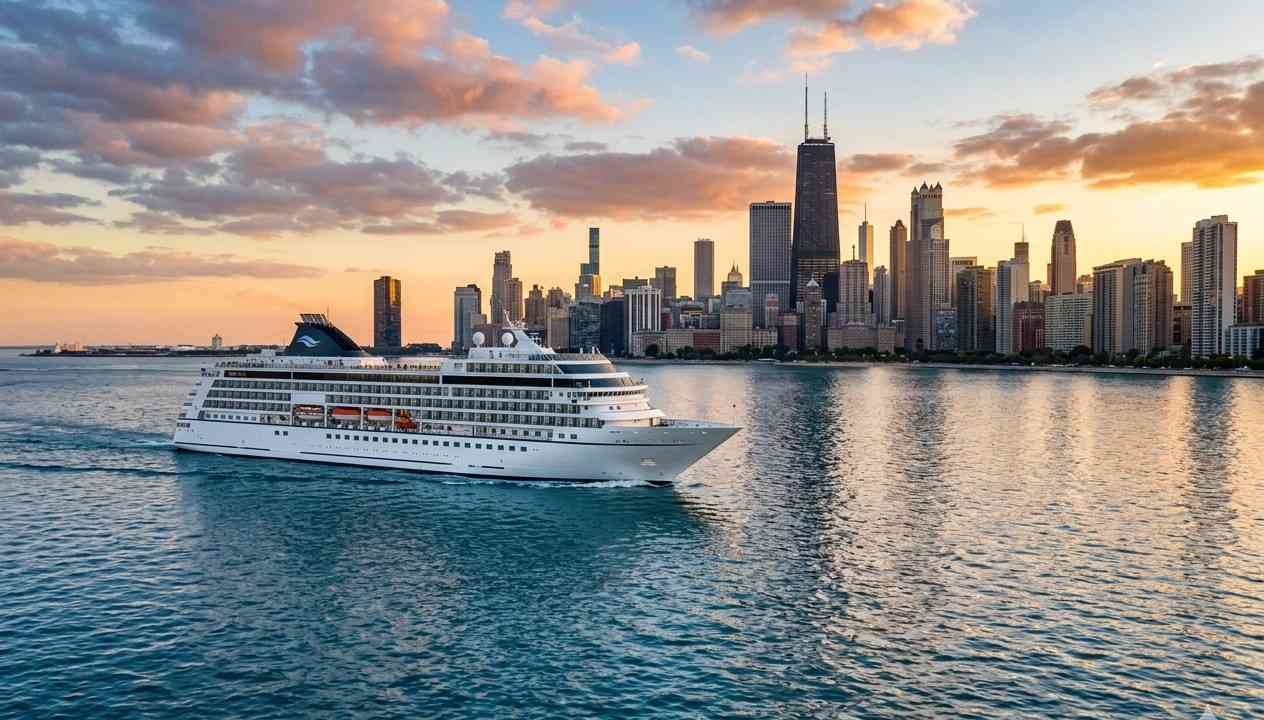
One hundred seventy-five thousand cruise passengers are projected to visit the Great Lakes region in 2026 — a number that tells a bigger story than just tourism growth. It signals that one of North America’s most overlooked travel destinations is quietly becoming one of its most exciting.
The freshwater seas shared by the United States and Canada have long played second fiddle to ocean cruising. But the numbers heading into 2026 suggest that gap is closing fast. Seven cruise lines operating ten vessels are expected to make more than eight hundred port calls across the region, generating an estimated $300 million in economic impact — a 15 percent increase over 2025 figures.
That’s not a blip. That’s a trend that port cities, local businesses, and travelers are all starting to pay close attention to.
(function(){var wrp=document.getElementById(“paap_stat_69c7d70a0aaa56.49941666”);if(!wrp)return;var ids=[“paap_stat_69c7d70a0aaa56.49941666_c0″,”paap_stat_69c7d70a0aaa56.49941666_c1”];var dur=1800;function ease(t){return 1-Math.pow(1-t,3);}function anim(){ids.forEach(function(id){var el=document.getElementById(id);if(!el)return;var tgt=parseFloat(el.getAttribute(“data-target”))||0;var pfx=el.getAttribute(“data-prefix”)||””;var sfx=el.getAttribute(“data-suffix”)||””;var dec=parseInt(el.getAttribute(“data-decimals”))||0;var st=null;function step(ts){if(!st)st=ts;var p=Math.min((ts-st)/dur,1);var v=ease(p)*tgt;el.textContent=pfx+v.toFixed(dec)+sfx;if(p<1)requestAnimationFrame(step);}requestAnimationFrame(step);});}if("IntersectionObserver" in window){var obs=new IntersectionObserver(function(e){e.forEach(function(en){if(en.isIntersecting){anim();obs.disconnect();}});},{threshold:0.2});obs.observe(wrp);}else{anim();}})();
Why the Great Lakes Cruise Market Is Surging Right Now
The Great Lakes stretch across eight U.S. states and the Canadian province of Ontario, covering more than 94,000 square miles of freshwater. For decades, cruise tourism here was modest — a niche offering for travelers who’d already done the Caribbean and Mediterranean and wanted something different.
What’s changed is scale and momentum. Regional authorities report that passenger numbers have doubled over the past decade, a pace of growth that has survived a pandemic and come out stronger on the other side. The 2026 projections represent the latest — and largest — milestone in that upward arc.
Seven cruise lines have committed to the region for the 2026 season, fielding ten vessels between them. With over eight hundred port calls scheduled, the itineraries now touch a wide range of destinations — from major urban centers to small lakeside communities that rarely see this kind of visitor traffic.
Officials have noted that this growth reflects both pent-up demand from travelers and deliberate investment by cruise operators who see long-term potential in the binational waterway.
The Numbers Behind the 2026 Great Lakes Cruise Season
Here’s a breakdown of the key figures shaping this season:
| Metric | 2026 Projection | Context |
|---|---|---|
| Passenger Visits | 175,000 | Doubled over the past decade |
| Cruise Lines Operating | 7 | Across the full Great Lakes region |
| Vessels in Service | 10 | Mix of large and boutique ships |
| Port Calls Scheduled | 800+ | Across U.S. and Canadian ports |
| Economic Impact | $300 million | Up 15 percent from 2025 |
(function(){function loadChartJs(cb){if(window.Chart){cb();return;}var s=document.createElement(“script”);s.src=”https://cdn.jsdelivr.net/npm/chart.js@4.4.0/dist/chart.umd.min.js”;s.onload=cb;document.head.appendChild(s);}function initChart(){var cv=document.getElementById(“paap_chart_69c7d70a0ab016.96075732”);if(!cv)return;var dv=[“175,000″,”800+”,”$300M”];new Chart(cv,{type:”bar”,data:{labels:[“Passenger Visits”,”Port Calls”,”Economic Impact ($M)”],datasets:[{data:[175000,800,300],backgroundColor:[“#3b82f6″,”#10b981″,”#f59e0b”],borderRadius:6,borderSkipped:false}]},options:{indexAxis:”y”,responsive:true,maintainAspectRatio:false,animation:{duration:1200,easing:”easeOutQuart”},plugins:{legend:{display:false},tooltip:{callbacks:{label:function(ctx){return dv[ctx.dataIndex]||ctx.formattedValue;}}}},scales:{x:{grid:{color:”#e5e7eb”},ticks:{color:”#6b7280″}},y:{grid:{display:false},ticks:{color:”#1a1a1a”,font:{weight:600}}}}}});}var cv=document.getElementById(“paap_chart_69c7d70a0ab016.96075732”);if(!cv)return;if(“IntersectionObserver” in window){var obs=new IntersectionObserver(function(e){e.forEach(function(en){if(en.isIntersecting){loadChartJs(initChart);obs.disconnect();}});},{threshold:0.1});obs.observe(cv);}else{loadChartJs(initChart);}})();
- Chicago and Toronto are identified as the primary hub cities, with increased sailings creating year-round economic activity in both downtown and waterfront areas.
- Mackinac Island is among the notable destinations drawing cruise visitors, with its heritage character making it a natural fit for this type of tourism.
- Smaller ports are benefiting disproportionately, as boutique vessels distribute visitors more evenly across the region rather than concentrating them in major cities.
- Government-backed sustainability initiatives are being implemented at docking facilities, aligning cruise operations with environmental standards for the shared waterway.
What This Means for Cities, Communities, and Travelers
For the major hubs, the impact is relatively straightforward: more visitors, more spending, more demand for hotels, restaurants, and cultural attractions. Chicago and Toronto are well-positioned to absorb and benefit from that volume, and increased sailings are expected to extend the tourism season beyond the traditional summer peak.
But the more interesting story may be happening in the smaller ports. Boutique cruise ships — smaller vessels designed for intimate, destination-focused travel — are spreading visitor traffic to communities that don’t normally appear on international tourism maps. That distribution effect is prompting local investments in dock infrastructure and new attractions, creating a ripple of economic development that reaches well beyond the waterfront.
For travelers, the Great Lakes now represent a genuinely compelling alternative to ocean cruising. The scenery is dramatic, the destinations range from cosmopolitan cities to quiet island communities, and the experience of sailing through the world’s largest freshwater system is unlike anything available on salt water.
High-spending cruise visitors — the kind who book shore excursions, dine locally, and visit heritage sites — are exactly the demographic that waterfront economies have been working to attract. The 2026 season is expected to deliver them in record numbers.
What the Great Lakes Cruise Boom Looks Like Going Forward
The 2026 season is shaping up as a milestone, but regional authorities and operators appear to be treating it as a foundation rather than a ceiling. The infrastructure investments now underway — upgraded docks, expanded port facilities, new visitor attractions — are designed with future growth in mind.
Sustainability is a central part of that planning. Government-backed programs promoting cleaner docking practices reflect the unique responsibility that comes with operating cruise tourism on a binational freshwater system that supplies drinking water to tens of millions of people. Observers note that getting this balance right could make the Great Lakes a model for responsible inland cruising worldwide.
With passenger numbers having doubled over a decade and economic impact now crossing the $300 million threshold, the trajectory points clearly upward. The question for port cities and cruise operators alike is no longer whether Great Lakes cruising has a future — it’s how large that future is going to be.
Frequently Asked Questions
How many cruise passengers are expected to visit the Great Lakes in 2026?
Regional projections point to approximately 175,000 passenger visits during the 2026 cruise season.
How much economic impact will the 2026 Great Lakes cruise season generate?
The season is projected to generate around $300 million in economic impact, representing a 15 percent increase over 2025.
Which cities are the main hubs for Great Lakes cruising?
Chicago and Toronto are identified as the primary hub cities, with increased sailings expected to drive year-round economic activity in both locations.
How many cruise lines and ships will be operating on the Great Lakes in 2026?
Seven cruise lines operating ten vessels are expected to make more than 800 port calls across the region during the 2026 season.
Are smaller ports also benefiting from Great Lakes cruise growth?
Yes — boutique ships are distributing visitors more evenly across the region, with smaller ports receiving disproportionate benefits and spurring local investments in docks and attractions.
Is sustainability a factor in Great Lakes cruise operations?
Government-backed initiatives promoting sustainable docking practices are being implemented to align cruise operations with environmental standards for the shared U.S.-Canada waterway.


Leave a Reply