
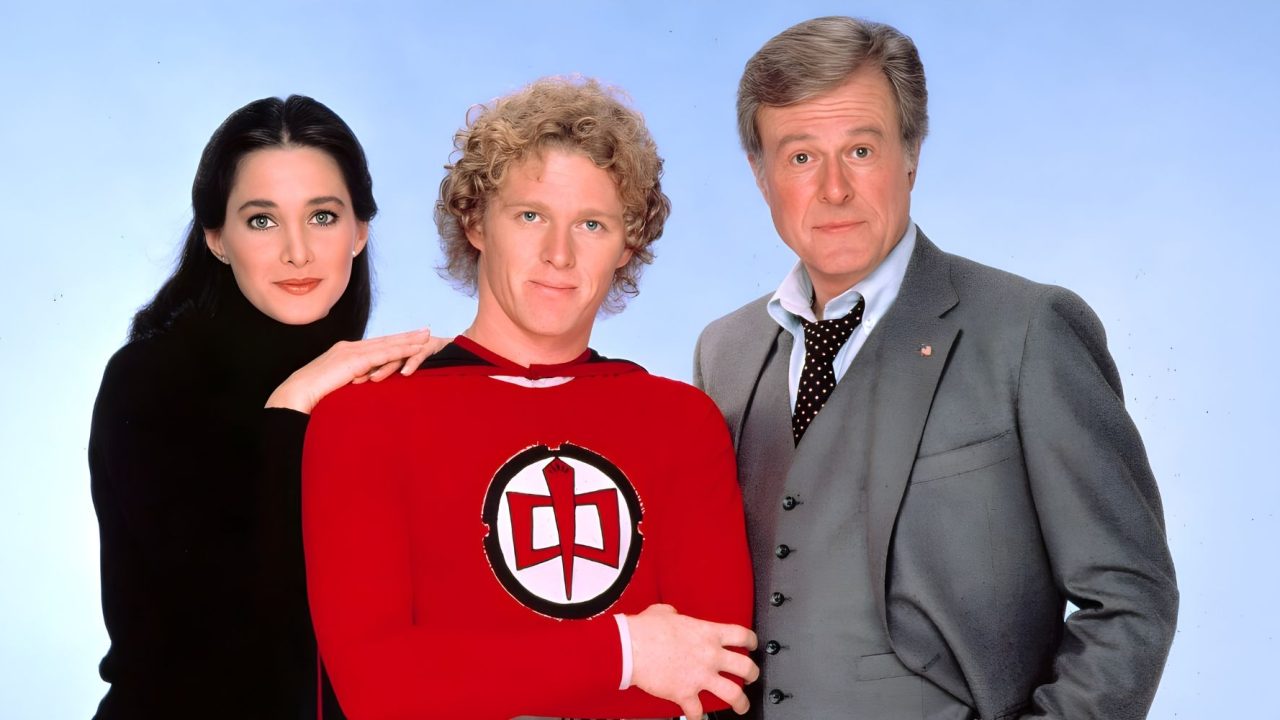
What if the superhero genre’s most quietly radical idea didn’t come from a comic book publisher, a Hollywood blockbuster, or a prestige streaming series — but from a three-part television pilot that most people have completely forgotten about?
The Greatest American Hero is that show. It aired in the early 1980s, and while it never became a cultural juggernaut on the scale of Superman or Spider-Man, it did something that almost no superhero story before it had the nerve to do: it made the hero genuinely, hopelessly bad at the job.
That single creative choice — so simple, so obvious in hindsight — quietly rewired the DNA of what a superhero story could be. And yet, decades later, the show remains largely overlooked, a footnote in TV history rather than the touchstone it arguably deserves to be.
The Premise That Changed Everything (Even If Nobody Noticed)
The core setup of The Greatest American Hero is deceptively straightforward. A schoolteacher named Ralph Hinkley is handed an alien supersuit by extraterrestrials, granting him extraordinary abilities. The catch? He immediately loses the instruction manual.
That’s it. That’s the whole joke — and also the whole point.
Without the manual, Ralph has no idea how to use any of his powers reliably. He can fly, but he can’t land. He has super strength, but he can’t control it. Every mission becomes a comedy of errors, a genuinely chaotic scramble where the hero is just as likely to crash into a wall as he is to save the day.
This is a radical departure from the superhero template. The genre, almost by definition, is built on competence. Superman doesn’t fumble. Batman doesn’t panic. Even the more relatable heroes — your Spider-Men, your Iron Men — are fundamentally good at what they do. Their struggles are emotional, not mechanical. They know how to throw a punch.
Ralph doesn’t know how to throw a punch. And that changes everything about how the audience relates to him.
Why the Superhero Genre Rarely Goes Here
There’s a reason most superhero stories avoid genuine incompetence: it’s hard to build tension around a hero you can’t trust to perform. The genre relies on a baseline of spectacle, and spectacle requires at least the appearance of control.
What The Greatest American Hero understood — and what made its three-part structure so effective as an origin — is that incompetence, played honestly, generates its own kind of tension. You’re not watching to see if Ralph will win. You’re watching to see how badly it will go wrong before something accidentally works out.
That’s a fundamentally different emotional contract with the audience, and it’s one that feels remarkably fresh even by modern standards. Shows like The Boys and films like Hancock have flirted with superhero deconstruction, but they tend to do it through cynicism or violence. The Greatest American Hero did it through warmth and genuine physical comedy.
The show trusted its audience to laugh at the hero without losing affection for him. That’s a trickier needle to thread than it sounds.
What the Three-Part Structure Actually Does
The decision to launch The Greatest American Hero as a three-part story wasn’t just a scheduling choice — it was a structural one that gave the concept room to breathe in ways a single pilot rarely allows.
Spreading the origin across three episodes meant the show could take its time establishing not just what Ralph’s powers are, but how thoroughly he fails to understand them. The audience gets to sit with the confusion alongside him. There’s no quick montage where he masters flight. There’s no training sequence that resolves the problem. The manual stays lost.
This extended setup also gave the supporting characters — particularly Ralph’s reluctant FBI partner — space to develop beyond simple archetypes. The dynamic between a man who desperately wants to do good and a more cynical partner who has to work around his chaos is a relationship the show earned over those three episodes rather than assumed.
The Elements That Set It Apart From Its Era
| Conventional Superhero Trope | How The Greatest American Hero Subverted It |
|---|---|
| Hero masters powers quickly | Ralph never fully masters his powers — the manual is gone |
| Competence drives the story | Incompetence and improvisation drive the story |
| Hero chooses the role willingly | Ralph is reluctant and frequently overwhelmed |
| Powers are consistent and reliable | Powers are unpredictable and often backfire |
| Tone is serious or epic | Tone is warm, comedic, and self-aware |
Each of these inversions was deliberate, and together they produced something that felt genuinely different from what superhero storytelling — on television or anywhere else — was doing at the time.
Why It Deserves a Second Look Right Now
The superhero genre in 2025 is exhausted. Audiences have made that clear at the box office, in streaming numbers, and in the cultural conversation. There’s a widespread feeling that the template has been run into the ground — too many origin stories, too much spectacle, not enough genuine humanity.
The Greatest American Hero is a reminder that the template was never the only option. A superhero story built on warmth, chaos, and a hero who genuinely cannot figure out how to land when he flies is not a lesser version of the genre. It’s a different genre entirely, one that puts the human being at the center rather than the powers.
That the show accomplished this in three episodes, decades before superhero fatigue was even a concept anyone worried about, makes it worth revisiting — not as nostalgia, but as a model for what the genre could still become if it had the courage to lose the instruction manual.
Frequently Asked Questions
What is The Greatest American Hero?
It is a television series from the early 1980s about a schoolteacher named Ralph Hinkley who receives an alien supersuit but loses the instruction manual, leaving him unable to reliably control his powers.
Why is the show considered a subversion of the superhero genre?
Unlike most superhero stories, it centers on a hero who is genuinely incompetent with his abilities — not through emotional struggle, but through literal ignorance of how his powers work.
What made the three-part structure significant?
Launching as a three-part story gave the show time to establish Ralph’s ongoing confusion and develop its supporting characters beyond simple archetypes, rather than resolving the premise quickly in a single episode.
How does the show compare to modern superhero deconstructions?
Where shows like The Boys use cynicism and violence to critique the genre, The Greatest American Hero used warmth and physical comedy — a fundamentally different and arguably more original approach.
Is there a revival or remake in development?
This has not been confirmed in the available source material.
Why has the show been largely forgotten?

Leave a Reply