
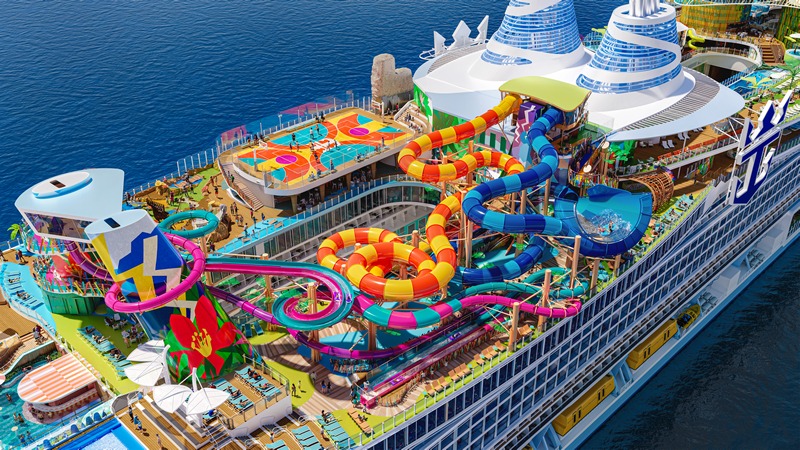
Sarah Kowalski had booked exactly one cruise before. She described it as “a nice hotel that occasionally rocked.” Then a friend sent her a video of a waterslide jutting out over open ocean, 154 feet above the waves, on a ship that hadn’t even launched yet. She stared at her phone for a long moment. “That’s not a cruise,” she said. “That’s something else entirely.”
She’s not wrong. Royal Caribbean’s Hero of the Seas, scheduled for a 2027 launch, represents the fourth entry in the company’s Icon Class lineup. But calling it just another Icon Class ship is a bit like calling the Grand Canyon just another canyon.
What Most Travelers Still Believe About Cruise Ships
The dominant image of a cruise vacation is remarkably stubborn. Ask a non-cruiser what they picture and they’ll describe shuffleboard decks, towel animals on the bed, and a schedule built around formal dinner seatings. Maybe a port stop in Nassau. The cruise industry has been fighting this perception for years.
Even among people who cruise regularly, the expectation is incremental improvement. A better spa. A newer restaurant concept. Another deck of balcony cabins. The assumption is that cruise ships evolve the way sedans evolve: slightly sleeker each generation, but fundamentally the same machine.
That assumption is precisely what Royal Caribbean is betting against. And Hero of the Seas is the most aggressive version of that bet yet.
Category 6 Waterpark: Six Record-Breaking Slides, One at 154 Feet Above Sea
The numbers here deserve a moment of attention. The Category 6 Waterpark on Hero of the Seas will feature six record-breaking waterslides. One of them climbs 154 feet above sea level. To put that in context, the Statue of Liberty’s torch sits about 305 feet above ground. You would be dropping from roughly half that height while surrounded by open ocean on all sides.
Beyond the height, the waterpark introduces two entirely new family raft slides. These are designed for groups to ride together, not just solo thrill-seekers. That’s a deliberate design choice, and it signals something important about who this ship is built for.
Then there is the funnel raft slide. According to Cruise Industry News, this is the first funnel raft slide ever installed on any ship at sea. A funnel slide accelerates riders through a tube and launches them into a wide, bowl-shaped funnel where they swing from side to side before dropping through the center. It’s a standard fixture at land-based water parks. Nobody had ever figured out how to engineer one into a working cruise ship. Hero of the Seas is the first.
That single detail is worth pausing on. Not “first on a Royal Caribbean ship.” First. On. Any. Ship. Ever.
| Feature | Hero of the Seas (2027) | Typical Cruise Ship |
|---|---|---|
| Waterslide height | 154 feet above sea level | 30–60 feet typical |
| Funnel raft slide | First ever at sea | Not available |
| Total pools | 9 pools | 2–4 typical |
| Waterslide count | 6 record-breaking slides | 1–3 typical |
| Zip line | Above the open sea | Rare; limited to a few ships |
| Family raft slides | 2 new designs | None or 1 |
Nine Pools, a Zip Line, and Suites Designed Around Families
The waterpark is the headline, but Hero of the Seas is built on a broader philosophy. Royal Caribbean’s press center revealed in March 2026 that the ship will feature nine pools in total. One of them, Coconut Cove, is an all-new concept designed specifically as a family gathering space. It sits steps from the waterpark, creating a natural ecosystem of water-based activities for mixed-age groups.
There is also a zip line. Not a simulation. Not a virtual experience. An actual zip line that runs above the open sea. Reports from the Jerusalem Post covering the ship’s unveiling highlighted it alongside the waterpark as one of the ship’s signature outdoor experiences.
The family suite program deserves its own scrutiny. Cruise ships have long offered suites, but most are simply enlarged versions of standard cabins. Hero of the Seas is developing suites that are architecturally different, built around the way families actually move through a shared space. The Treehouse Suite concept, which has drawn significant search interest ahead of the 2027 launch, represents a category of accommodation that doesn’t have a direct equivalent in the current cruise market.
“Royal Caribbean’s Hero of the Seas introduces the next evolution of family vacation experiences” on a ship described as one of the most ambitious in the company’s history.
— Royal Caribbean International Press Center, 2026
The themed restaurant program is similarly ambitious. While details are still emerging ahead of the 2027 launch, Royal Caribbean’s Icon Class ships have pioneered immersive dining environments that function less like restaurants and more like theatrical experiences. Hero of the Seas is expected to push further in this direction, with concepts built around complete sensory environments rather than just menus.
| Ship | Launch Year | Gross Tonnage | Passenger Capacity | Notable First | Status |
|---|---|---|---|---|---|
| Icon of the Seas | 2024 | 250,800 GT | 7,600 | First Icon Class ship; largest cruise ship ever | Active |
| Star of the Seas | 2025 | ~250,000 GT | 7,600 | First Icon Class ship with expanded AquaDome features | Upcoming |
| Silver of the Seas | 2026 | ~250,000 GT | 7,600 | Expanded entertainment district | Announced |
| Hero of the Seas | 2027 | ~255,000 GT | 7,800 | First funnel raft slide on any vessel; 154 ft above ocean | In Development |
What the 2027 Launch Actually Means for Families Planning Now
Here is where the practical reality matters. Hero of the Seas is launching in 2027, which puts it within serious planning range for families making multi-year travel decisions right now. Cruise bookings, particularly for new ships in popular vacation windows, tend to fill fastest in the 12 to 24 months before launch.
The ship also reflects a broader trend that travel researchers have been tracking for several years. Post-pandemic family travel has shifted heavily toward experiential destinations: places where every member of the group, from a six-year-old to a grandparent, has something genuinely designed for them. Land-based resorts have been chasing this demand. Hero of the Seas is the cruise industry’s most direct response to it.
Demand for cruises in Europe, where Royal Caribbean has been expanding its itinerary offerings, has grown sharply. A ship with this level of onboard programming changes the calculus for families who previously chose land destinations specifically because cruise ships felt too passive.
The ship is also significant for what it tells us about where cruise development is heading. Each Icon Class ship has introduced at least one feature that had never existed on any vessel before. Hero of the Seas continues that pattern with the funnel raft slide. The question the industry is quietly asking is what the fifth Icon Class ship will introduce that we can’t currently imagine.
For Sarah Kowalski, who described her first cruise as a hotel that occasionally rocked, the video she watched was a data point. A ship with a 154-foot waterslide, nine pools, a zip line above open water, and suites designed around family life isn’t competing with other cruise ships. It’s competing with Disney World, with all-inclusive resorts, with the kind of land-based destinations that have traditionally captured the highest-spending family travel dollars.
Royal Caribbean seems to understand exactly what it’s competing against. Whether Hero of the Seas actually delivers on the promise of its unveiling will be the story of 2027. But the ambition, at least, has never been clearer: the ship isn’t trying to be a better cruise. It’s trying to make the question of “cruise versus resort” feel irrelevant before you’ve even packed your bag.


Leave a Reply