
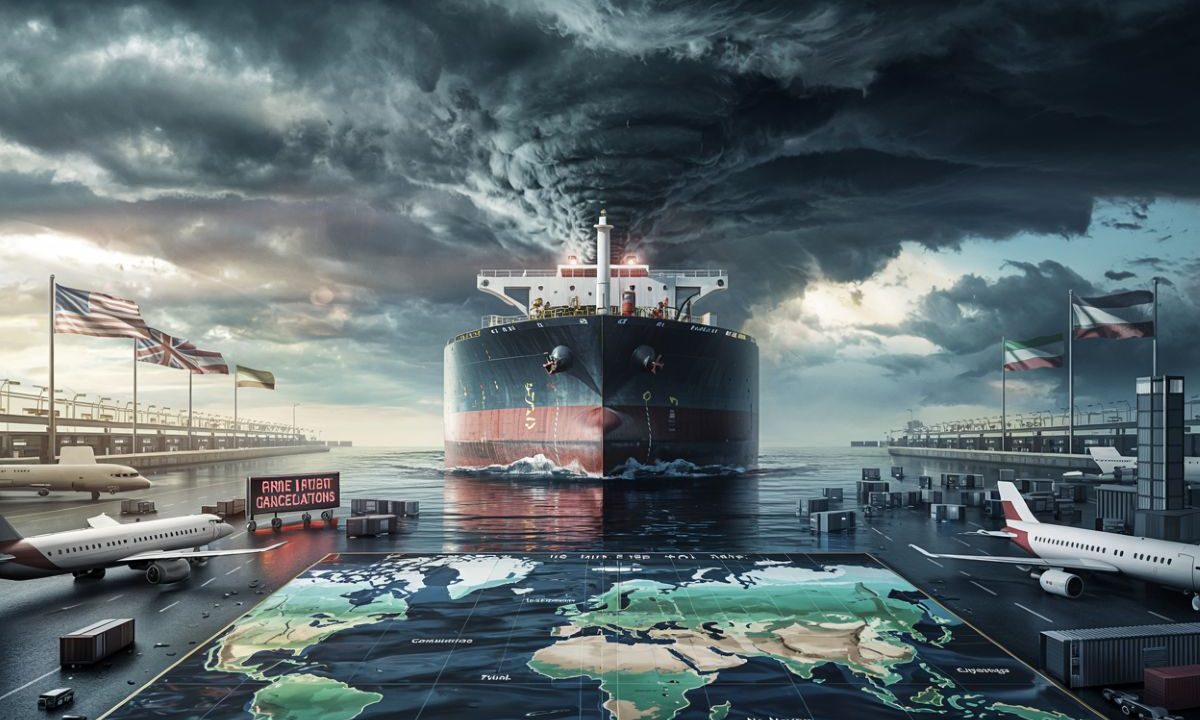
Oil prices surging past $200 per barrel. Flights becoming unaffordable overnight. Global supply chains grinding to a halt. These are not distant hypotheticals — they are the scenarios now being discussed by energy analysts and governments worldwide as Iran threatens to block one of the world’s most critical maritime corridors following the Strait of Hormuz crisis.
The situation is drawing in major economies from across the globe. The United States, United Kingdom, Japan, South Korea, India, and Germany are among the nations now grappling with the consequences of rising tensions in the Middle East — tensions that strike directly at the arteries of global trade and travel.
For everyday travelers, tourists, and the businesses that depend on international logistics, what happens in these narrow stretches of water matters far more than most people realize.
What Is Happening in the Strait of Hormuz and Bab el-Mandeb
The Strait of Hormuz, located between Iran and the Arabian Peninsula, is one of the most strategically vital waterways on Earth. A significant share of the world’s seaborne oil passes through it. When tensions rise in this corridor, the entire global energy market feels the tremors.
Now, Iran has escalated the situation further by threatening to block the Bab el-Mandeb strait — the narrow passage connecting the Red Sea to the Gulf of Aden at the southern tip of Yemen. This waterway is a critical link between Asian and European trade routes, and any disruption there compounds the pressure already building around the Strait of Hormuz.
The threat of blocking both corridors simultaneously — what analysts describe as a “double choke” — is what has drawn such an urgent, coordinated response from major world powers. The economic consequences of that scenario would be severe and nearly immediate.
Why a Double Choke Point Crisis Could Push Oil Past $200 a Barrel
The math is straightforward, even if the geopolitics are not. Both the Strait of Hormuz and the Bab el-Mandeb are irreplaceable links in the global energy supply chain. Rerouting tankers around these corridors adds weeks to delivery times and dramatically increases shipping costs.
If Iran were to successfully disrupt or block both passages, the resulting supply shock could send oil prices soaring to levels not seen in modern history — with projections suggesting a spike beyond $200 per barrel.
That kind of price increase does not stay contained to fuel pumps. It ripples outward into every corner of the economy, hitting aviation fuel costs, freight charges, manufacturing inputs, and consumer prices across the board.
| Waterway | Location | Strategic Significance | Countries Most Affected |
|---|---|---|---|
| Strait of Hormuz | Between Iran and Arabian Peninsula | Major seaborne oil transit route | US, UK, Japan, South Korea, India, Germany |
| Bab el-Mandeb | Southern tip of Yemen / Red Sea entrance | Critical Asia-Europe trade link | US, UK, Japan, South Korea, India, Germany |
How This Threatens Global Travel and Tourism
For the travel industry, geopolitical instability of this scale creates a cascade of problems that are difficult to contain or predict.
Airline operating costs are directly tied to jet fuel prices, which track closely with crude oil markets. A sustained spike in oil prices would force carriers to raise airfares, reduce routes, or both. Long-haul international travel — already recovering from years of disruption — would face fresh headwinds.
Beyond airfares, the broader economic anxiety triggered by an energy crisis tends to suppress consumer confidence. When households feel squeezed by rising costs, discretionary spending on holidays and international tourism is often the first thing to go.
Tourism-dependent economies, particularly those relying on long-haul visitors from the US, Europe, and Asia, would feel the impact acutely. The ripple effect extends to hotels, tour operators, cruise lines, and destination businesses that depend on predictable visitor volumes and stable logistics.
- Higher jet fuel costs leading to rising airfares globally
- Disruption to international shipping affecting tourism supply chains
- Reduced consumer confidence suppressing travel demand
- Increased costs for tour operators and travel businesses
- Unpredictable route changes for airlines navigating conflict zones
The Nations Now Watching This Crisis Most Closely
The breadth of countries drawn into this situation reflects just how globally interconnected energy and trade have become. The United States, United Kingdom, Japan, South Korea, India, and Germany each have significant economic exposure to disruptions in Middle Eastern energy corridors.
Japan and South Korea, for example, are heavily dependent on imported oil and have few domestic alternatives. Any prolonged disruption to their energy supply chains carries serious economic consequences. India, one of the world’s fastest-growing energy consumers, faces similar vulnerabilities.
European nations like Germany, already navigating their own energy transition challenges, would face compounding pressure from a sustained oil price shock. And the United States, while more energy-independent than it was a decade ago, remains deeply integrated into global markets where price shocks spread regardless of domestic production levels.
The coordination among these nations signals that the crisis is being treated not as a regional concern, but as a global one requiring a collective response.
What Comes Next for Energy Security and Global Stability
The immediate question is whether Iran’s threats translate into action — and how quickly the international community can respond if they do. The presence of so many major economies publicly aligned against further escalation suggests significant diplomatic and potentially military pressure is being applied behind the scenes.
For the travel industry and global businesses, the near-term outlook depends heavily on how quickly the situation either stabilizes or deteriorates. A de-escalation could see markets recover relatively quickly. A prolonged standoff — or actual blockades — would create disruptions that could take months to untangle.
Energy security and the freedom of maritime navigation have rarely felt more fragile. And for anyone planning international travel, booking flights, or running a business that depends on global logistics, the developments in these two narrow straits deserve close attention.
Frequently Asked Questions
What is the Bab el-Mandeb strait and why does it matter?
The Bab el-Mandeb is a narrow waterway at the southern entrance to the Red Sea, connecting it to the Gulf of Aden. It is a critical link in trade routes between Asia and Europe, and any blockage would severely disrupt global shipping.
How high could oil prices go if both straits are blocked?
According to the source reporting, a simultaneous disruption to both the Strait of Hormuz and Bab el-Mandeb could push oil prices beyond $200 per barrel.
Which countries are most affected by this crisis?
The United States, United Kingdom, Japan, South Korea, India, and Germany are among the nations identified as facing significant exposure to the rising instability.
How would this affect airline tickets and travel costs?
Higher oil prices directly increase jet fuel costs, which airlines typically pass on to passengers through higher airfares. Sustained price spikes could significantly raise the cost of international travel.
Is Iran actually blocking these straits right now?
As of the reporting, Iran has issued threats to block the Bab el-Mandeb following the Strait of Hormuz crisis. Whether those threats have been carried out has not been confirmed in
What does this mean for tourism industries worldwide?
The combination of rising travel costs, economic uncertainty, and suppressed consumer confidence poses significant challenges for tourism-dependent economies and the businesses that serve international travelers.


Leave a Reply