
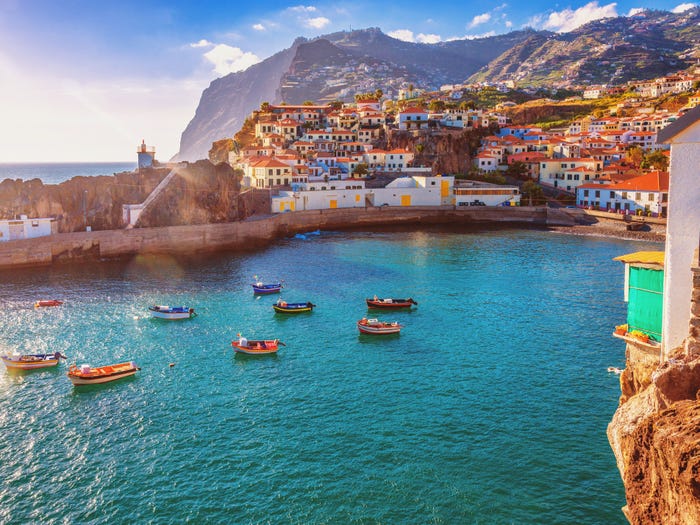
Portugal is about to invest €931 million into a single port by 2035. That number, tied to the Port of Leixões near Porto, isn’t just a budget line. It signals something much larger: a full-scale reimagining of how the country’s maritime infrastructure thinks, communicates, and operates in the 21st century.
At the center of that reimagining is a new cooperation agreement between two of Portugal’s most strategically significant ports: Madeira and Leixões. The deal, focused on digital enhancement of port efficiency and maritime safety, arrives at a moment when the Atlantic shipping corridor faces mounting pressure from weather disruptions, rising cruise traffic, and the urgent demands of a connected global economy.
The Atlantic Corridor Under Pressure
The Atlantic is not a gentle stretch of water. Anyone who has watched a cruise itinerary shift overnight understands this viscerally. In early 2025, Silversea’s new Silver Ray was forced to skip its scheduled Madeira call entirely due to rough Atlantic conditions, diverting to Leixões near Porto instead and reshaping the voyage for hundreds of passengers.
That single incident compressed the problem into one headline. Madeira, perched in the mid-Atlantic, is exposed. Leixões, tucked into Portugal’s northern coast, offers a sheltered alternative. The two ports are not rivals; they are natural complements. And now, they are formally acting like it.
The cooperation agreement between the two port authorities isn’t just a handshake. It represents a deliberate push to integrate digital systems, share operational knowledge, and build a maritime safety architecture that can withstand the unpredictability of Atlantic conditions.
What the Digital Partnership Actually Involves
The agreement covers a broad spectrum of technological cooperation. Port operations today generate enormous volumes of data: vessel tracking, cargo manifests, weather modeling, berth scheduling, and security surveillance. The challenge isn’t collecting that data. It’s turning it into decisions that prevent accidents, delays, and threats.
The partnership between Madeira and Leixões is designed to bridge exactly that gap. By sharing platforms and expertise, both ports can develop more responsive operational systems, coordinate vessel routing during adverse weather, and apply predictive analytics to reduce the kind of last-minute diversions that cost carriers time and travelers their itineraries.
The Madeira-Leixões agreement extends this network logic northward, creating a corridor from the archipelago all the way up Portugal’s Atlantic-facing coast. Think of it less as two ports cooperating and more as a nervous system slowly developing across the country’s entire maritime edge.
AI and the New Face of Port Security
One layer of this initiative deserves particular attention: artificial intelligence. According to the EU Atlantic Maritime Strategy Implementation Report 2024, AI modules are now being actively deployed across European port networks to identify concealed threats and reinforce security infrastructure.
These systems don’t just flag anomalies. They learn. They integrate vessel behavior patterns, cargo data, and surveillance feeds to build a real-time picture of what’s normal and what isn’t. For a port like Madeira, which handles both commercial freight and a significant volume of cruise traffic, that capability is operationally valuable.
“These elements join forces to empower artificial intelligence modules, ultimately fortifying our capacity to safeguard ports and identify concealed threats.”
— EU Atlantic Maritime Strategy Implementation Report, 2024
The framing here matters. Maritime safety has traditionally been reactive: respond to the incident, file the report, adjust the protocol. AI-driven systems shift that model toward the predictive. They raise a flag before the ship drifts off course or the container manifests an irregularity.
What This Means for Travelers
Most travelers don’t think about port infrastructure until something goes wrong. A delayed boarding. A cancelled port call. An itinerary reshuffled because a harbor couldn’t safely accommodate a vessel in high swells. These disruptions are more common than cruise brochures suggest, and they almost always trace back to gaps in coordination or safety response.
| Port | Location | Key Role | Investment / Status |
|---|---|---|---|
| Leixões | Near Porto, mainland Portugal | Major commercial and cruise hub; Atlantic weather alternative | €931M by 2035 (Portos 5+ strategy) |
| Madeira (Funchal) | Mid-Atlantic archipelago | Cruise destination; exposed Atlantic position | Active digital cooperation agreements with Sines, Algarve, and Leixões |
| Sines | Southern mainland Portugal | Deep-water freight; strategic energy port | Cooperation agreement with Madeira active |
The Madeira-Leixões digital partnership directly addresses that problem. When both ports share real-time operational data and coordinated vessel management systems, rerouting decisions become faster and better-informed. The Silver Ray diversion to Leixões was managed, but it was reactive. Future diversions may be anticipated hours earlier, giving passengers more notice and carriers more flexibility.
For travelers planning Atlantic cruises or ferry routes through this corridor, the practical upshot is meaningful. A more digitally integrated port network means fewer surprises, more transparent communication, and a higher baseline of safety on every voyage that touches these waters.
The Bigger Story: Portugal’s Maritime Ambitions
Portugal occupies a unique geographic position. Its coastline faces the open Atlantic. Its archipelagos, Madeira and the Azores, are deep into the ocean. The country’s maritime sector isn’t peripheral; it’s foundational to the national economy and identity.
The Portos 5+ national strategy reflects that understanding. The €931 million earmarked for Leixões alone, spanning new infrastructure, digitization, and capacity expansion, signals a government that sees its ports not as legacy assets but as competitive levers in a global logistics race.
The digital cooperation between Madeira and Leixões fits that frame precisely. It costs far less than new infrastructure. But by aligning data systems, emergency protocols, and AI-driven safety tools, it multiplies the value of every euro already invested in physical port development.
This approach isn’t unique to Portugal. Across the EU, the Atlantic Maritime Strategy has been pushing member states toward exactly this kind of port-network integration since its 2013 launch. What’s notable here is the pace. Portugal isn’t waiting for mandates. It’s building the architecture now, port agreement by port agreement, corridor by corridor.
The Tension That Still Exists
Not everyone embraces the expansion uncritically. The Leixões harbour extension, launched back in March 2017 at a cost of €320 million, drew fierce opposition from environmental groups. The Surfrider Foundation’s Coastal Defenders campaign fought to suspend the works, citing damage to surf breaks and coastal ecosystems along Porto’s shoreline.
That tension between maritime growth and coastal preservation hasn’t disappeared. It has simply been absorbed into a more complex conversation about what modern port development looks like. Digital innovation, in this context, offers a partial answer: smarter systems can reduce physical footprints, optimize existing infrastructure, and minimize environmental disruption better than raw construction ever could.
Whether the Madeira-Leixões digital partnership will meaningfully satisfy those environmental concerns remains an open question. What’s clear is that Portugal is no longer treating its ports as isolated nodes. They are becoming a networked system, and that system is being built around data, coordination, and the hard lessons of every voyage that almost went wrong.
The Atlantic doesn’t care about agreements or investment strategies. But the people navigating it, and the travelers trusting their itineraries to it, increasingly will.



Leave a Reply