
▶ Read transcript
Here’s what you need to know about a star that’s rewriting everything astronomers thought they understood about how massive stars die.
WOH G64 is one of the largest known stars in the observable universe, sitting about 160,000 light-years from Earth in the Large Magellanic Cloud. At roughly 1,540 times the size of our Sun, it belongs to an extreme class called red hypergiants. For years it pulsed on a predictable cycle. Then around 2011 it dimmed significantly, and when it came back, something had fundamentally changed.
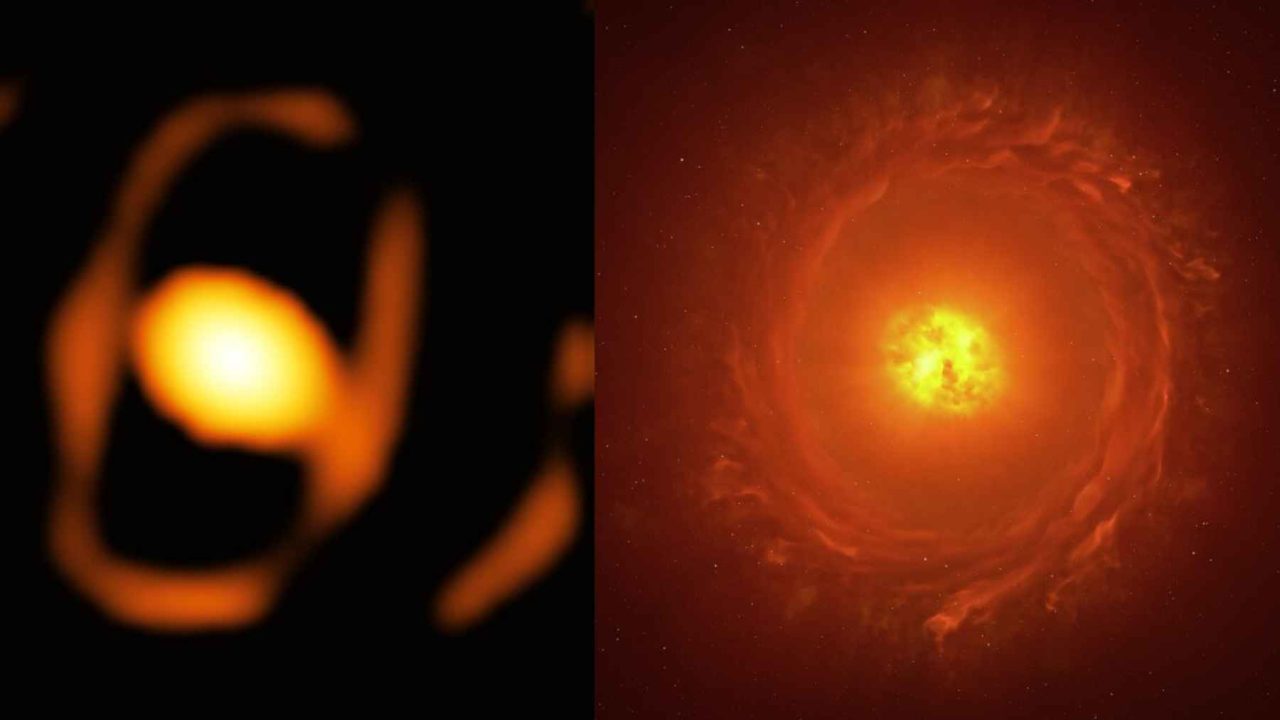
The star’s surface temperature rose by about 1,000 kelvins, and its color shifted from deep red toward yellow. Researchers using the Very Large Telescope Interferometer confirmed in 2024 that WOH G64 may be entering a yellow hypergiant phase, a transition almost never witnessed in real time.
If you’re curious about space science, this is a story worth following closely. We may be watching a star die in a way no model has ever predicted.
Here is the uncomfortable truth about stellar evolution: astronomers thought they understood how massive stars die. They had models, timelines, and neat theoretical boxes. Then WOH G64 started doing something none of those models predicted, and the entire field had to pause.
This is not a minor anomaly. This is one of the largest known stars in the observable universe behaving in ways that have left researchers openly admitting they don’t know what comes next. That kind of uncertainty, in a field built on centuries of careful observation, is genuinely extraordinary.
WOH G64: The Star That Rewrites the Rulebook on Stellar Death
WOH G64 sits in the Large Magellanic Cloud, a satellite galaxy of the Milky Way roughly 160,000 light-years from Earth. At an estimated radius of approximately 1,540 times that of the Sun, it belongs to a rare class of stars called red hypergiants. These are not just large stars. They are among the most extreme objects in the known universe, burning through fuel at a rate that makes their lifespans cosmically brief.
| Star | Classification | Size (Solar Radii) | Distance |
|---|---|---|---|
| WOH G64 | Red Hypergiant (transitioning) | ~1,540 | 160,000 light-years |
| VY Canis Majoris | Red Hypergiant | ~1,420 | ~3,900 light-years |
| The Sun | Yellow Dwarf | 1 | 0 |
For most of its observed history, WOH G64 pulsed with a relatively predictable rhythm. Its brightness cycled on a period of approximately 886 days, a slow, deep heartbeat that astronomers could track and log. It was enormous, luminous, and stable enough to study. Then, around 2011, it dimmed significantly.
That dimming event was not unusual on its own. Massive stars dim. They shed material, they fluctuate. But when WOH G64 rebounded in 2013 and 2014, it came back different. The star that returned was not the same star that had faded.
A Color Change That Stunned the Team Watching It
In 2024, researchers using the European Southern Observatory’s Very Large Telescope Interferometer took a close look at WOH G64. What they found stopped them cold. The star was surrounded by a thick cocoon of gas and dust, and its apparent color had shifted noticeably. It was no longer the deep, saturated red that had defined it for decades. It was trending toward yellow.

You Might Also Like

Accor’s 800th Hotel in China Reveals Who’s Really Winning Asia
Accor opens its 800th hotel in Greater China — the Sofitel Changzhou Hi-Tech District. What…

Engineers have developed a material capable of self-repairing more than 1,000 times, which promises to extend the service life of key components in airplanes, cars, and wind turbines for centuries
U.S. engineers have built a fiber composite that self-repairs over 1,000 times and outperforms current…

WIC income limits by household size: What You Could Get Each Month, Who May Qualify, and How to Apply, With Current Official Figures and Step-by-Step Help — Up to $2,430 a Month
If you are pregnant, recently gave birth, breastfeeding, or have a child under age 5,…
Leave a Reply