
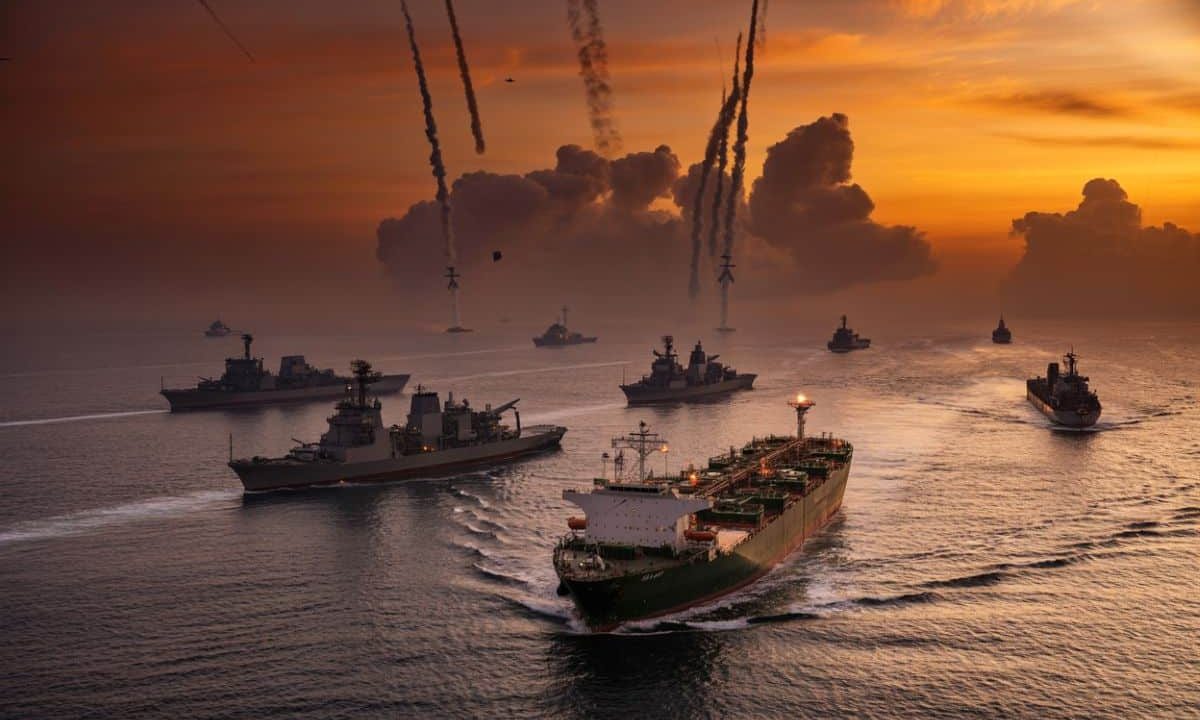
Nearly 20 million barrels of oil pass through the Strait of Hormuz every single day — roughly one-fifth of everything the world consumes. Now, with the United States moving to enforce a military blockade of that critical waterway following the collapse of diplomatic talks, the consequences are rippling across global energy markets, international tourism, and trade in ways that few countries can afford to ignore.
Germany, Spain, Saudi Arabia, the UAE, China, India, and a growing list of major economies are all facing the same harsh reality: if the Strait of Hormuz closes — even partially — the economic fallout will be immediate, severe, and felt by ordinary people far beyond the Middle East.
The trigger for the current crisis is the failure of US–Iran ceasefire negotiations held in Islamabad, which has pushed an already tense standoff toward open confrontation. With diplomatic options narrowing, the threat of a sustained blockade is no longer a distant scenario — it is the situation markets and governments are now actively preparing for.
(function(){var wrp=document.getElementById(“paap_stat_69de951e1990b0.19036228”);if(!wrp)return;var ids=[“paap_stat_69de951e1990b0.19036228_c0″,”paap_stat_69de951e1990b0.19036228_c1”];var dur=1800;function ease(t){return 1-Math.pow(1-t,3);}function anim(){ids.forEach(function(id){var el=document.getElementById(id);if(!el)return;var tgt=parseFloat(el.getAttribute(“data-target”))||0;var pfx=el.getAttribute(“data-prefix”)||””;var sfx=el.getAttribute(“data-suffix”)||””;var dec=parseInt(el.getAttribute(“data-decimals”))||0;var st=null;function step(ts){if(!st)st=ts;var p=Math.min((ts-st)/dur,1);var v=ease(p)*tgt;el.textContent=pfx+v.toFixed(dec)+sfx;if(p<1)requestAnimationFrame(step);}requestAnimationFrame(step);});}if("IntersectionObserver" in window){var obs=new IntersectionObserver(function(e){e.forEach(function(en){if(en.isIntersecting){anim();obs.disconnect();}});},{threshold:0.2});obs.observe(wrp);}else{anim();}})();
Why the Strait of Hormuz Is the World’s Most Dangerous Chokepoint
The Strait of Hormuz is a narrow passage between Iran and Oman, connecting the Persian Gulf to the Arabian Sea. It is the single most important oil transit route on the planet. Countries like Saudi Arabia, the UAE, Kuwait, Iraq, and Iran all depend on it to export their crude to global markets.
When that route is threatened, the consequences extend well beyond the oil industry. Fuel prices rise. Airline operating costs climb. Freight costs increase. Tourism becomes more expensive for travelers and less profitable for operators. Supply chains that depend on affordable energy face sudden disruption.
The current US threat to enforce a blockade — following the breakdown of talks in Islamabad — has injected a level of uncertainty into global markets that analysts describe as some of the most serious in years. The prospect of nearly 20 million barrels per day being cut off, even temporarily, is enough to send shockwaves through every sector that depends on stable energy prices.
Which Countries Are Most Exposed — and What They Stand to Lose
The list of nations now facing serious economic exposure is long and spans multiple continents. Each country faces its own version of the same core problem: rising costs, falling confidence, and a tourism and trade outlook that has darkened sharply.
| Country | Primary Exposure | Key Sector at Risk |
|---|---|---|
| Germany | Oil import costs, industrial energy prices | Manufacturing, exports |
| Spain | Fuel costs, inbound tourism disruption | Tourism, aviation |
| Saudi Arabia | Oil export route dependency | Energy revenue, Vision 2030 tourism |
| UAE | Trade hub status, aviation connectivity | Tourism, logistics, finance |
| China | Massive oil import volumes via Hormuz | Manufacturing, trade |
| India | Gulf oil imports, diaspora travel routes | Energy, aviation, tourism |
Germany’s inclusion on this list is particularly significant. As Europe’s largest economy and a major industrial power, Germany depends heavily on stable global energy prices to keep its manufacturing sector competitive. A sustained spike in oil costs translates directly into higher production costs — and ultimately higher prices for German goods in export markets already under pressure.
For Saudi Arabia and the UAE, the irony is acute. Both countries are major oil exporters, but they also depend on the Strait of Hormuz to get their product to market. A blockade doesn’t just hurt oil importers — it traps exporters too. Both nations have invested heavily in tourism as part of long-term economic diversification strategies, and a prolonged regional conflict threatens to undermine that work.
What This Means for Global Travel and Tourism Right Now
Tourism is one of the first industries to feel the effects of geopolitical instability — and one of the last to recover. The combination of rising fuel costs, regional conflict, and traveler uncertainty creates a perfect storm for the global travel sector.
Airlines face higher jet fuel costs, which translate into higher ticket prices or reduced route profitability. Hotels and hospitality operators in affected regions see booking cancellations spike. Travelers who had planned trips to the Gulf, South Asia, or connecting through major Middle Eastern hubs are reconsidering their options.
Spain, which relies heavily on inbound international tourism as a pillar of its economy, faces a different but related problem. European travelers who might have booked long-haul trips — including to destinations served by Gulf carriers — may pull back as economic uncertainty grows and discretionary spending tightens under higher fuel and energy costs at home.
What Happens Next — and What to Watch For
The immediate question is whether diplomatic channels can be reopened after the Islamabad talks collapsed. The failure of those negotiations has left few obvious off-ramps, and the US posture of enforcing a military blockade suggests that pressure — rather than dialogue — is currently the dominant strategy.
For energy markets, the focus will be on whether oil-producing nations outside the Gulf can increase output quickly enough to offset any disruption. That is a difficult ask in the short term, and prices are likely to remain elevated as long as the threat of blockade persists.
For the travel industry, the watchpoints are airline fuel surcharges, booking trend data from Gulf-connected routes, and any travel advisories issued by governments for the broader region. If the situation escalates further, expect more countries to join the growing list of economies publicly acknowledging the threat to their tourism and trade outlooks.
The situation remains fluid. What is clear is that the stakes — measured in barrels per day, tourism revenue, and economic stability for dozens of nations — could hardly be higher.
Frequently Asked Questions
How much oil passes through the Strait of Hormuz?
Approximately 20 million barrels per day transit the Strait of Hormuz, representing around 20% of global oil consumption.
Why did the ceasefire talks in Islamabad fail?
This has not yet been fully confirmed in available reporting.
Which countries are most affected by the potential Hormuz blockade?
Germany, Spain, Saudi Arabia, the UAE, China, and India are among the major economies identified as facing significant exposure to oil price increases and trade disruption.
How does a Hormuz blockade affect tourism?
Rising fuel costs push up airline ticket prices, reduce route profitability, and dampen traveler confidence — all of which reduce international tourism activity and revenue for affected destinations.
Are Saudi Arabia and the UAE affected even though they export oil?
Yes — both countries depend on the Strait of Hormuz to export their oil, meaning a blockade would trap their exports as well as restrict imports by other nations.
Is there a diplomatic solution still being pursued?
Further developments have not yet been confirmed.


Leave a Reply