
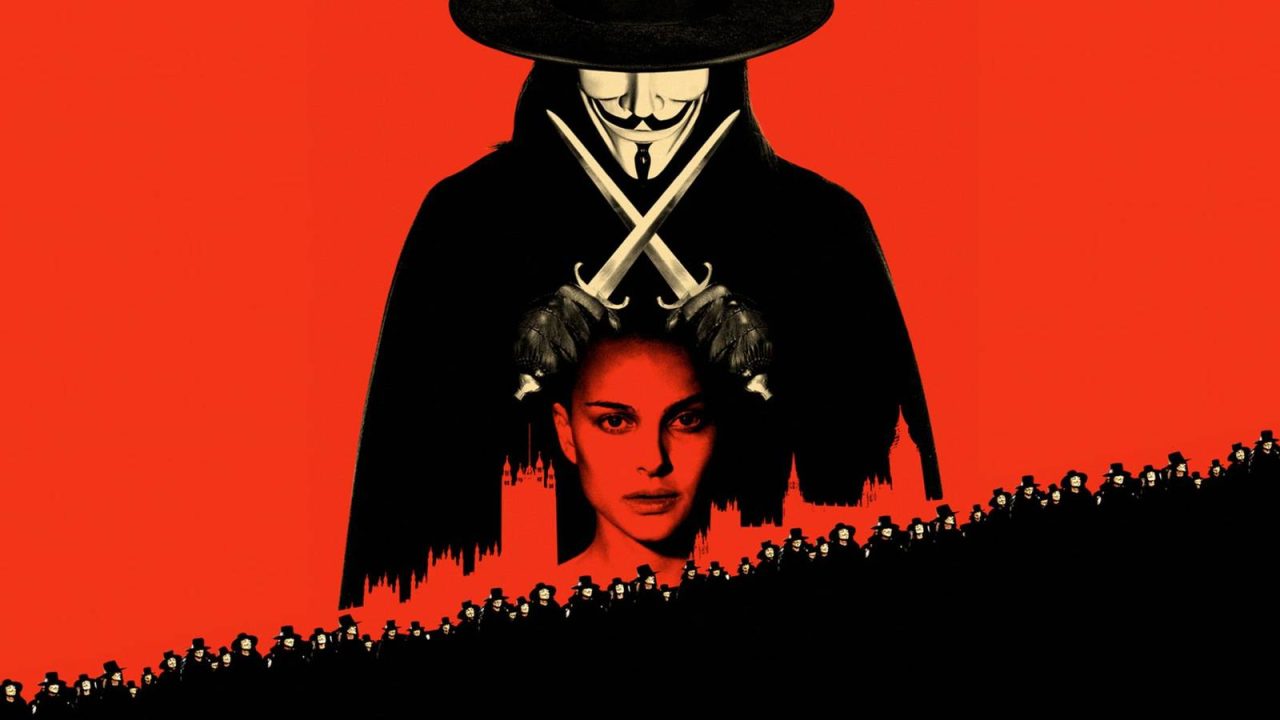
Twenty years after its release, V for Vendetta remains one of the most politically charged and culturally resonant films to come out of the superhero-adjacent genre — and the conversation around what made it work is still very much alive. The Guy Fawkes mask that the film’s mysterious protagonist wears has become a global symbol of resistance and protest, spotted everywhere from Occupy Wall Street demonstrations to online activist communities. That kind of cultural staying power doesn’t happen by accident.
The 2005 film, directed by James McTeigue and produced by the Wachowskis, was adapted from Alan Moore and David Lloyd’s celebrated graphic novel. It told the story of a masked vigilante known only as V, operating in a dystopian fascist Britain, and the young woman named Evey who becomes entangled in his revolutionary mission. It was dark, theatrical, and unapologetically political — and it connected with audiences in ways that most comic book adaptations simply don’t.
So what actually made it work? As the film marks two decades since its release, that question is worth taking seriously.
V for Vendetta Was Never Really a Superhero Movie
One of the most important things to understand about V for Vendetta is what it deliberately chose not to be. At a time when the superhero genre was beginning its long march toward total Hollywood dominance — Spider-Man had already swung into theaters, Batman Begins arrived the same year — this film took a sharply different path.
V has no origin story in the traditional sense. He has no team, no mentor, no franchise setup. He is violent, morally ambiguous, and at times genuinely frightening. The film never asks you to simply cheer for him the way you would for a conventional hero. Instead, it asks harder questions: about power, about complicity, about what ordinary people owe each other when governments turn authoritarian.
That refusal to conform to superhero genre conventions is widely considered central to why the film endures. It treated its audience as adults capable of sitting with discomfort, rather than offering the clean moral resolution that most blockbusters of the era preferred.
What Set This Film Apart From Its Comic Book Peers
Looking at where V for Vendetta sits relative to other comic book adaptations of its era helps clarify just how unusual it was:
| Film | Release Year | Tone | Political Subtext |
|---|---|---|---|
| V for Vendetta | 2005 | Dark, theatrical, morally complex | Explicit and central to the story |
| Batman Begins | 2005 | Gritty but heroic | Present but secondary |
| Spider-Man | 2002 | Hopeful, crowd-pleasing | Minimal |
| Fantastic Four | 2005 | Light, comedic | Largely absent |
The film’s political content wasn’t window dressing — it was the entire point. A totalitarian government using fear and surveillance to control its citizens, state-sanctioned violence against minorities, and the question of whether revolution can ever truly be justified. These weren’t subtle background details. They were front and center, and audiences responded.
Why the Film Still Feels Uncomfortably Relevant
Part of what keeps V for Vendetta in the cultural conversation two decades later is that the world it depicts doesn’t feel as distant as it once might have. Surveillance states, the weaponization of fear by governments, the suppression of political dissent — these are not abstract historical concerns. They’re active debates in democracies around the world.
The film’s central argument — that ideas are bulletproof, that symbols of resistance outlast the individuals who carry them — has been tested repeatedly in real-world protest movements since 2005. The Guy Fawkes mask became the face of Anonymous and appeared in demonstrations across dozens of countries. Whether one agrees with the politics or not, that level of real-world adoption is extraordinary for any piece of popular fiction.
The fact that its themes translated so cleanly to the early 2000s post-9/11 climate — and continue to resonate today — speaks to how carefully the filmmakers preserved the story’s core warnings rather than softening them for mainstream palatability.
The Anti-Superhero Formula That Actually Worked
What V for Vendetta got right, in a way that many films have tried and failed to replicate, was committing fully to its own logic. V is not redeemable in a conventional sense. He is a product of state-sanctioned torture, driven by vengeance as much as ideology. The film doesn’t flinch from that.
Evey’s journey — from frightened bystander to someone who genuinely understands and chooses the cause — is the emotional spine of the story. Her transformation is earned slowly and painfully, not handed to her through a training montage. That emotional authenticity gave audiences something to hold onto even when the film’s politics felt confrontational.
Hugo Weaving’s performance as V, delivered entirely behind a mask and through voice alone, remains one of the more remarkable acting achievements of that decade. And Natalie Portman’s Evey gave the film its human anchor — the person through whose eyes an ordinary viewer could process an extraordinary situation.
What Happens to a Film’s Legacy at the Twenty-Year Mark
Two decades is a meaningful threshold for any film. It’s long enough to separate genuine cultural impact from initial hype, and long enough to see whether a movie’s ideas hold up under the weight of time and changing circumstances.
For V for Vendetta, the twenty-year mark finds it arguably more discussed than ever — not as nostalgia, but as a live reference point. That’s a rare achievement, and it speaks directly to the choices made by everyone involved in its production to prioritize substance over spectacle.
Frequently Asked Questions
Who directed V for Vendetta?
The film was directed by James McTeigue and produced by the Wachowskis. It was released in 2005.
Is V for Vendetta based on a comic book?
Yes. It is adapted from the graphic novel by Alan Moore and David Lloyd, originally written in the 1980s.
Why is the Guy Fawkes mask from V for Vendetta so culturally significant?
The mask became a widely recognized symbol of political resistance and protest, adopted by movements such as Anonymous and used in demonstrations around the world following the film’s release.
What makes V for Vendetta different from other superhero films?
The film deliberately avoids conventional superhero storytelling, presenting a morally ambiguous protagonist, explicit political themes, and no clean heroic resolution — setting it apart from most comic book adaptations of its era.
Who stars in V for Vendetta?
Hugo Weaving plays V, performing entirely behind a mask, while Natalie Portman plays Evey, the film’s emotional anchor and central human perspective.
Has the film’s source material been confirmed as the basis for its political themes?
Yes. Alan Moore’s original graphic novel was written as a direct response to Thatcherite Britain in the 1980s, and those political themes were preserved and adapted for the film’s early 2000s context.

Leave a Reply