
Only about 2.3 million tourists visited Iceland in 2023, a number that sounds large until you realize the entire country has fewer than 380,000 permanent residents. For a landmass shaped by two colliding tectonic plates, active volcanoes, and glaciers that have existed for millennia, Iceland absorbs visitors the way lava absorbs everything: slowly, completely, permanently.
Mara Lindqvist, a 34-year-old landscape photographer from Minneapolis, booked her Iceland trip on a Tuesday evening in November 2024. She had just received a difficult medical diagnosis — nothing terminal, but enough to make her stop and ask a question she had been avoiding for years. What was she actually waiting for?
The Decision That Cost More Than She Expected
Mara had saved roughly $6,400 over eighteen months for what she vaguely called “a big trip someday.” Iceland was not her first choice. She had circled Japan, considered Patagonia, and briefly flirted with Morocco. Iceland felt cold, expensive, and logistically complicated.
Then she read a single sentence that stopped her scrolling: Iceland sits atop the meeting point of the Eurasian and North American tectonic plates, and hot rock has been bubbling up for millions of years to form what we now see. She closed her laptop and booked a 10-day solo itinerary that same night.
Her total trip cost landed at $7,100, including flights from Minneapolis to Reykjavik via Icelandair, a rented 4×4 for eight days, accommodation ranging from guesthouses at $95 per night to one splurge night at a glacier hotel for $340, and daily meals averaging $55. Iceland is not a budget destination. She knew that going in.
What she did not know was how quickly the landscape would dismantle her sense of scale.
| Region / Attraction | Type | Avg. Visit Time | Best Season |
|---|---|---|---|
| Golden Circle | Geysers, waterfalls, rift valley | 1 full day | Year-round |
| Reykjavik | Capital city, culture, food | 1–2 days | Year-round |
| Jökulsárlón Glacial Lagoon | Glacial lake with floating icebergs | 2–4 hours | Year-round |
| Snæfellsnes Peninsula | Glacier, lava fields, fishing villages | 1–2 days | Summer / Autumn |
| Westfjords | Remote fjords, cliffs, solitude | 2–3 days | Summer only |
| Northern Lights (Aurora Borealis) | Natural light phenomenon | Variable | Sept – March |
The Ring Road, the Golden Circle, and the Weight of Silence
Mara landed in Reykjavik on a grey January morning, collected her 4×4, and drove directly to the Golden Circle. She had read about it. She thought she was prepared. She was not.
The Golden Circle is a roughly 300-kilometer loop east of Reykjavik that passes through three of Iceland’s most iconic sites: Þingvellir National Park, where the North American and Eurasian plates visibly separate; the Geysir geothermal area, where the Strokkur geyser erupts every 5 to 10 minutes; and Gullfoss waterfall, a two-tiered cascade that drops 32 meters into a narrow canyon.
Standing at the edge of the rift valley at Þingvellir, Mara felt something she later struggled to describe. “It’s not awe exactly,” she wrote in her travel journal. “It’s more like being reminded that you are made of the same stuff as all of this. And that is both terrifying and completely fine.”
From Reykjavik, she drove the Ring Road east, a route that circles the entire island and covers roughly 1,332 kilometers. She had eight days to do a partial loop, focusing on the south coast and the glacial interior before looping back through the Snæfellsnes Peninsula.
The south coast delivered exactly what the photographs had promised and then exceeded them in ways photographs simply cannot capture. The black sand beaches at Reynisfjara felt threatening in a way that made her pulse quicken. The basalt columns rose like organ pipes from the cliffs. The waves came without warning, and signs posted near the shore listed the number of tourists who had been swept out to sea in recent years. She stayed well back from the water.
Jökulsárlón: The Lagoon That Stopped Time
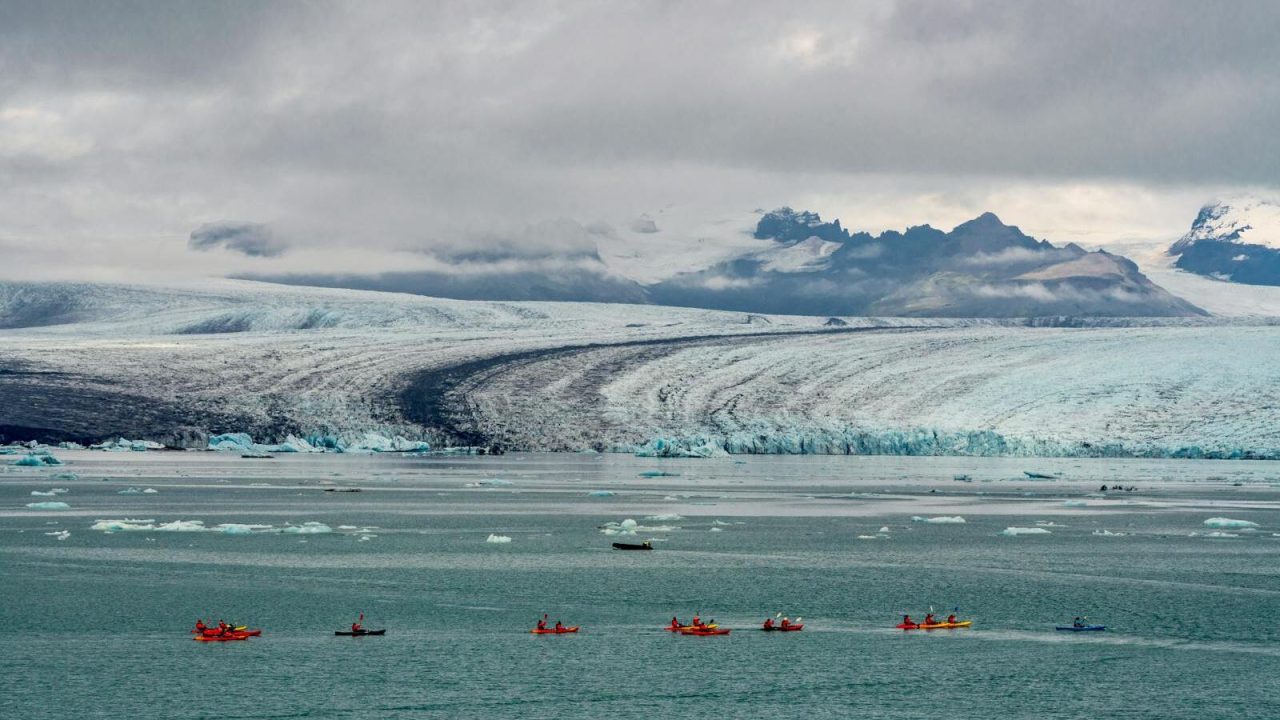
On day five, Mara reached Jökulsárlón Glacial Lagoon in southeast Iceland. The lagoon sits at the edge of Vatnajökull, Europe’s largest glacier by volume, covering roughly 8,100 square kilometers and containing about 10 percent of Iceland’s total landmass.
Icebergs calve from the glacier and drift slowly across the lagoon before washing out to sea. Some are the size of cars. Some are the size of houses. They are blue in a way that has no name in ordinary English — a deep, pressurized blue that forms only when ice has been compacted for hundreds of years and all air bubbles have been forced out.
“Imagine a place where dramatic landscapes of fire and ice coexist — where glaciers meet volcanic craters and geothermal springs bubble beside frozen tundra. Iceland is not a metaphor. It is a fact.”
— Goway Travel, describing Iceland’s appeal to first-time visitors
Mara sat at the lagoon’s edge for two hours without taking a single photograph. This surprised her. She had come to Iceland partly as a professional, hoping to build a portfolio. But at Jökulsárlón, the camera stayed in her bag. She was not sure she wanted to mediate the experience through a lens.
It was the first time in years she had sat with something beautiful without immediately trying to capture and share it.
The Night the Sky Moved
The Northern Lights had been the primary reason many of her friends urged her to go to Iceland in winter. She had managed her expectations carefully. Aurora forecasts are notoriously unreliable. Cloud cover, solar activity, and light pollution all conspire against the experience. She had read accounts of travelers who spent two weeks in Iceland and never saw a single flicker.
On her seventh night, parked on a gravel pullout near Vík with the engine off and the heater cooling, the sky opened. The Aurora Borealis began as a faint green smear on the northern horizon. Within twenty minutes it had spread across the entire sky in curtains of green, violet, and white that moved with a physical quality, as if the atmosphere itself were breathing.
She stood outside in minus eight degrees Celsius for ninety minutes. She took photographs. She also put the camera down several times and just looked. The display intensified around midnight and then faded slowly, the way a fire goes out rather than the way a light switches off.
She cried, which embarrassed her slightly when she wrote about it later. But she included it in the account anyway, because leaving it out would have been dishonest.
What She Skipped, and Why It Mattered
Mara had originally planned to visit the Blue Lagoon geothermal spa near Reykjavik, one of Iceland’s most visited attractions. She skipped it. Entry fees had risen to approximately $80 to $120 per person for basic access by early 2025, and every account she read described crowds, selfie sticks, and a resort atmosphere that felt disconnected from the raw Iceland she was seeking.
Instead, she found smaller, less-trafficked hot springs along the Ring Road, including the Seljavallalaug pool tucked into a valley on the south coast, which requires a 15-minute hike and costs nothing. The water was cooler and the facilities were minimal. It was also completely empty on a Tuesday morning in January, with snow on the surrounding hills and steam rising off the water into cold air.
The lesson she took from that choice was not about money. It was about the difference between visiting a place and actually being inside it.
Coming Home Changed, Not Fixed
Mara returned to Minneapolis on a Thursday in late January 2025, ten days after she had left. Her medical situation had not changed. Her bank account was $7,100 lighter. Her apartment was exactly as she had left it, slightly too warm and slightly too quiet.
What had changed was harder to quantify. She had spent ten days in a landscape that predated human concern entirely. The glaciers at Vatnajökull had been forming for roughly 2,500 years. The lava fields she had driven through were, in geological terms, practically newborn. None of it had required her presence or her anxiety to exist.
She did not come home with answers. She came home with a different relationship to the questions.
Her Iceland photographs, when she finally edited them three weeks later, were among the best work she had ever produced. But the two hours at Jökulsárlón, the ones with the camera in the bag, remain the part of the trip she thinks about most often. Some things are diminished by being recorded. Iceland taught her to notice which things those are.
The tectonic plates beneath the island are still moving, still pulling apart, still making room for something new. That process does not pause for visitors, or for anyone.
Frequently Asked Questions

You Might Also Like
West Godavari District Just Handed Over Land to Boost Its Tourism Future
A government decision to transfer strategically located land parcels to the Tourism Department in West…
Spain Now Joins Seven European Nations Welcoming UK Youth Groups Differently
For the first time since Brexit reshaped travel between the UK and Europe, a meaningful…
Allegiant Air’s Tax Day Bonus: 1,040 Points for Summer Routes
Allegiant Air's Tax Day 2026 promotion offers 1,040 bonus points for summer bookings. Here's what…
Leave a Reply