
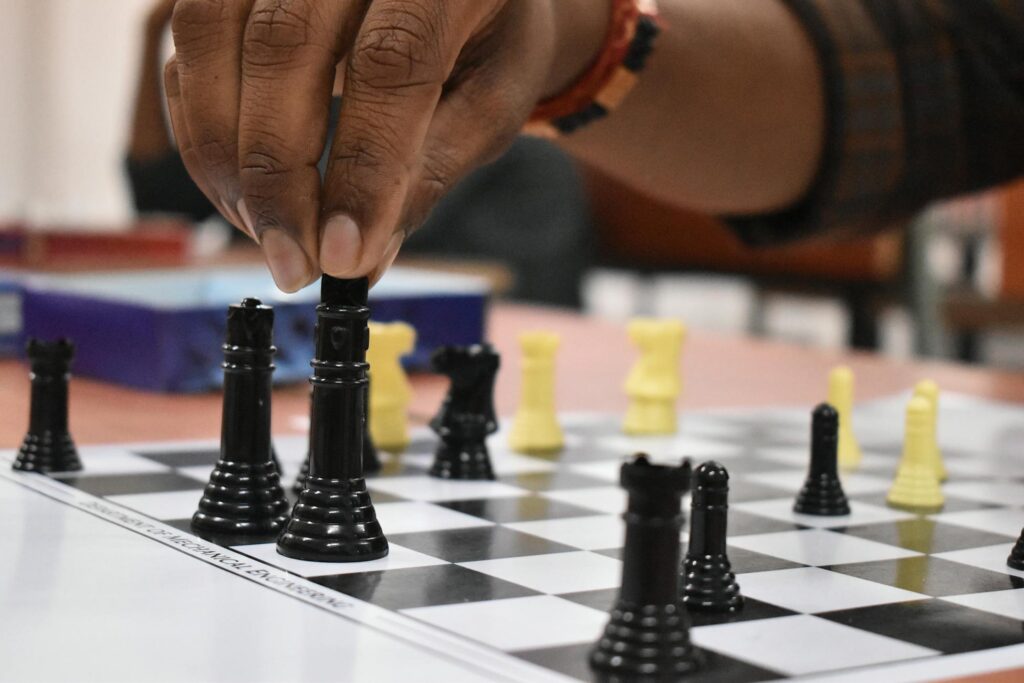
Sarah turned forty in a hospital waiting room. Not because she was sick, but because her mother was — and Sarah had been in that waiting room, metaphorically speaking, for thirty years. She spent her entire thirties feeling like life was happening to her rather than being directed by her choices. She’d taken the job because it was offered. Married because it felt like the next square on the board. Stayed because leaving seemed too complicated.
She wasn’t lazy. She wasn’t weak. She had simply never learned that she was the one holding the pieces.
That realization, when it finally arrived, felt less like an epiphany and more like grief.
The Moment the Metaphor Becomes Real
The idea that life resembles chess is not a new one. Benjamin Franklin wrote about it in 1779, arguing in his essay On the Morals of Chess that the game teaches “several very valuable qualities of the mind, useful in the course of human life.” He listed foresight, caution, and the ability to not despair when things go wrong.
But what Franklin intuited philosophically, modern psychology has since confirmed empirically. Life is not a series of random events strung together by luck and circumstance. It is a compounding sequence where each choice shapes the terrain of the next one, constraining some futures while opening others.
The question isn’t whether your moves matter. They do. The question is whether you’re making them consciously — or letting someone else play your game.
Locus of Control: The Hidden Architecture of Every Decision
In the 1950s and 60s, psychologist Julian Rotter developed the concept of locus of control: a framework describing whether people believe their lives are shaped primarily by their own actions or by external forces beyond their reach.
People with an internal locus of control believe their choices drive their outcomes. They study harder because they believe studying works. They leave bad relationships because they believe they deserve and can build better ones. They course-correct after failure rather than concluding the universe is simply against them.
People with an external locus of control experience life more like a passenger. Things happen to them. Success feels like luck. Failure feels like fate. The chess board exists, but someone else seems to be moving the pieces.
| Trait | Internal Locus of Control | External Locus of Control |
|---|---|---|
| Response to failure | Analyzes what to change | Attributes it to bad luck |
| Relationship patterns | Actively builds and repairs | Endures or exits passively |
| Career behavior | Seeks growth, advocates for self | Waits to be noticed or promoted |
| Anxiety levels | Consistently lower | Consistently higher |
| View of the future | Shapeable and directional | Unpredictable and threatening |
These aren’t personality quirks you’re born with. They’re learned orientations, often developed in childhood, and they can be changed. But first, you have to understand how the opening moves were played.
The Opening Game: Why Childhood Sets the Board
Chess grandmasters study opening moves with obsessive precision. The reason is stark: careless play in the first ten moves can make the rest of the game nearly unwinnable. The opening doesn’t determine everything, but it shapes what’s possible in every phase that follows.
In psychological terms, our opening game is childhood. Most of us didn’t choose those moves. We were handed a board mid-game, already partially set.
Consider what it means to grow up in a home where emotional volatility is the baseline. When a parent’s mood sets the tempo for every evening, children develop rapid, hypervigilant scanning systems. They learn to read the room before they learn to read a book. They develop emotional strategies not because they’re weak, but because those strategies kept them safe.
By age eight or nine, most children from unpredictable households have built what psychologists call a defensive schema: a set of assumptions about how relationships work, how much control they have, and how safe it is to want things. Those schemas don’t evaporate at eighteen. They run in the background like software, shaping every choice that feels, to the adult, like a free and independent decision.
A father who responds to volatility with extreme calm may be coping. But the child watching that dynamic may spend decades interpreting his stillness as absence, and later model their own emotional unavailability as a form of strength, when it is actually a move learned from the opening.
This is not about blame. It is about recognizing that the pieces were arranged before you understood you were playing.
The Mid-Game: Where Most People Live — and Where Change Is Possible
“Life is like a game of chess. To win you have to make a move. Knowing which move to make comes with insight and knowledge.”
— Allan Rufus
Most people live in what chess players call the mid-game: enough of the opening has unfolded to reveal the shape of things, but enough pieces remain on the board to genuinely influence the outcome. This is the territory of adulthood, and it is far more malleable than most people assume.
The problem is that passivity masquerades as patience. Drifting through a first marriage, staying in a career that fits like the wrong shoe, avoiding the hard conversation for the fourth year running — none of these feel like moves. They feel like non-events. But in chess, not moving is still a turn. And every turn you spend not playing is a turn your opponent, or your circumstances, plays for you.
Research on what psychologists call intentional living suggests that the shift from passive to active decision-making doesn’t require a personality transplant. It requires something more modest and more demanding: the willingness to notice when you’re reacting on autopilot versus choosing with awareness.
That noticing is itself a move. Often the most important one you’ll make all year.
When you face a difficult choice, do you pause to consider the long-term consequences before acting?
Are you aware of whose expectations or pressures are guiding your current path?
Do you regularly review your past decisions to learn from them — both the wins and the mistakes?
Do you feel that changing course now — even if uncomfortable — is something within your power to do?
Do you feel that changing course now — even if uncomfortable — is something within your power to do?
WAKE-UP CALL: Like Sarah in the waiting room, you may be letting life happen to you. Start by identifying one area where you feel stuck and ask: whose move was this really? Awareness is your first piece on the board.
STRATEGIC PLAYER: You are consciously directing your game. You think ahead, learn from experience, and own your choices. Keep refining your strategy — the best players never stop studying the board.
DEVELOPING PLAYER: You have self-awareness but need stronger follow-through. Practice translating reflection into deliberate action. Each small conscious move builds the habit of intentional living.
DEVELOPING PLAYER: You have self-awareness but need stronger follow-through. Practice translating reflection into deliberate action. Each small conscious move builds the habit of intentional living.
PARALYZED PAWN: You can see the pressures around you but feel powerless to move. Remember: even a pawn can cross the board and transform. Seek one small area where you can reclaim a single choice today.
The Endgame: Compounding Choices and the Weight of Pattern
In chess, the endgame is where patterns established twenty moves ago either pay off or collapse. Resources are scarce, the board is cleaner, and the consequences of earlier decisions become impossible to ignore.
In life, this tends to arrive somewhere in midlife, though it can appear earlier. The relationships you’ve maintained or neglected. The skills you built or deferred. The self-knowledge you pursued or avoided. These are not abstract concepts at fifty. They are the pieces you have left on the board.
What makes this genuinely hopeful, rather than terrifying, is the neuroscience of change. The brain retains neuroplasticity well into adulthood. The schemas built in childhood are durable but not permanent. Therapeutic work, meaningful relationships, and deliberate behavioral change have all been shown to shift the internal architecture of how people make decisions.
The person who spent their twenties believing life was random, who drifted through early adulthood collecting experiences without direction, is not locked in. The board is different than it was. Some moves are no longer available. But the game is not over, and the player has changed.
What Comes Next: Toward Conscious Play
The most dangerous psychological position is not pessimism or even anxiety. It is the quiet conviction that your choices don’t particularly matter, that things will unfold as they will, that effort and intention are somewhat beside the point.
That conviction feels like humility. It is actually a way of avoiding the weight of agency. If nothing is really in your control, you can’t be held responsible for the shape of your life. And you also can’t change it.
Reclaiming locus of control doesn’t mean believing you can control everything. It means accepting that your moves shape the terrain, even when the terrain fights back. It means asking, in any given moment: Is this a choice I’m making, or a default I’m accepting?
The Game No One Told You You Were Playing
Sarah eventually left the waiting room. Not all at once, and not without grief. But she began, in her early forties, to make choices she could name and own. She changed careers not because a door opened but because she built one. She entered her second relationship differently, not with certainty, but with awareness of her own patterns.
She still doesn’t control everything. No one does. The board is large and the other players are real. But she stopped being surprised to find herself exactly where her previous moves had taken her.
That shift, from bewilderment to authorship, is not a personality trait. It is a skill. And like any skill in chess, it begins with the willingness to study the game you’re already playing.
The pieces have been moving all along. The only question worth sitting with is whether you’ve been the one deciding where they go.
Frequently Asked Questions

You Might Also Like

The Quiet Magnetism: Why Room-Dominators Aren’t Extroverts
Psychology reveals that people who command attention in any room aren't extroverts — they use…

The Likable Stranger: Why Some People Can’t Let Anyone In
Psychology reveals that likable but unreachable people aren't commitment-phobic. They learned in childhood that being…

The Helper Who Had No One: Why Caretakers End Up Alone at 60
27% of adults over 60 have no close friends. Research shows many spent decades as…
Leave a Reply