
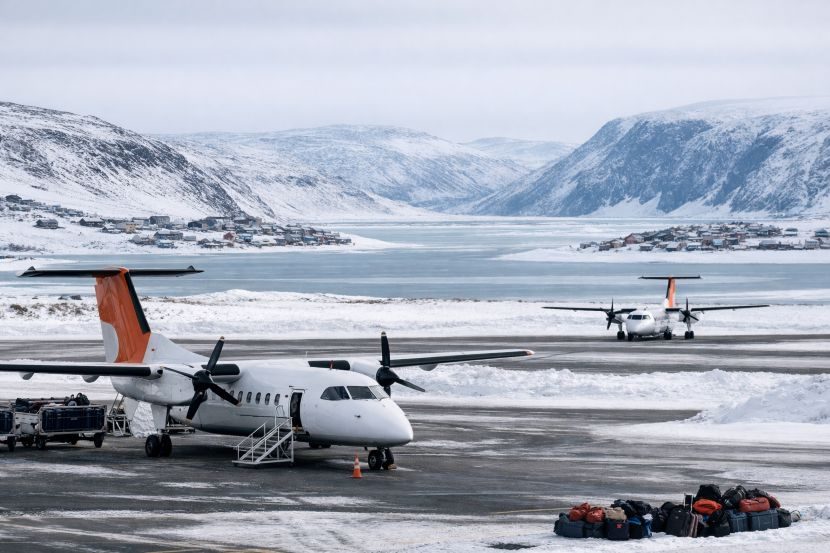
Four flights cancelled. Zero delays. And an 80% wipeout of the day’s scheduled service to one of Canada’s most remote communities — that’s the reality facing travellers trying to reach or leave Kangiqsujuaq, a northern Quebec village where air travel isn’t a convenience. It’s the only way in or out.
Air Inuit, the primary carrier serving Kangiqsujuaq, is at the centre of the disruption. All four cancellations reported were Air Inuit flights, leaving passengers from Montreal, Quebec City, and Toronto stranded or scrambling to rearrange plans with no alternative airline to turn to.
For a community this isolated, a single cancelled flight is a serious problem. Four in one day — representing the vast majority of scheduled service — is something else entirely. And while no delays were reported alongside the cancellations, the absence of partial service offers little comfort to those who needed to travel.
(function(){var wrp=document.getElementById(“paap_stat_69cac664f29918.53371245”);if(!wrp)return;var ids=[“paap_stat_69cac664f29918.53371245_c0″,”paap_stat_69cac664f29918.53371245_c1”];var dur=1800;function ease(t){return 1-Math.pow(1-t,3);}function anim(){ids.forEach(function(id){var el=document.getElementById(id);if(!el)return;var tgt=parseFloat(el.getAttribute(“data-target”))||0;var pfx=el.getAttribute(“data-prefix”)||””;var sfx=el.getAttribute(“data-suffix”)||””;var dec=parseInt(el.getAttribute(“data-decimals”))||0;var st=null;function step(ts){if(!st)st=ts;var p=Math.min((ts-st)/dur,1);var v=ease(p)*tgt;el.textContent=pfx+v.toFixed(dec)+sfx;if(p<1)requestAnimationFrame(step);}requestAnimationFrame(step);});}if("IntersectionObserver" in window){var obs=new IntersectionObserver(function(e){e.forEach(function(en){if(en.isIntersecting){anim();obs.disconnect();}});},{threshold:0.2});obs.observe(wrp);}else{anim();}})();
Why Kangiqsujuaq’s Air Links Matter More Than Most
Kangiqsujuaq sits in Nunavik, the vast northern region of Quebec that stretches above the 55th parallel. There are no roads connecting it to southern Canada. No rail lines. No ferry routes that operate year-round. When flights stop, the community is effectively cut off.
This geographic reality puts enormous pressure on carriers like Air Inuit to maintain reliable schedules. The airline serves not just travellers and tourists, but residents who depend on flights for medical appointments, family visits, and the delivery of essential goods. A cancellation isn’t just an inconvenience — it can mean missed healthcare, delayed supplies, and disrupted livelihoods.
The local tourism industry also feels the impact directly. Kangiqsujuaq is known for its striking Arctic landscape and attracts visitors interested in northern wilderness experiences. When flights are cancelled at this scale, tour operators, guides, and accommodation providers all absorb the consequences of passengers who never arrive.
What the Numbers Actually Show
The scale of today’s disruption becomes clearer when laid out plainly. Air Inuit operates as the sole commercial airline serving Kangiqsujuaq, which means there is no competing carrier to absorb overflow passengers or offer alternative routing.
| Metric | Detail |
|---|---|
| Total flights cancelled | 4 |
| Total flights delayed | 0 |
| Percentage of scheduled flights cancelled | 80% |
| Airline responsible for all cancellations | Air Inuit |
| Traveller origin cities affected | Montreal, Quebec City, Toronto |
| Community location | Northern Quebec, Canada |
What stands out in the data is the completeness of the failure. No flights were merely delayed — they were cancelled outright. And with 80% of the day’s schedule eliminated, the remaining 20% of flights, if any operated at all, could not meaningfully compensate for the disruption passengers experienced.
Who Gets Hit Hardest When Flights Disappear
The passengers most immediately affected are those who booked travel from Montreal, Quebec City, and Toronto — three of Canada’s major southern hubs — with Kangiqsujuaq as their destination. For travellers coming from those cities, rebooking options are severely limited when there is only one airline serving the route.
But the impact ripples further than stranded passengers. Communities like Kangiqsujuaq rely on consistent air connectivity for basic functioning. Healthcare workers travelling north, families returning home, and commercial shipments all move through the same narrow pipeline of scheduled flights. When that pipeline collapses — even for a single day — the effects compound quickly.
Tourism operators face a particularly acute problem. Unlike a delayed hotel stay or a rescheduled meeting, wilderness travel experiences often have narrow windows tied to weather, seasons, and guide availability. A cancelled flight doesn’t just push a trip back by a day — it can cancel the experience entirely.
Observers familiar with remote northern communities have long noted that the lack of redundancy in air service creates a structural vulnerability. When a single carrier controls all access to a community and that carrier experiences operational difficulties, there is no fallback. Passengers have nowhere to turn.
What Happens Next for Affected Travellers
For passengers caught in today’s disruptions, the immediate priority is contacting Air Inuit directly to understand rebooking options. Because the airline operates as the sole carrier on these routes, any resolution will have to come through Air Inuit itself — there are no codeshare partners or competing airlines that can step in.
The broader question of whether these cancellations represent a one-day anomaly or a sign of longer-term scheduling challenges for the airline remains open.
For travellers planning future trips to Kangiqsujuaq, the events of today serve as a practical reminder that itineraries to remote northern communities require flexibility. Building in buffer days, purchasing travel insurance that covers cancellations, and staying in close contact with Air Inuit before departure are prudent steps given the nature of service to this region.
Whether Air Inuit releases a formal explanation for today’s cancellations — or commits to a timeline for resolving the operational challenges behind them — has not yet been confirmed.
Frequently Asked Questions
How many flights were cancelled at Kangiqsujuaq?
Four flights were cancelled, which represents 80% of the day’s scheduled service to the community.
Which airline was responsible for the cancellations?
All four cancellations were by Air Inuit, the primary and sole commercial carrier serving Kangiqsujuaq.
Which cities were affected by the Air Inuit cancellations?
Travellers from Montreal, Quebec City, and Toronto were among those affected by the disruptions.
Were any flights delayed rather than cancelled?
No delays were reported — the disruptions consisted entirely of outright cancellations with no partial service offered.
Is there another airline travellers can use to reach Kangiqsujuaq?
Air Inuit is confirmed as the primary airline serving the community, and no alternative carrier options were identified in available information.
Why are flight cancellations especially serious for Kangiqsujuaq?
Kangiqsujuaq has no road or rail connections to the rest of Canada, making air travel the community’s only reliable link to southern cities and essential services.


Leave a Reply