
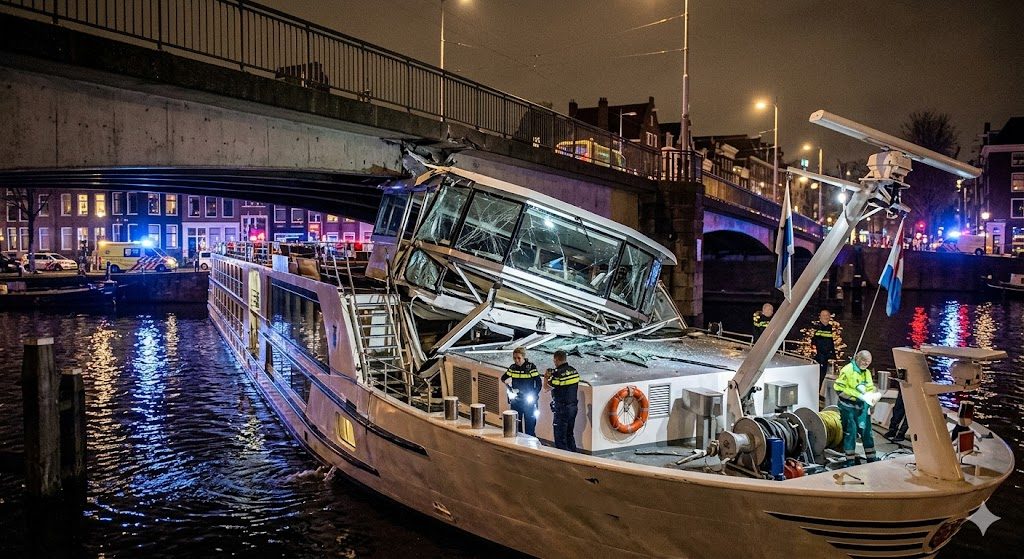
Two hundred and eighty travelers were aboard the luxury river cruise ship A-Rosa Sena when it struck a bridge in Amsterdam late on a Tuesday night, turning what was meant to be a dream Dutch holiday into a frightening ordeal of shattered glass and sudden chaos.
The incident happened at 9:30 p.m. as the vessel was departing Amsterdam. The A-Rosa Sena, a 135-meter-long ship designed for European river tourism, collided with the Amsterdamsebrug bridge. The Dutch Ministry of Infrastructure and Water Management, known as Rijkswaterstaat, confirmed the collision. The damage was immediate and severe — the ship’s glass wheelhouse structure was crushed on impact.
For the passengers on board, many of whom had saved for months to take this trip, the sound of that impact marked the end of their holiday before it had truly begun.
What Went Wrong on the Amsterdam River That Night
The A-Rosa Sena is not an ordinary vessel. It is built with a retractable wheelhouse — a feature specifically engineered to lower the ship’s profile when passing under low bridges, which are a routine challenge on European river routes. Amsterdam’s canal and river network is famously lined with historic, low-clearance bridges.
On the night of the incident, however, the wheelhouse was still in the raised position when the ship attempted to pass under the Amsterdamsebrug. The result was a direct, forceful collision with the bridge span. The glass structure of the wheelhouse bore the brunt of the impact and was destroyed.
Rijkswaterstaat confirmed the details of the collision. Investigators will now need to determine why the wheelhouse was not lowered before the transit — a question with serious implications for the ship’s crew and the operator.
Key Facts About the A-Rosa Sena Collision
Here is what has been confirmed about the incident so far:
- The ship involved was the A-Rosa Sena, a luxury European river cruise vessel
- The vessel is 135 meters long
- It was carrying 280 passengers at the time of the collision
- The collision occurred at 9:30 p.m. as the ship departed Amsterdam
- The ship struck the Amsterdamsebrug bridge
- The A-Rosa Sena is fitted with a retractable wheelhouse designed for low bridge clearances
- The wheelhouse was in the raised position at the time of impact
- The glass wheelhouse structure was crushed by the collision
- The incident was confirmed by Rijkswaterstaat, the Dutch Ministry of Infrastructure and Water Management
| Detail | Confirmed Information |
|---|---|
| Ship Name | A-Rosa Sena |
| Ship Length | 135 meters |
| Passengers on Board | 280 |
| Time of Collision | 9:30 p.m. |
| Bridge Struck | Amsterdamsebrug |
| Safety Feature Involved | Retractable wheelhouse (not lowered) |
| Damage Reported | Wheelhouse glass structure crushed |
| Confirming Authority | Rijkswaterstaat |
The Human Cost: What 280 Passengers Actually Lost
Numbers and technical details only tell part of this story. Behind the confirmed facts are hundreds of people who experienced something genuinely traumatic. Passengers described hearing a violent “thump” — a single moment that ended their holiday and, for many, shook their confidence in river travel entirely.
River cruising has grown into one of Europe’s most popular premium travel experiences. Travelers often plan these trips far in advance, budgeting carefully for what they expect to be a relaxing, scenic journey through some of the continent’s most historic waterways. Amsterdam is frequently the jewel in the crown of such itineraries — a city of canals, bridges, and evening lights that looks extraordinary from the water.
For the 280 aboard the A-Rosa Sena, that promise collapsed the moment the ship hit the Amsterdamsebrug. Beyond the physical damage to the vessel, the emotional toll on passengers — particularly families and couples who had planned and saved for this trip — is significant and real.
The incident also raises broader questions about safety protocols on river cruise vessels operating in urban waterways. The retractable wheelhouse exists precisely to prevent this kind of collision. When that system is not used correctly, the consequences fall squarely on the passengers.
What Happens Now for the Ship, the Passengers, and the Investigation
With the A-Rosa Sena damaged and its wheelhouse destroyed, the immediate future for the ship and its passengers remains uncertain. Investigations by Dutch authorities, including Rijkswaterstaat, are expected to focus on why the retractable wheelhouse was not lowered before the vessel attempted to pass under the Amsterdamsebrug.
For the 280 passengers, the cruise was effectively over the moment the collision happened. Whether they received alternative arrangements, refunds, or onward transportation has not yet been confirmed in available reporting. The ship’s operator, A-Rosa, will also face scrutiny over crew procedures and safety compliance.
European river cruise operators are generally required to follow strict navigation protocols in urban waterways, particularly in cities like Amsterdam where historic bridges create regular clearance challenges. How the wheelhouse came to be in the raised position — whether through crew error, a mechanical issue, or a procedural failure — is the central question investigators will need to answer.
For travelers considering river cruises in Europe, this incident serves as a stark reminder that even modern, purpose-built vessels are not immune to serious accidents when safety systems are not properly deployed.
Frequently Asked Questions
What ship was involved in the Amsterdam bridge collision?
The ship was the A-Rosa Sena, a 135-meter luxury European river cruise vessel.
How many passengers were on board when the collision happened?
There were 280 passengers on board the A-Rosa Sena at the time of the incident.
What caused the A-Rosa Sena to hit the Amsterdamsebrug bridge?
The ship’s retractable wheelhouse, which is designed to lower for bridge clearances, remained in the raised position during the transit, causing it to strike the bridge span.
What was damaged in the collision?
The glass structure of the ship’s wheelhouse was crushed on impact with the Amsterdamsebrug bridge.
Which authority confirmed the incident?
Rijkswaterstaat, the Dutch Ministry of Infrastructure and Water Management, confirmed the collision and its circumstances.
What time did the collision occur?
The collision happened at 9:30 p.m. as the A-Rosa Sena was departing Amsterdam.


Leave a Reply