
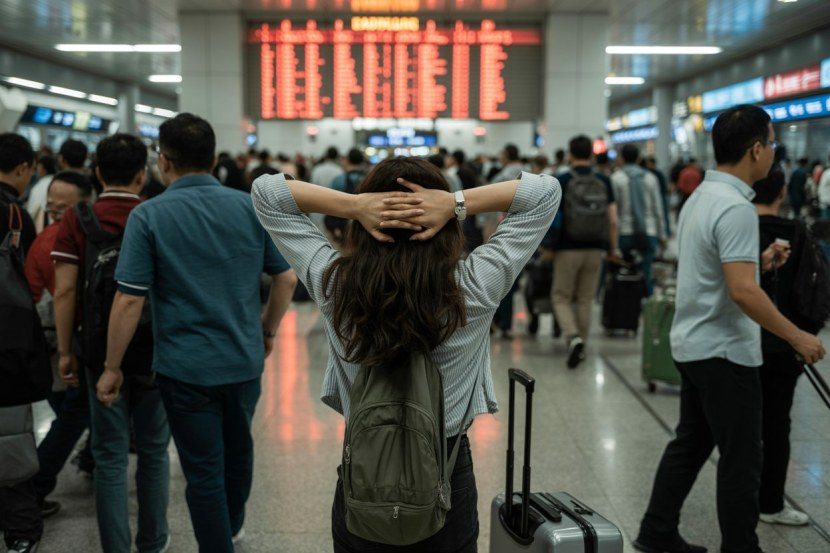
More than 2,550 flights across Asia and the Middle East were delayed or cancelled on March 26, 2026, leaving thousands of passengers stranded at airports from Bangkok to Tokyo, Beijing to Dubai. The disruption hit some of the world’s busiest aviation hubs simultaneously, creating cascading chaos that affected major carriers including AirAsia, Japan Airlines, Emirates, and Air China.
The scale of the breakdown is hard to overstate. With 2,468 delays and 103 cancellations recorded across multiple countries in a single day, travellers faced hours of uncertainty at terminals that were simply not equipped to absorb disruption of this magnitude. Families on holiday, business travellers, and transit passengers all found themselves caught in the same gridlock.
Whether you’re planning travel through any of these regions soon, or you’re trying to understand what happened to someone you know who was flying today, here’s what the data shows.
(function(){var wrp=document.getElementById(“paap_stat_69c4b67702c6b3.58999989”);if(!wrp)return;var ids=[“paap_stat_69c4b67702c6b3.58999989_c0″,”paap_stat_69c4b67702c6b3.58999989_c1”];var dur=1800;function ease(t){return 1-Math.pow(1-t,3);}function anim(){ids.forEach(function(id){var el=document.getElementById(id);if(!el)return;var tgt=parseFloat(el.getAttribute(“data-target”))||0;var pfx=el.getAttribute(“data-prefix”)||””;var sfx=el.getAttribute(“data-suffix”)||””;var dec=parseInt(el.getAttribute(“data-decimals”))||0;var st=null;function step(ts){if(!st)st=ts;var p=Math.min((ts-st)/dur,1);var v=ease(p)*tgt;el.textContent=pfx+v.toFixed(dec)+sfx;if(p<1)requestAnimationFrame(step);}requestAnimationFrame(step);});}if("IntersectionObserver" in window){var obs=new IntersectionObserver(function(e){e.forEach(function(en){if(en.isIntersecting){anim();obs.disconnect();}});},{threshold:0.2});obs.observe(wrp);}else{anim();}})();
Where the Disruption Hit Hardest
The breakdown wasn’t confined to one country or one airline. It spread across six nations — Thailand, Japan, China, the UAE, India, and Malaysia — and struck airports of vastly different sizes and functions all at once.
Mumbai’s Chhatrapati Shivaji International Airport recorded the highest single-airport delay count, with 283 delays and 10 cancellations. Dubai International, one of the world’s most trafficked airports, logged 124 delays and 20 cancellations — the highest cancellation number among the airports reported. Bangkok’s Suvarnabhumi Airport was not far behind, with 215 delays and 11 cancellations.
Japan was particularly hard hit across multiple airports. Tokyo Haneda recorded 232 delays. Narita International saw 140 delays and 4 cancellations. Fukuoka Airport added 116 delays and 4 cancellations. Even smaller facilities like Chubu Centrair International (44 delays, 4 cancellations) and Nagoya Airfield (2 delays, 6 cancellations) were affected.
Abu Dhabi International Airport reported 76 delays and 10 cancellations, adding further pressure to UAE airspace already strained by the Dubai figures.
Airport-by-Airport Breakdown: The Numbers
| Airport | Country | Delays | Cancellations |
|---|---|---|---|
| Mumbai Chhatrapati Shivaji International | India | 283 | 10 |
| Tokyo Haneda | Japan | 232 | — |
| Suvarnabhumi Airport Bangkok | Thailand | 215 | 11 |
| Narita International | Japan | 140 | 4 |
| Dubai International | UAE | 124 | 20 |
| Fukuoka Airport | Japan | 116 | 4 |
| Abu Dhabi International | UAE | 76 | 10 |
| Chubu Centrair International | Japan | 44 | 4 |
| Nagoya Airfield | Japan | 2 | 6 |
(function(){function loadChartJs(cb){if(window.Chart){cb();return;}var s=document.createElement(“script”);s.src=”https://cdn.jsdelivr.net/npm/chart.js@4.4.0/dist/chart.umd.min.js”;s.onload=cb;document.head.appendChild(s);}function initChart(){var cv=document.getElementById(“paap_chart_69c4b67702cdc0.79669773”);if(!cv)return;var dv=[“283 delays”,”232 delays”,”215 delays”,”140 delays”,”124 delays”,”116 delays”,”76 delays”];new Chart(cv,{type:”bar”,data:{labels:[“Mumbai Chhatrapati Shivaji”,”Tokyo Haneda”,”Bangkok Suvarnabhumi”,”Narita International”,”Dubai International”,”Fukuoka Airport”,”Abu Dhabi International”],datasets:[{data:[283,232,215,140,124,116,76],backgroundColor:[“#3b82f6″,”#10b981″,”#f59e0b”,”#ef4444″,”#8b5cf6″,”#3b82f6″,”#10b981″],borderRadius:6,borderSkipped:false}]},options:{indexAxis:”y”,responsive:true,maintainAspectRatio:false,animation:{duration:1200,easing:”easeOutQuart”},plugins:{legend:{display:false},tooltip:{callbacks:{label:function(ctx){return dv[ctx.dataIndex]||ctx.formattedValue;}}}},scales:{x:{grid:{color:”#e5e7eb”},ticks:{color:”#6b7280″}},y:{grid:{display:false},ticks:{color:”#1a1a1a”,font:{weight:600}}}}}});}var cv=document.getElementById(“paap_chart_69c4b67702cdc0.79669773”);if(!cv)return;if(“IntersectionObserver” in window){var obs=new IntersectionObserver(function(e){e.forEach(function(en){if(en.isIntersecting){loadChartJs(initChart);obs.disconnect();}});},{threshold:0.1});obs.observe(cv);}else{loadChartJs(initChart);}})();
Who Got Caught in the Chaos
The airlines disrupted read like a who’s who of Asian and Middle Eastern aviation. AirAsia, one of the region’s dominant budget carriers and a major connector between Southeast Asian cities, was among those affected — meaning that budget-conscious travellers with no flexibility in their bookings faced the sharpest consequences.
Japan Airlines, a full-service carrier with a strong reputation for punctuality, was also caught in the disruption across Japan’s multiple affected airports. Emirates and Air China — serving two of the world’s most significant hub airports in Dubai and Beijing respectively — were likewise named among the disrupted carriers.
For passengers in transit, the situation was especially difficult. Someone flying Dubai to Tokyo with a connection in Bangkok, for example, could have faced delays at every single leg of their journey. Transit passengers often have the fewest options when disruption hits, since they are far from home airports and may not qualify for the same rebooking protections as origin-country travellers.
Travellers with tight connections, time-sensitive business commitments, medical appointments, or cruise departures would have been among the worst affected. Hotel bookings, ground transport, and onward arrangements all become uncertain the moment a flight is delayed by several hours — and many of today’s disruptions stretched well beyond that threshold.
What Travellers Should Do Right Now
If you have upcoming travel through any of the affected airports — Bangkok, Tokyo, Dubai, Abu Dhabi, Mumbai, or airports across Japan — it’s worth monitoring your flight status closely in the days ahead. Disruptions of this scale can create ripple effects that last beyond the initial incident, as airlines work to reposition aircraft and crews.
Passengers who were affected on March 26 should contact their airline directly to understand rebooking rights and any compensation entitlements. The rules vary significantly by country — EU261 protections do not apply in most of Asia, meaning travellers flying through Asian hubs may have more limited automatic rights than those flying through European airports.
Travel insurance holders should document all delays and cancellations carefully, keeping boarding passes, delay notifications, and any hotel or meal receipts that resulted from the disruption. These records will be essential for any claim.
Airlines affected — including AirAsia, Japan Airlines, Emirates, and Air China — have not yet issued public statements specifically addressing the full scale of today’s disruption, and the root causes across all six countries have not been confirmed in the available reporting.
Frequently Asked Questions
How many flights were affected across Asia on March 26, 2026?
A total of 2,468 flights were delayed and 103 were cancelled, affecting airports across Thailand, Japan, China, the UAE, India, and Malaysia.
Which airport recorded the most delays?
Mumbai’s Chhatrapati Shivaji International Airport recorded the highest delay count, with 283 delays and 10 cancellations.
Which airport had the most cancellations?
Dubai International Airport reported the highest number of cancellations, with 20 flights cancelled alongside 124 delays.
Which airlines were disrupted?
Confirmed disrupted carriers include AirAsia, Japan Airlines, Emirates, and Air China, among others operating across the affected hubs.
What caused the widespread disruptions?
The specific causes of the disruptions across all six countries have not yet been confirmed in available reporting.
Do passengers have compensation rights for these delays?
Compensation entitlements vary by country and airline; passengers should contact their carrier directly, as automatic compensation protections differ significantly across Asian and Middle Eastern aviation jurisdictions.



Leave a Reply