
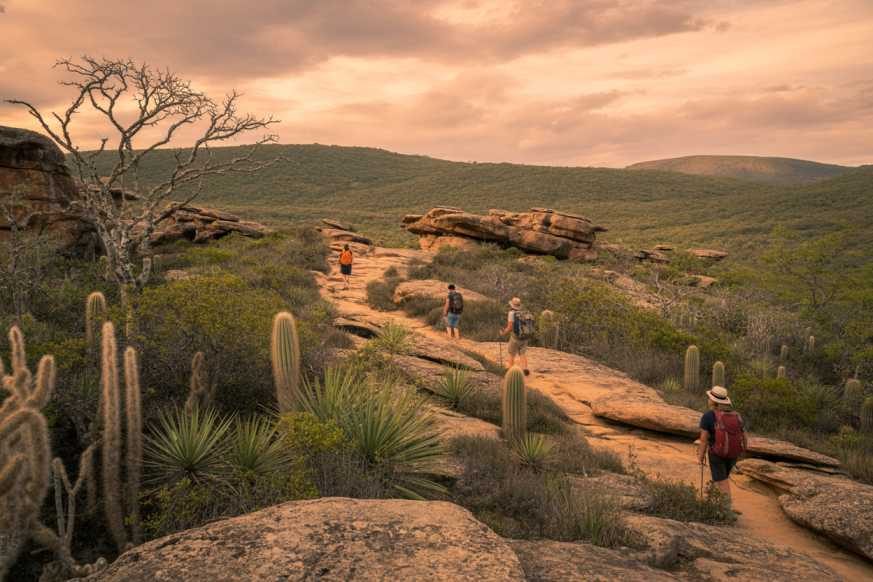
A 180-kilometre trail through one of the most overlooked ecosystems on Earth — that’s what Brazil has just opened to the world. The Trilha Caminhos da Ibiapaba is the country’s newest long-distance hiking route, and it carries a distinction no other trail in the world can claim: it is the first long-distance route to cross the Caatinga biome.
For most international travellers, the Caatinga barely registers on the radar. The Amazon gets the headlines, the Pantanal draws the wildlife photographers, and the Atlantic Rainforest earns its conservation campaigns. But the Caatinga — a vast, semi-arid scrubland found only in Brazil — has quietly been waiting for its moment. That moment may have arrived.
The new trail connects the northeastern Brazilian states of Piauí and Ceará, threading through landscapes that shift dramatically as you walk. It’s not just a hike. It’s a journey through three distinct ecosystems, a living demonstration of Brazil’s ecological complexity, and a deliberate bet on sustainable tourism as a tool for both conservation and community development.
The Trail That Crosses Three Ecosystems in One Journey
What makes the Trilha Caminhos da Ibiapaba genuinely unusual isn’t just its length. Along the 180 km route, hikers pass through not one but three separate biomes: the Caatinga, the Atlantic Rainforest, and the Cerrado. That kind of ecological range within a single continuous trail is rare anywhere in the world.
The Caatinga itself is a biome unique to Brazil — a semi-arid region of thorny vegetation, dry riverbeds, and extraordinary wildlife adapted to survive harsh conditions. It’s often described as one of the most biodiverse dry forests on the planet, yet it receives far less international attention and conservation funding than Brazil’s more famous ecosystems.
By routing the trail through the Caatinga and connecting it to the Atlantic Rainforest and Cerrado, the initiative creates something rare in adventure travel: a single route where the landscape genuinely transforms around you. Travellers aren’t just walking through one environment — they’re watching ecosystems transition in real time.
Officials have framed this as more than a tourism product. The trail is described as a sustainable tourism initiative designed to combine biodiversity conservation with immersive travel, ensuring that visitor activity contributes to environmental protection rather than undermining it.
What the Route Actually Looks Like
| Trail Feature | Detail |
|---|---|
| Trail Name | Trilha Caminhos da Ibiapaba |
| Total Length | 180 kilometres |
| States Connected | Piauí and Ceará (northeastern Brazil) |
| Ecosystems Crossed | Caatinga, Atlantic Rainforest, Cerrado |
| Trail Distinction | First long-distance trail through the Caatinga biome |
| Primary Purpose | Sustainable tourism, biodiversity conservation, community development |
The trail’s location in northeastern Brazil is also significant from a regional development perspective. This part of the country has historically attracted fewer international visitors than the south or the Amazon basin. A flagship long-distance hiking route gives the region a concrete draw for adventure travellers and nature enthusiasts who are actively looking for experiences off the beaten path.
Why This Matters Beyond the Hiking Community
The launch of this trail sits inside a broader shift in how Brazil is positioning itself as a travel destination. The country has been deliberately leaning into eco-conscious travel — the kind of tourism where the visitor experience and environmental protection reinforce each other rather than pulling in opposite directions.
That approach matters because the Caatinga has long been underfunded in conservation terms. Greater visibility through tourism can generate local economic activity that gives communities a direct financial stake in protecting the biome rather than clearing it. When the people living alongside a landscape benefit from its preservation, the conservation case becomes a practical one, not just an ethical argument.
Adventure travellers and long-distance hikers are also a particularly desirable tourism demographic — they tend to stay longer, spend more locally, and seek out smaller, community-based services rather than large resort infrastructure. A well-managed long-distance trail can distribute economic benefit along its entire length, not just concentrate it at a single gateway town.
Supporters of the initiative argue that this kind of trail infrastructure also strengthens Brazil’s standing as a serious destination for global nature travel, putting the country’s lesser-known ecosystems on the same map as iconic hiking routes in Patagonia, New Zealand, or the European Alps.
The Caatinga Has Been Waiting for This Kind of Attention
It’s worth pausing on what the Caatinga actually is, because most people — even seasoned travellers — couldn’t describe it. Found exclusively within Brazil, it covers a significant portion of the country’s northeastern interior. The biome is defined by its semi-arid climate, its resilient and often thorny plant life, and wildlife that has evolved remarkable adaptations to survive seasonal drought.
It is also, by most ecological measures, deeply threatened. Agricultural expansion, charcoal production, and overgrazing have degraded large portions of the biome over decades. A long-distance hiking trail that draws international visitors and attaches economic value to the intact landscape is one practical response to that pressure.
The trail’s integration with the Atlantic Rainforest and Cerrado — two other ecologically significant and threatened Brazilian biomes — means the route also tells a larger story about Brazil’s environmental diversity and the stakes involved in protecting it.
What Comes Next for the Trail and the Region
The trail has been launched as part of Brazil’s broader push toward sustainable and nature-based tourism. While specific details about infrastructure, guided tour operators, or phased development were not confirmed in the available source material, the initiative is framed as a long-term investment in both ecological preservation and regional tourism development.
For travellers considering the route, northeastern Brazil’s Piauí and Ceará states offer a starting point for planning — though travellers are advised to seek current logistical information closer to their intended visit, as trail services and access points may continue to develop in the months following the launch.
Frequently Asked Questions
What is the Trilha Caminhos da Ibiapaba?
It is a newly launched 180-kilometre long-distance hiking trail in northeastern Brazil, connecting the states of Piauí and Ceará.
What makes this trail historically significant?
It is the first long-distance trail to cross the Caatinga biome, a unique ecosystem found only in Brazil.
How many ecosystems does the trail pass through?
The trail crosses three ecosystems: the Caatinga, the Atlantic Rainforest, and the Cerrado.
What is the purpose behind building the trail?
The trail was developed as a sustainable tourism initiative aimed at combining biodiversity conservation with immersive travel experiences and supporting community development.
Where exactly is the trail located?
The trail runs through the northeastern Brazilian states of Piauí and Ceará.
Is there confirmed information about guided tours or facilities along the route?
Specific details about trail infrastructure or tour operators have not yet been confirmed in available reporting — travellers should check with local tourism authorities closer to their visit.



Leave a Reply