
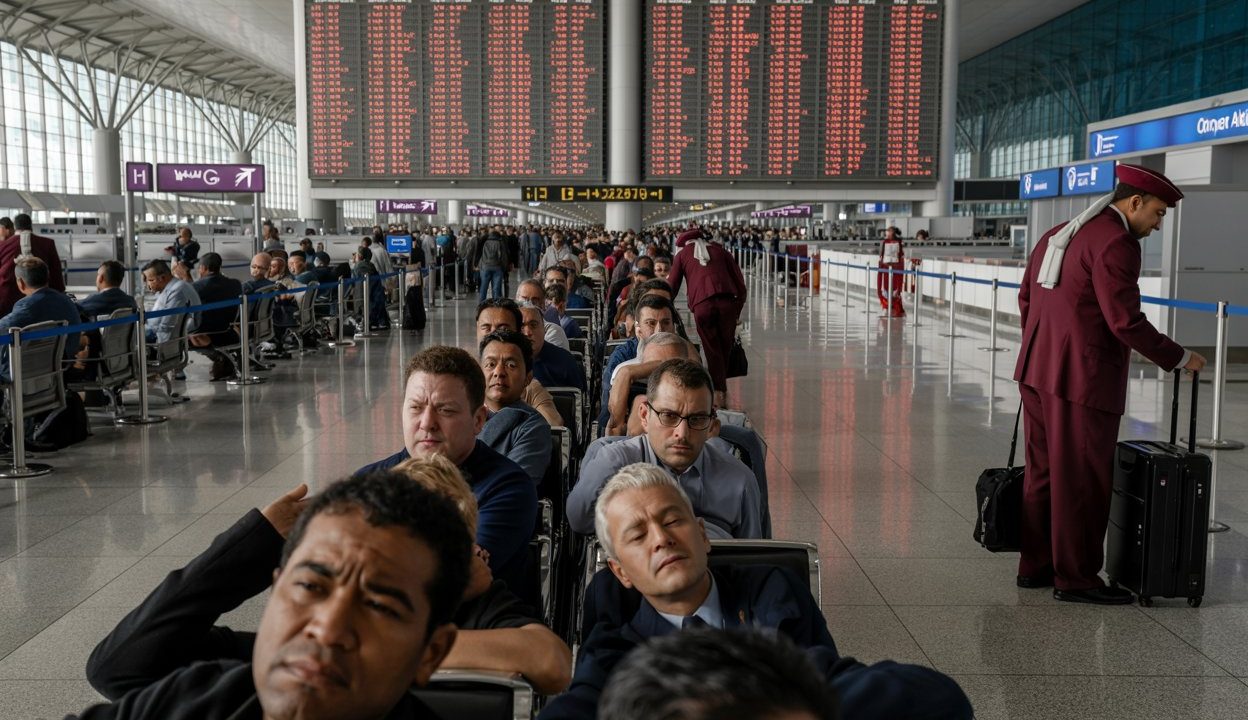
More than 100 flights delayed and 8 outright cancelled in a single day — that’s the scale of disruption that hit Baltimore/Washington International Thurgood Marshall Airport (BWI) this week, leaving hundreds of passengers stranded at terminal gates with few answers and rapidly changing departure boards.
The chaos touched nearly every major carrier operating out of BWI, including American Airlines, Delta, and Southwest, and rippled across some of the country’s busiest air corridors — routes connecting Baltimore to New York, Chicago, Orlando, and other major cities.
For travelers who had booked family vacations, planned business meetings, or were counting on connecting flights to get them home, the disruption meant hours of waiting, frantic calls to airline customer service lines, and last-minute scrambles to rebook.
What Happened at BWI This Week
BWI, one of the primary airports serving the Washington D.C. and Baltimore metro region, became the center of a significant travel breakdown that unfolded across multiple airlines and dozens of routes simultaneously.
According to confirmed reports, 101 flights were delayed and 8 flights were cancelled during the disruption period. Passengers found themselves navigating a terminal environment defined by shifting flight boards, long queues, and limited real-time communication from airlines and airport staff about what was causing the delays or when flights would resume normal operations.
Airlines affected included some of the highest-traffic carriers in the United States. The breadth of disruption — spanning multiple airlines rather than being isolated to one — suggests the problems were not carrier-specific but likely tied to broader operational or environmental factors affecting the airport as a whole.
Which Airlines and Routes Were Hit Hardest
The disruption was widespread rather than concentrated, touching the major carriers that collectively handle the bulk of BWI’s daily passenger volume.
| Airlines Affected | Routes Disrupted | Total Flights Delayed | Total Flights Cancelled |
|---|---|---|---|
| American Airlines | Multiple, including major city pairs | 101 (combined across all carriers) | 8 (combined across all carriers) |
| Delta | Multiple, including major city pairs | ||
| Southwest | Multiple, including major city pairs | ||
| Additional carriers | Multiple routes |
Among the routes most visibly affected were flights connecting BWI to New York, Chicago, and Orlando — three of the busiest destination corridors from the Baltimore-Washington market. These routes handle high volumes of both leisure and business travelers, which means delays on these corridors tend to produce outsized ripple effects on connecting itineraries further down the line.
- New York — a key short-haul business and commuter route
- Chicago — a major hub connection point for onward domestic and international travel
- Orlando — one of the country’s top leisure and family vacation destinations
- Additional major cities also reported disruptions
What This Meant for Real Passengers on the Ground
The human cost of an event like this is easy to understate when you’re looking at numbers. But behind each of those 101 delayed flights is a gate full of frustrated people — families with children trying to reach theme parks, professionals trying to make it to meetings, and travelers attempting to connect to international departures they now risk missing entirely.
For passengers whose flights were cancelled outright, the options are typically limited and rarely convenient: rebook on the next available flight (which may be a day away on busy routes), accept a refund and find alternative transport, or try to reroute through a different airport entirely.
Those caught in delays face a different but equally exhausting experience — hours of uncertainty, draining phone batteries, airport food costs, and the constant anxiety of watching a departure time push back again and again without a clear endpoint.
BWI airport authorities and airlines were reported to be working to manage the situation, but the sheer volume of affected flights — 109 total when delays and cancellations are combined — made rapid resolution difficult for all carriers involved.
Why BWI Disruptions Carry Outsized Impact
Baltimore/Washington International Thurgood Marshall Airport occupies a unique position in the mid-Atlantic travel ecosystem. It serves not just Baltimore but also a significant portion of the Washington D.C. metro area, functioning as a critical alternative to Reagan National and Dulles International airports for millions of travelers.
Southwest Airlines, in particular, has historically maintained one of its largest operational footprints at BWI, making it especially sensitive to any disruption at the airport. When Southwest experiences cascading delays at a hub-level station, the effects can travel across the carrier’s entire point-to-point network — affecting passengers in cities far removed from Maryland.
Similarly, delays on American Airlines and Delta routes out of BWI affect connecting passengers at major hubs like Dallas-Fort Worth, Atlanta, and Chicago O’Hare, compounding the disruption well beyond the airport’s gates.
What Travelers Should Do If They’re Affected
If you were caught in the BWI disruption — or if you have upcoming travel through the airport and are concerned — there are practical steps worth taking now.
- Check your airline’s app directly for real-time flight status rather than relying solely on airport departure boards
- Contact your airline proactively if your flight was cancelled — rebooking options can disappear quickly on high-demand routes
- Document all expenses incurred due to delays or cancellations, including meals and accommodation — many airlines have policies covering these costs in certain circumstances
- Review your travel insurance policy if you have one, as trip interruption coverage may apply
- Monitor the FAA’s real-time flight delay information if you have upcoming BWI travel to stay ahead of any ongoing issues
Frequently Asked Questions
How many flights were affected at BWI during this disruption?
A total of 101 flights were delayed and 8 flights were cancelled, affecting hundreds of passengers across multiple airlines.
Which airlines were disrupted at BWI?
American Airlines, Delta, and Southwest were among the carriers confirmed to be affected, along with additional airlines operating at the airport.
Which destinations were most impacted by the BWI delays?
Routes to New York, Chicago, and Orlando were among those specifically identified as disrupted during the event.
What caused the delays and cancellations at BWI?
The specific cause of the disruptions has not been confirmed in the available reporting. Passengers are advised to check directly with their airline for flight-specific information.
Can passengers get compensation for the delays or cancellations?
This depends on the airline’s policy and the cause of the disruption. Passengers whose flights were cancelled should contact their carrier directly to understand rebooking and compensation options.
Is BWI back to normal operations?
This has not yet been confirmed in the available reporting. Travelers with upcoming BWI flights should monitor their airline’s app and the airport’s official channels for current status updates.


Leave a Reply