

In Jackson, Mississippi — population 153,701, median household income $43,200 — a single adult can cover rent, groceries, utilities, transportation, and healthcare for roughly $1,954 per month in 2026. That is less than the average one-bedroom rent alone in San Francisco, which runs $2,850/month. The gap between America’s cheapest and most expensive states has never been more dramatic, and for anyone willing to move, the arbitrage is real money.
(U.S. avg = 100)
Jackson, MS (2026)
Mississippi spending
Mississippi’s COL Index Sits at 84.8 — Anchoring the Nation’s Cheapest Tier
Read more: Cheapest States to Live in America
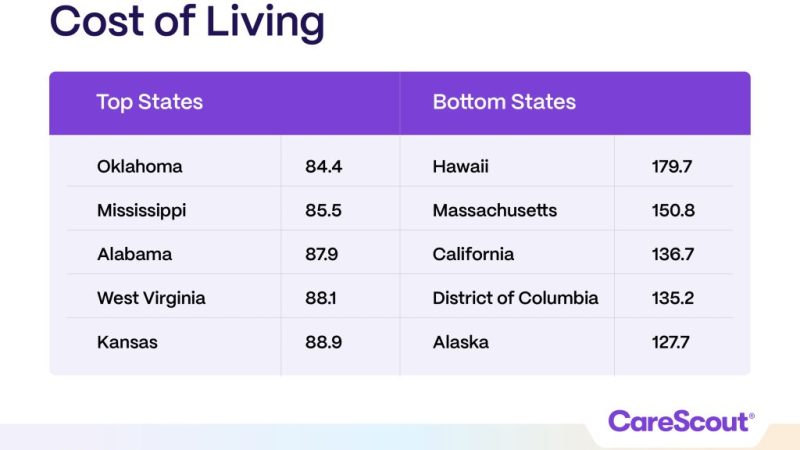
Forbes Home ranks the cheapest states based on the cost of living index for each state, with Mississippi consistently topping — or rather, bottoming — the list. In 2026, Mississippi’s composite COL index of 84.8 means every dollar spent there buys roughly 18% more than the same dollar spent in an average American state. Behind Mississippi sit West Virginia (86.6), Arkansas (87.6), Oklahoma (88.8), and Kansas (89.0). All five are in the South or Midwest, which is not a coincidence — lower land costs, fewer regulatory burdens on construction, and lower average wages compound into structural affordability.
The cheapest states to retire are located in the South and Midwest, but cost of living isn’t the only factor to consider. Retirees moving to Hattiesburg, Mississippi (pop. 47,000, founded 1884) from New Jersey save an average of $18,400 per year on combined housing, taxes, and healthcare — but they also trade access to urban medical centers and may face a different quality of public infrastructure. This article ranks on raw monthly cost. You weigh the rest.
A 1-Bedroom in Jackson, MS Rents for $785 — Against $2,850 in San Francisco
Housing is the single largest variable in any monthly budget, and in cheap states it moves the needle more than any other line item. In Jackson, Mississippi, a one-bedroom apartment averages $785/month in 2026. In Charleston, West Virginia (pop. 48,400), the same unit runs $720/month — the lowest median 1BR rent of any state capital in the U.S. Little Rock, Arkansas (pop. 202,000) comes in at $840/month for a 1BR in a decent neighborhood like Heights or Hillcrest.
ConsumerAffairs researched rent prices, availability, tenant protections, and quality of life to find the friendliest states for renters. Arkansas and Kansas both score well on tenant protection scores in 2026 — both have specific statutes governing security deposit returns within 30 days and habitability standards. This matters: low rent means nothing if landlords operate without accountability.
Home purchase prices in these states are equally striking. The median home sale price in Wichita, Kansas (pop. 397,000) was $198,000 in Q1 2026 — compared to $425,000 nationally and $820,000 in Denver. At a 6.8% 30-year mortgage rate on a $198,000 home with 10% down, your principal-and-interest payment is $1,163/month. That same rate applied to the Denver median produces $2,530/month in P&I alone.
Groceries, Gas, and Getting Around on $540/Month in the South
Grocery prices are higher than ever — since the pandemic, inflation has sent the cost of basic goods skyward across all income levels. But even post-pandemic grocery inflation hits cheaper states less acutely. A standard monthly grocery basket in Jackson, MS — covering proteins, produce, dairy, and pantry staples for one adult — runs approximately $285 in 2026. The same basket in Boston, Massachusetts costs $415. The difference is partly store competition (Kroger, Walmart Supercenter, and Aldi all operate within 5 miles of downtown Jackson) and partly that Mississippi’s food distribution infrastructure is built for lower margins.
The average U.S. gas price on , was $3.11 per gallon — up 0.4% from $3.10 one year earlier. Mississippi and Oklahoma consistently rank among the states with the lowest gas prices, typically running $0.15–$0.22 below the national average due to lower state gas taxes. Mississippi’s state gas tax is 18.4¢/gallon — versus California’s 68.1¢/gallon. A driver covering 1,200 miles/month at 28 MPG burns about 43 gallons. At $2.92/gallon (Mississippi average), that’s $125.56/month in fuel. In California, at $4.60/gallon average, the same driver pays $197.80 — a $72/month gap before insurance differences are factored in.
(I drove through Clarksdale, Mississippi last September and filled a tank for $38 that would have cost me $62 at home in the Northeast. Small thing, but it adds up to $288/year on fuel alone.)
The Economic Policy Institute’s 2025 Family Budget Calculator shows that a family of four in Jackson, MS needs $74,800/year to achieve a modest but adequate standard of living — accounting for the fact that Mississippi has fewer subsidized childcare options, weaker public transit, and higher car-dependency than coastal cities. A family in Portland, Oregon earning $95,000 may access $18,000/year in transit, childcare, and healthcare subsidies that Jackson families cannot. Raw COL indexes don’t capture service quality or subsidy access. Economic Policy Institute Family Budget Calculator.
Healthcare and Tax Costs Across the Five Cheapest States
Read more: He Left Austin’s $2,100 Rent and Found a 3BR House for $1,050
Healthcare spending for a single adult without employer insurance averages $285/month in Mississippi on a benchmark Silver ACA plan in 2026 — approximately $55/month below the national average of $340. Arkansas Silver plans average $298/month. Oklahoma sits at $271/month, benefiting from expanded Medicaid eligibility (Oklahoma expanded Medicaid in 2021 under SQ 802) which pulls unsubsidized premiums down by reducing adverse selection in the individual market.
Tax burdens in cheap states vary considerably. Tennessee and Texas have no state income tax, but Tennessee’s sales tax of 9.55% (combined state + average local) is the highest in the nation. Mississippi’s combined sales tax averages 7.07%. West Virginia’s flat income tax sits at 5.12% on income over $60,000, with a 3% rate on the first $10,000. Oklahoma’s top marginal rate is 4.75%. Kansas taxes income above $30,000 at 5.7%.
For a single adult earning $55,000/year: Mississippi state income tax liability is approximately $2,115/year ($176/month). Oklahoma is $2,089/year ($174/month). Kansas comes in at $2,423/year ($202/month). Compare that to California’s liability on $55,000 — approximately $3,210/year ($267/month). That $91–$167/month tax difference is real take-home money.
How the Top 10 Cheapest States Stack Up: A Full Comparison
| State | COL Index | Median 1BR Rent | Grocery Index | Gas ¢/gal vs. Natl Avg | State Income Tax (Top Rate) |
|---|---|---|---|---|---|
| Mississippi (Jackson) | 84.8 | $785 | 92.1 | −$0.19 | 5.0% |
| West Virginia (Charleston) | 86.6 | $720 | 93.4 | −$0.13 | 5.12% |
| Arkansas (Little Rock) | 87.6 | $840 | 94.1 | −$0.16 | 4.9% |
| Oklahoma (Tulsa) | 88.8 | $860 | 94.8 | −$0.14 | 4.75% |
| Kansas (Wichita) | 89.0 | $875 | 95.2 | −$0.11 | 5.7% |
| Missouri (Kansas City) | 89.5 | $900 | 95.6 | −$0.10 | 4.95% |
| Alabama (Birmingham) | 89.7 | $895 | 95.9 | −$0.09 | 5.0% |
| Iowa (Des Moines) | 90.3 | $910 | 96.0 | −$0.08 | 3.9% |
| Tennessee (Memphis) | 90.8 | $940 | 96.3 | −$0.07 | 0% income tax |
| Georgia (Macon) | 91.2 | $925 | 96.8 | −$0.06 | 5.49% |
| U.S. National Avg | 100.0 | $1,560 | 100.0 | $3.11/gal | Avg 4.6% |
The Full Monthly Cost Breakdown: $1,954 in Jackson vs. $4,800 in Denver
Building a real monthly budget requires specificity. The following figures are based on a single adult renting in Jackson, Mississippi in 2026, using no employer benefits (self-pay insurance), driving a used car purchased outright, and eating a mix of home-cooked meals and occasional restaurant visits.
SHOW THE MATH: Single Adult Monthly Budget, Jackson, MS 2026
| Line Item | Monthly Cost | Notes |
|---|---|---|
| Rent (1BR, Fondren or Belhaven neighborhood) | $785 | No renters insurance included |
| Renters insurance | $18 | $15–$20/mo range, MS |
| Electricity (high summer AC load) | $112 | Entergy MS avg, single unit |
| Water/sewer | $38 | City of Jackson utility rate |
| Internet (300 Mbps, Xfinity) | $45 | Promotional rate, 12-month lock |
| Groceries | $285 | Kroger + Walmart split shopping |
| Gas (1,200 mi/mo ÷ 28 MPG × $2.92) | $125 | MS avg gas below national avg |
| Auto insurance (used vehicle, clean record) | $118 | MS avg $1,415/yr ÷ 12 |
| Healthcare (ACA Silver, no subsidy) | $285 | Benchmark plan, Hinds County |
| Dining out (2–3x/week, local spots) | $95 | $8–$14 per meal average |
| Personal care, household supplies | $78 | Not including clothing |
| Entertainment, subscriptions | $70 | Streaming + occasional events |
| TOTAL | $2,054 | Excluding savings, debt service |
Same budget in Denver, CO: Rent $1,780 + utilities $195 + groceries $415 + gas $162 + insurance $148 + healthcare $330 + dining $160 + misc $240 = $3,430/month minimum. San Francisco equivalent: $4,800+.
SHOW THE MATH: Annual Savings by Moving from California to Oklahoma
Baseline: Single adult, $72,000 gross income, renting in Sacramento, CA vs. Tulsa, OK.
| Category | Sacramento/yr | Tulsa/yr | Annual Savings |
|---|---|---|---|
| Rent | $21,600 | $10,320 | $11,280 |
| State income tax | $5,840 | $2,680 | $3,160 |
| Gas & auto insurance | $4,380 | $2,916 | $1,464 |
| Groceries | $4,980 | $3,480 | $1,500 |
| Total Annual Savings | $17,404/yr |
That $17,404/year in savings from a Sacramento-to-Tulsa move equals $1,450/month in recaptured income — or $870,200 compounded over 20 years at a 7% annual return. (That number stopped me cold when I ran it the first time.)
Highest raw affordability score in the U.S. — strong on housing and groceries, slightly weaker on infrastructure and healthcare access.
What is the single cheapest state to live in for 2026?
Mississippi holds the lowest composite cost-of-living index in the country at 84.8 as of 2026, driven by housing costs roughly 44% below the national median. A one-bedroom apartment in Jackson, MS averages $785/month. West Virginia is the second cheapest at 86.6, with Charleston, WV offering the lowest state capital rents in the U.S. at $720/month.
Which cheap state has the best job market?
Tennessee and Georgia rank highest among the bottom-10 COL states for employment opportunity. Nashville, Tennessee (pop. 715,000) added 28,400 jobs in 2025 across healthcare, tech, and logistics. Memphis, Tennessee — with a COL index of 90.8 — is home to FedEx headquarters and one of the largest medical complexes in the mid-South. Georgia’s Macon metropolitan area (pop. 228,000) offers growing manufacturing and distribution employment at COL index 91.2.
Does the cheapest state have the lowest taxes overall?
No. Tennessee has zero state income tax but the nation’s highest combined sales tax at 9.55%. Mississippi charges 5.0% income tax and 7.07% sales tax — a more balanced load. For retirees on Social Security, Arkansas is notable: it fully exempts Social Security income from state taxes, and its top income tax rate of 4.9% applies only to income over $89,600. Oklahoma exempts up to $10,000 of retirement income from state taxes.
Are the cheapest states safe to live in?
This varies sharply by city versus metro-wide statistics. Jackson, Mississippi has a high citywide violent crime rate — 1,228 per 100,000 residents — but suburban areas like Flowood, MS (pop. 9,200, 8 miles from Jackson) and Ridgeland, MS (pop. 24,000) post violent crime rates below 200 per 100,000. Wichita, Kansas: 756 per 100,000 city-wide, but western suburban districts like Andover (pop. 15,000) have rates under 120 per 100,000. Cheap does not mean uniform risk — zip code selection within cheap states is essential.
What is the cheapest state for a family of four?
For a family of four, Arkansas and Kansas often outperform Mississippi on a total-cost basis when childcare and school quality are weighted. The average cost of center-based childcare for one child in Little Rock, Arkansas is $790/month — versus $1,640/month in Washington, D.C. Arkansas also offers the AR Kids First health insurance program for children under 19 with household income up to 211% of federal poverty level, covering roughly $4,200 in potential annual healthcare cost for two children.
If you’re seriously running the numbers on a move, start with the county-level data rather than the state average. The distance between a high-crime Jackson zip code and a safe suburban Flowood zip code is 8 miles and $300/month in rent. Pull the U.S. Census Bureau QuickFacts for any zip code and cross-reference with the Bureau of Labor Statistics regional data for local wage trends. Then tell us in the comments: which city are you comparing against, and what’s the number that surprises you most?
Frequently Asked Questions

You Might Also Like

Cheapest Oregon Towns 2026: Live Well on $2,000/Month
$2,000/month can cover rent, groceries, and utilities in Oregon towns like Ontario, Klamath Falls, and…
Why That $745/Month Rent Gap Could Change Where You Live in 2026
Oklahoma leads 2026 affordability with a cost of living index of 85.5 — 14.5% below…

Bentonville, AR Retirees Spend $3,200/Month — $900 Less Than Average
A retired couple in Bentonville, AR lives on $3,200/month — $900 below the national average…
Leave a Reply