
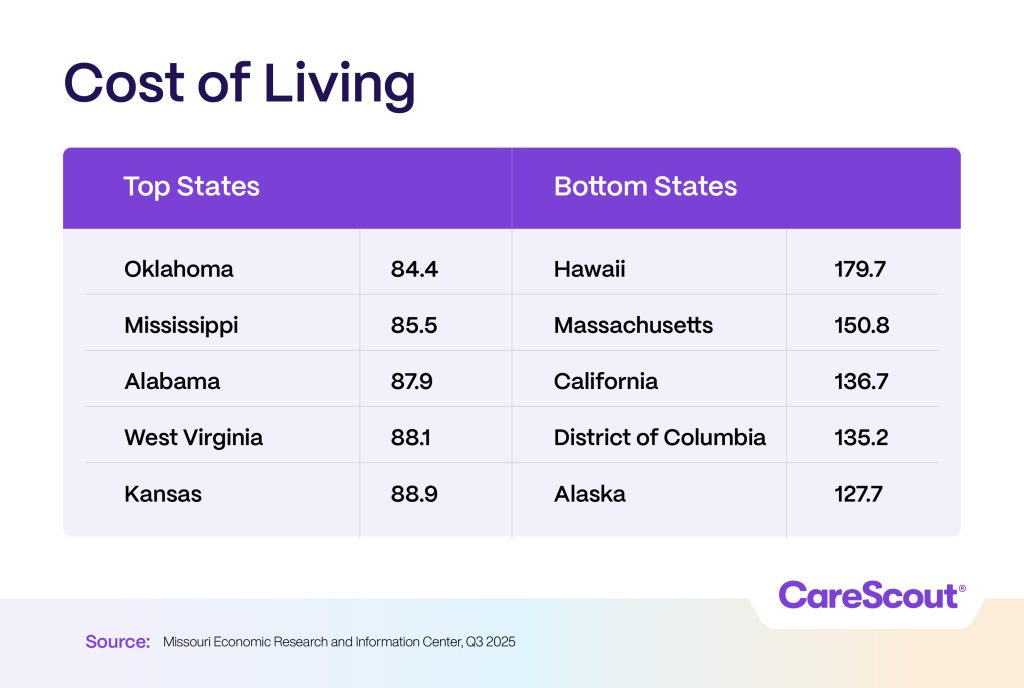
Maria Okonkwo sat at a kitchen table in Evansville, Indiana — Vanderburgh County, population 117,000 — signing a two-bedroom lease for $675 a month, about what she’d paid for a parking spot in Chicago. That moment, in January 2025, was the entire argument for relocating to one of America’s cheapest states made real.
Five states — Mississippi, Kansas, Oklahoma, Alabama, and Indiana — consistently rank at the intersection of low housing costs and low overall living expenses. A single person living in Evansville, Indiana can realistically hit a full monthly budget under $2,050, compared to the national average closer to $3,189.
(100 = national avg)
Evansville, Indiana
Jackson, Mississippi
What It Actually Costs to Live in America’s Cheapest States
Read more: Cheapest States to Live in America
Cost of living indexes are abstractions. Real people pay rent in Hattiesburg, Mississippi (Forrest County) or buy groceries in Wichita Falls, Texas (Wichita County, pop. 104,000). Forbes ranks Brownsville, Texas; Wichita Falls, Texas; South Bend, Indiana; Evansville, Indiana; and Toledo, Ohio among the ten most affordable cities in the country. What unites them: housing costs below $900/month, median incomes that go further, and states that keep taxes lean.
A recent analysis of living expenses for retirees specifically called out Mississippi, Kansas, and Oklahoma as top-tier destinations where fixed incomes stretch farthest. But these states aren’t just retirement havens. Young families, remote workers, and anyone priced out of coastal metros are arriving with purpose.
Housing Breakdown: Where the Savings Are Biggest
Housing is the lever. In Tulsa, Oklahoma (Tulsa County), the median home sale price as of early 2026 sits near $199,000. A 30-year mortgage at 6.8% with 10% down runs approximately $1,165/month including estimated taxes and insurance — about what a one-bedroom costs in Phoenix, Arizona.
Renters do even better. In Wichita, Kansas (Sedgwick County, pop. 397,000), the average one-bedroom apartment rents for around $720/month. In South Bend, Indiana (St. Joseph County), a two-bedroom averages $840/month. Compare that to the national median one-bedroom rent of roughly $1,500/month as of Q1 2026. The gap is not marginal — it’s life-changing.
| City / State | Median Home Price | Avg 1BR Rent | COL Index |
|---|---|---|---|
| Evansville, IN | $185,000 | $650 | 88.1 |
| Wichita, KS | $205,000 | $720 | 86.5 |
| Tulsa, OK | $199,000 | $775 | 86.7 |
| Brownsville, TX | $172,000 | $690 | 85.2 |
| Jackson, MS | $158,000 | $610 | 83.3 |
| National Average | $419,000 | $1,500 | 100 |
Groceries, Utilities & Daily Essentials
In Wichita Falls, Texas (Wichita County), a single person’s monthly grocery bill runs roughly $290–$330, based on USDA moderate-cost food plans for individuals. That’s approximately 15% below the national average of around $380. A gallon of whole milk costs about $3.20; a dozen eggs around $3.50 at a local H-E-B.
Utilities in Wichita Falls average $145/month for a standard 900 sq ft apartment — electricity, water, and trash combined. That compares favorably to the U.S. average of roughly $200/month. Internet service through local providers runs $55–$75/month for 200 Mbps.
In Jackson, Mississippi (Hinds County), monthly groceries average $270–$310 for a single adult. A dozen eggs at a Kroger on Lakeland Drive runs around $3.20. Electric bills average $128/month — lower than most Southern metros despite Mississippi’s summer heat — largely because Entergy Mississippi’s residential rates sit near 10.8 cents per kWh, well below the national average of roughly 16 cents.
Tulsa, Oklahoma (Tulsa County) rounds out the daily-essentials picture. A dinner for two at a mid-range restaurant on Cherry Street costs around $50–$60. A monthly gym membership runs $25–$35 at a local YMCA branch. A standard haircut averages $18. These aren’t sacrifices — they’re just what normal life costs outside high-density coastal metros.
Transportation: Gas, Insurance & Commutes
Car ownership is nearly unavoidable in most of America’s cheapest states. The tradeoff: gas and insurance are cheaper here too. As of early , average gas prices in Oklahoma hover near $2.89/gallon — roughly 30 cents below the national average. In Mississippi, drivers pay some of the country’s lowest auto insurance premiums. The state average is around $1,080/year for full coverage, compared to a national average of approximately $1,760/year, according to data compiled by the National Association of Insurance Commissioners.
In Bartlesville, Oklahoma (Washington County, population ~36,000), the average one-way commute to downtown is under 12 minutes. Annual vehicle maintenance — oil changes, tires, registration — typically totals $800–$1,100 for a midsize sedan. Compare that to commuters in Austin or Denver spending $2,000+ annually on parking alone.
Kansas offers a similar story. In Salina, Kansas (Saline County, population ~46,000), car insurance averages $1,140/year full coverage. The city has no traffic congestion to speak of — average commute times run 14 minutes. The nearest major highway, I-70, connects residents to Wichita in under 90 minutes and Kansas City in about 2.5 hours.
State Income Tax, Property Tax & the Real Tax Picture
Low cost of living and low taxes don’t always travel together — but in several of these states, they do. Texas charges zero state income tax. So does Tennessee. Mississippi eliminated its state income tax on wages starting in under legislation signed in 2025 — making it one of the newer no-income-tax states. Oklahoma levies a flat 4.75% income tax as of 2026 after a series of rate reductions from its previous top rate of 4.75% on incomes over $7,200.
Property taxes, however, are the variable that trips people up. In Texas, no income tax is partly offset by high property tax rates. In Harris County (Houston), effective property tax rates average around 1.8–2.1%. On a $200,000 home, that’s $3,600–$4,200/year. By contrast, Alabama has a median effective property tax rate of just 0.41% — one of the lowest in the country. On a $180,000 home in Tuscaloosa, Alabama (Tuscaloosa County), your annual property tax bill might be as low as $738.
| State | Income Tax | Avg. Effective Property Tax | State Sales Tax |
|---|---|---|---|
| Mississippi | 0% (wages, 2026) | 0.63% | 7.0% |
| Oklahoma | 4.75% flat | 0.85% | 4.5% |
| Arkansas | 3.9% top rate | 0.61% | 6.5% |
| Alabama | 5.0% top rate | 0.41% | 4.0% |
| Kansas | 5.7% top rate | 1.33% | 6.5% |
| Texas | 0% | 1.60% | 6.25% |
Healthcare Costs in Low-Cost States
Healthcare is the wildcard in any cost-of-living calculation. In Fort Smith, Arkansas (Sebastian County, population ~88,000), a benchmark ACA silver plan for a 40-year-old non-smoker runs approximately $420–$460/month before subsidies. A standard doctor’s office visit averages $110–$130. Emergency room visits at Mercy Hospital Fort Smith typically generate bills of $800–$1,200 for non-critical issues before insurance.
Rural healthcare access is a genuine concern. In Leflore County, Mississippi — one of the poorest counties in the United States — the nearest Level I trauma center is roughly 90 miles away in Jackson. This is the honest trade: lower costs sometimes mean longer drives for specialized care. Anyone with chronic conditions should factor this into their decision carefully.
That said, Tulsa, Oklahoma and Huntsville, Alabama (Madison County) both have robust healthcare infrastructure. Huntsville Hospital is a 941-bed regional medical center. In Tulsa, the Saint Francis Health System employs over 5,000 healthcare workers. You don’t have to give up quality care to live affordably — you just have to choose your city strategically.
5 Specific Towns Worth Serious Consideration
These aren’t abstract rankings. These are actual places where the numbers work.
Tupelo, Mississippi
Lee County. Population ~38,000. Median home price: $189,000. Median household income: ~$52,000. Birthplace of Elvis Presley. Anchored by Toyota’s North American manufacturing plant — bringing stable employment. Monthly rent for a 2BR: $850–$950.
Clarksville, Tennessee
Montgomery County. Population ~175,000. Zero state income tax. Median home: $299,000. 45 minutes to Nashville. Fort Campbell drives a strong local economy. Median household income: ~$62,000. Monthly rent 2BR: $1,050–$1,200.
Owensboro, Kentucky
Daviess County. Population ~60,000. Median home: $198,000. Kentucky’s flat income tax: 4.0%. Riverfront city on the Ohio River. Growing healthcare and manufacturing base. Monthly rent 2BR: $780–$920. Cost index roughly 15% below national average.
Enid, Oklahoma
Garfield County. Population ~50,000. Median home: $152,000. One of the lowest home prices on this list. Agriculture and Vance Air Force Base anchor the economy. Monthly rent 2BR: $650–
Frequently Asked Questions

You Might Also Like

10 Most Underrated US Cities That Are Affordable & Worth Moving To
These overlooked US cities offer low cost of living, strong job markets, and real quality…
8 Affordable US Cities Under $300K That Beat Austin and Denver
Tulsa's median home is $185K. The national median is $407,500. Eight cities like it offer…
Oklahoma Beats Every State on Affordability — $2,240/Month Total
Oklahoma leads 2026's most affordable states with a cost-of-living index of 85.5. A Tulsa adult…
Leave a Reply