
Sandra Okafor pushes a full cart out of a Reasor’s grocery store in midtown Tulsa on a Tuesday morning, spending $87 — for the week. Her two-bedroom apartment in Broken Arrow, just east of the city, runs $895 a month, which is less than a studio in Austin and roughly what a parking spot costs in San Francisco.
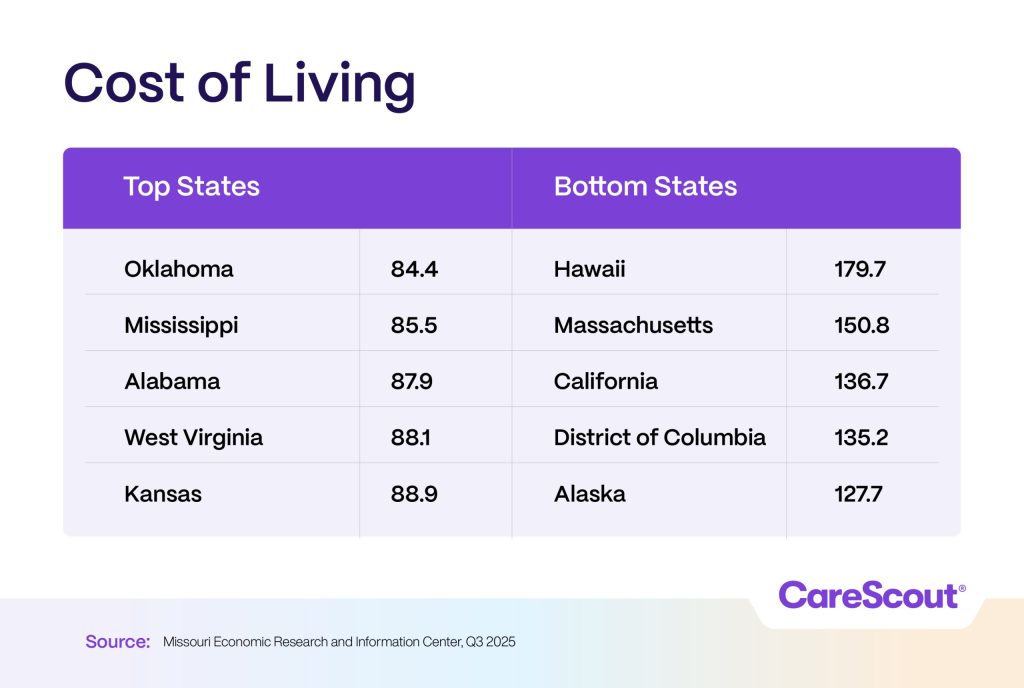
That’s not a fluke. It’s Oklahoma’s economy working exactly as advertised. Oklahoma ranks number one for overall affordability in 2026 with a cost-of-living index of 85.5, followed by Mississippi, Alabama, Missouri, and West Virginia. This guide breaks down what you actually pay — month by month, category by category — in America’s cheapest states.
A single adult living in Tulsa, Oklahoma can cover all essential monthly expenses — housing, food, transport, healthcare, and utilities — for approximately $2,240/month. The national average for the same basket runs closer to $3,700. That gap — $1,460/month — is $17,520 a year you keep.
Where America’s Cost-of-Living Floor Actually Lives
Read more: Cheapest States to Live in America
Forbes ranks the cheapest states using a cost-of-living index where 100 equals the national average. Every state below 90 means residents pay less than 90 cents on every dollar a typical American spends. The five states leading that list in 2026 are clustered in the South and Midwest — a geographic corridor stretching from the Ozarks to the Gulf Coast.
These aren’t just cheap in one category. They’re cheap across housing, groceries, healthcare, and taxes simultaneously — a convergence that’s rare and increasingly valuable as coastal costs spiral.
#1 in the U.S.
Broken Arrow, OK
Single adult, Tulsa
COL Index 89
Housing Costs in the Cheapest States — the Real Numbers
Housing is where the gap between cheap and expensive states is most violent. In Tulsa, Oklahoma, the median home sale price as of early sits near $198,000. That same money buys a closet in Denver and a fantasy in Los Angeles.
In Hattiesburg, Mississippi — a college town of roughly 48,000 anchored by the University of Southern Mississippi — a three-bedroom house in a quiet neighborhood runs around $160,000. A one-bedroom apartment in the Oak Grove corridor rents for approximately $710/month.
In Huntsville, Alabama — now one of the fastest-growing cities in the Southeast, driven by NASA’s Marshall Space Flight Center and the defense sector — you can rent a clean one-bedroom for $850 to $950/month. A starter home goes for around $210,000 to $240,000.
Springfield, Missouri, in Greene County, offers one-bedrooms near the Missouri State University corridor for $700 to $800/month. Compare that: $800/month in Springfield is what a studio costs in Phoenix — about $1,927 for a one-bedroom there in 2026.
Groceries, Utilities & the Everyday Essential Budget
Grocery indices in Oklahoma, Mississippi, and Alabama run roughly 8–12% below the national average. A weekly grocery run for a single adult in Tulsa — whole foods, proteins, produce — comes in around $80 to $95. In Chicago, the same basket costs $115 to $130.
Utilities in West Virginia and Missouri average $140 to $175/month for a standard apartment. Oklahoma’s utility bills spike slightly in summer due to air conditioning load, averaging closer to $155 to $195/month year-round.
Monthly budget at a glance for a Tulsa single adult: groceries run $340, utilities $165, and personal care/household supplies add roughly $90. That’s $595/month for everything outside rent — about 35% less than the national composite.
Transportation: Where Cheap Gas Meets Cheap Insurance
Car ownership costs vary wildly by state. In Iowa, Kansas, and Missouri, full-coverage auto insurance for a clean-record driver averages $1,080 to $1,320 per year. In Michigan or Florida, that same driver pays $2,400 to $3,100 annually.
Gas prices in Oklahoma, Arkansas, and Mississippi consistently run $0.20 to $0.40 below the national average. In Joplin, Missouri, regular unleaded averaged $2.89/gallon through early 2026. Los Angeles averaged $4.52 over the same period.
Public transit in cheaper states is sparse. That’s the tradeoff. In Huntsville, Alabama — population 215,006 — owning a car is effectively mandatory. Budget $350 to $430/month for a car payment, insurance, and gas combined. That’s still cheaper than New York’s MetroCard plus rideshares.
Monthly transportation for a single adult in the cheapest states averages $380 to $460. The national average is $628, per the Bureau of Labor Statistics Consumer Expenditure Survey.
Healthcare Costs: The Variable Nobody Warns You About
Read more: Why Millions Are Leaving Colorado for $1,140 Mortgages in Oklahoma
Healthcare is where cheap-state math gets complicated. States like Mississippi and Arkansas have fewer specialists and longer wait times. But for routine care, the out-of-pocket costs are genuinely lower.
A standard primary care visit in Tupelo, Mississippi runs $95 to $140 without insurance. In San Francisco, the same visit bills at $280 to $400. Dental cleanings in Fort Smith, Arkansas average $85 to $110. In Boston, expect $175 to $250.
ACA marketplace premiums for a 40-year-old non-smoker at 300% of the federal poverty level average $210/month in Oklahoma versus $390/month in Connecticut, after subsidies. That $180 gap adds up to $2,160/year — nearly a month’s rent in Tulsa.
Retirees especially benefit. Medicare Advantage premiums in Wichita, Kansas start as low as $0/month for basic plans with meaningful dental and vision coverage bundled in. That same coverage tier costs $45 to $80/month in northeastern states.
The Full 2026 Ranking: Cheapest States by Monthly Cost of Living
The numbers below represent a composite monthly budget for a single adult renting a one-bedroom apartment. Categories include rent, groceries, utilities, transportation, and basic healthcare. Data sourced from the Missouri Economic Research and Information Center (MERIC), BLS, and state-specific housing surveys.
| Rank | State | Anchor City | Est. Monthly Budget | vs. National Avg. |
|---|---|---|---|---|
| 1 | Mississippi | Jackson | $1,910 | −28% |
| 2 | Oklahoma | Tulsa | $1,980 | −25% |
| 3 | Arkansas | Fort Smith | $2,010 | −24% |
| 4 | Kansas | Wichita | $2,050 | −23% |
| 5 | Alabama | Huntsville | $2,080 | −22% |
| 6 | Missouri | Joplin | $2,110 | −21% |
| 7 | West Virginia | Morgantown | $2,130 | −20% |
| 8 | Iowa | Cedar Rapids | $2,160 | −19% |
| 9 | Indiana | Evansville | $2,190 | −18% |
| 10 | Tennessee | Clarksville | $2,230 | −16% |
National average single-adult monthly cost of living benchmark: approximately $2,660/month. Source methodology combines MERIC composite index, HUD Fair Market Rents, and BLS Consumer Expenditure data for .
Hidden Costs Nobody Puts in the Brochure
Cheap states have hidden costs. West Virginia’s roads are punishing — expect higher tire and suspension bills than average. Mississippi ranks last nationally in broadband access per the FCC Broadband Deployment Report, which matters enormously for remote workers.
Property taxes are low in Mississippi (0.63% effective rate) but homeowner’s insurance in tornado-prone Oklahoma and Arkansas runs
Frequently Asked Questions

You Might Also Like

West Virginia 2026: Full Life Under $2,100/Month in Charleston
West Virginia's cost of living index sits at 83.2 — 17% below the U.S. average.…

Texas Charges Zero Income Tax — So Why Is This Retiree Paying $4,800?
Nine states have no income tax in 2026, but Texas property taxes hit $4,800/yr and…
Save $1,400/Month? The 5 Cheapest States to Live in 2026
Oklahoma leads 2026 affordability with a cost of living index of 85.5. See the full…
Leave a Reply