
▶ Read transcript
Here’s what you need to know about chimpanzees, crystals, and what they reveal about the origins of human beauty.
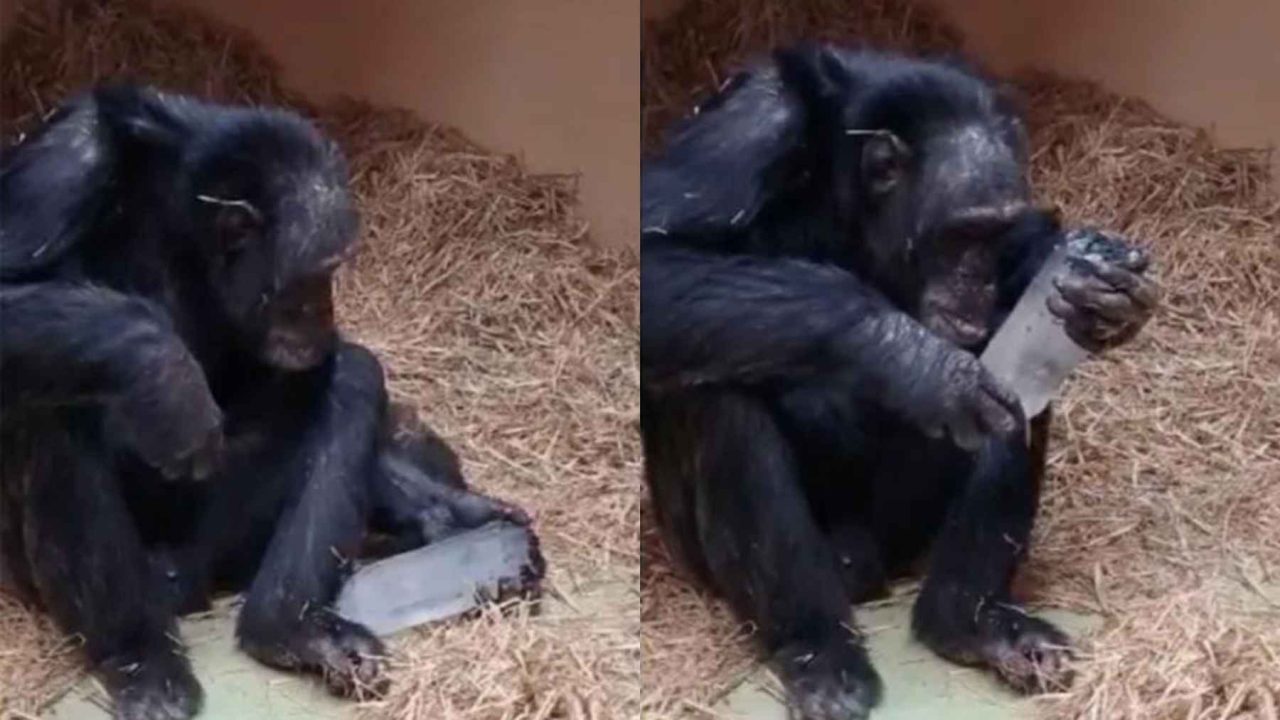
A study published in Frontiers in Psychology gave nine adult chimpanzees access to quartz crystals, sandstone rocks, and mixed piles of pebbles. The chimps showed a strong, statistically significant preference for the crystals every time. In one case, they held onto a large quartz specimen for nearly two full days, retreating to their sleeping quarters with it, and only gave it back when researchers offered yogurt. One chimp named Yvan repeatedly held a small crystal up to his eye for over fifteen minutes, seemingly fascinated by the way light passed through it.
What makes this remarkable is the archaeological connection. Crystals have been found at hominin sites going back 780,000 years, collected with no practical purpose. This new research suggests that attraction to translucent, lustrous objects isn’t a human cultural invention. It may be hardwired into primate biology itself.
The takeaway: next time you’re drawn to something shiny or beautiful for no logical reason, consider that the impulse might be six million years old.
The caretakers at the primate research facility had a problem. They needed their crystal back. The large, transparent quartz specimen — 14 inches tall, weighing 7.3 pounds — had been handed to the chimpanzees as part of a scientific experiment. Now, nearly two full days later, the chimps had carried it into their sleeping quarters and showed no interest in returning it. Bananas didn’t work. Yogurt did, eventually. But only barely.
This was not a fluke. It was data. And it points toward something profound about what it means to be a primate on this planet.
A Study That Began With a Simple Question About Beauty
The research, published in Frontiers in Psychology, set out to explore whether non-human primates show any preference for visually striking objects, specifically crystals and translucent stones. Nine adult chimpanzees, divided into two separate social groups, were the subjects. Researchers introduced them to a range of objects: a large quartz crystal, a sandstone rock of comparable size, and piles of mixed pebbles that included crystals and non-crystal stones.
The results were not subtle. The chimpanzees spent significantly more time interacting with the crystal than with the sandstone rock. The statistical significance reached a p-value of 0.0052, which means the probability that this difference was random is less than one in a hundred. In the pebble pile experiments, the drop in crystal counts — as chimps selected and removed them from the piles — reached a p-value of less than 0.0001.
These are not the numbers of a coincidence. They are the numbers of a preference. And a preference, in the language of evolutionary biology, is a story.
Yvan, the Crystal Inspector, and What He Reveals About Primate Perception
Among the nine chimpanzees, one individual stood out. A chimp named Yvan repeatedly retrieved a small quartz crystal from one of the pebble piles and held it directly up to his eye. He did this multiple times, spending more than 15 minutes in total examining the crystal this way. He wasn’t playing. He was looking.
“The chimps apparently share our own fascination with lustrous and translucent objects.”
— Michael Haslam, archaeologist, as quoted in Smithsonian Magazine
Haslam’s framing is careful but striking. He doesn’t say the chimps understand crystals. He says they share our fascination. That distinction matters enormously. Understanding requires cognition. Fascination requires something older, something more instinctive, something wired into perception itself.
Yvan’s behavior suggests the chimps weren’t just attracted to novelty. They were drawn to a specific visual quality: translucency. The way light passes through quartz, bending and scattering, is physically different from how it reflects off sandstone. That difference registered, and it registered deeply enough to hold a chimpanzee’s attention for quarter of an hour.
780,000 Years of Evidence: Crystals in Ancient Hominin Sites
Here is where the study becomes genuinely archaeological. This was never just about nine chimpanzees in a research facility. It was about a pattern that stretches back across geological time.
Archaeologists have found quartz and calcite crystals at ancient hominin sites going back roughly 780,000 years. These crystals appear repeatedly, across different species of early humans, in contexts that suggest deliberate collection rather than accidental inclusion. They weren’t tools. They weren’t food. They were kept.
The question archaeologists have long struggled with is this: why did early hominins collect these crystals? They had no monetary value. They served no survival function. The most honest answer has always been that something about them was appealing. This new research suggests that “something” is not a human invention. It predates humanity entirely.
| Object | Weight | Height | Chimp Preference |
|---|---|---|---|
| Large Quartz Crystal | 7.3 lbs | ~14 inches | High (p = 0.0052) |
| Sandstone Rock | 4.6 lbs | ~13 inches | Low (control object) |
| Crystal Pebbles (in mixed pile) | Varied | Small | Very High (p < 0.0001) |
What This Means for the Origins of Aesthetic Sense in Primates
The implications here reach well beyond crystals. If chimpanzees, with no cultural conditioning and no exposure to human concepts of beauty, show a measurable preference for translucent and lustrous objects, then aesthetic preference is not a product of civilization. It is a product of biology.
This connects to a broader debate in evolutionary psychology about what drives human attraction to certain visual stimuli. One long-standing hypothesis holds that our preference for shiny, reflective surfaces is tied to water detection. In a savanna environment, a glinting surface often meant fresh water. Organisms that noticed it survived. Organisms that didn’t, sometimes didn’t.
Crystals, of course, glint. They refract light in ways that no ordinary rock does. If the water-detection hypothesis has any merit, then the chimpanzee preference for crystals fits neatly into it. Both species, sharing a common ancestor, may have inherited the same visual bias from the same evolutionary pressure.
You are a researcher and a chimpanzee has carried your 7-pound quartz crystal into its sleeping area and refuses to come out. The crystal is irreplaceable equipment. You have bananas, yogurt, and one hour before the facility closes.
But there is another possibility, one that is harder to quantify and more philosophically interesting. The chimps may simply find crystals beautiful. Not in any language-dependent, culturally mediated sense. But in the raw, pre-verbal sense of something that compels attention, that rewards looking, that feels worth keeping.
Congo the Painter and the Broader Case for Primate Aesthetics
The crystal study does not exist in a vacuum. It joins a growing body of evidence that chimpanzees have something resembling aesthetic sensibility. The most famous case involves a chimpanzee named Congo, who in the 1950s produced dozens of paintings under the observation of zoologist Desmond Morris.
Congo showed a capacity for symmetrical consistency. When Morris drew a shape on one side of a piece of paper, Congo would balance it by making marks on the other half. This is not random mark-making. It reflects a sense of visual composition, of where things belong in relation to each other.
Congo’s paintings were later sold at auction for significant sums, purchased alongside works by Renoir and Warhol. Whether that says more about Congo or about the art market is a fair question. But it underscores a serious point: the capacity for visual attention and aesthetic response in chimpanzees is not a recent discovery. The crystal study adds a new, quantified dimension to a pattern that researchers have been tracking for decades.
Where the Research Goes From Here
The logical next steps are already visible. Researchers will likely test other great apes with similar objects to determine whether the preference is unique to chimpanzees or shared across the family. Bonobos, who share an equally close genetic relationship with humans, are an obvious candidate. So are orangutans, who have been observed collecting and playing with unusual objects in the wild.
There is also the question of what specific visual property drives the preference. Is it translucency? Reflectivity? Color? The refractive index of quartz is distinct from that of glass or water. Controlled experiments that isolate each variable could tell us whether chimps are responding to light transmission, surface sheen, or something else entirely.
Archaeologists, meanwhile, have a new lens through which to interpret ancient crystal collections. If the preference for these objects is biologically rooted rather than culturally constructed, then the presence of crystals at hominin sites 780,000 years ago takes on a different meaning. It was not an early sign of symbolic thinking, necessarily. It may have been something even more ancient: a shared primate instinct, expressed by creatures who had not yet invented language but already knew what caught their eye.
The human obsession with diamonds, gemstones, and crystal healing is often dismissed as vanity or magical thinking. This research suggests the dismissal is too easy. The pull toward these objects may be older than our species. It may be older than our genus. It may be, in the most literal sense, in our nature.
When Yvan held that crystal up to his eye and looked through it for 15 minutes, he wasn’t performing for the researchers. He wasn’t following a cultural script. He was doing what primates have apparently been doing for millions of years: finding something that catches the light and refusing to look away.



Leave a Reply