
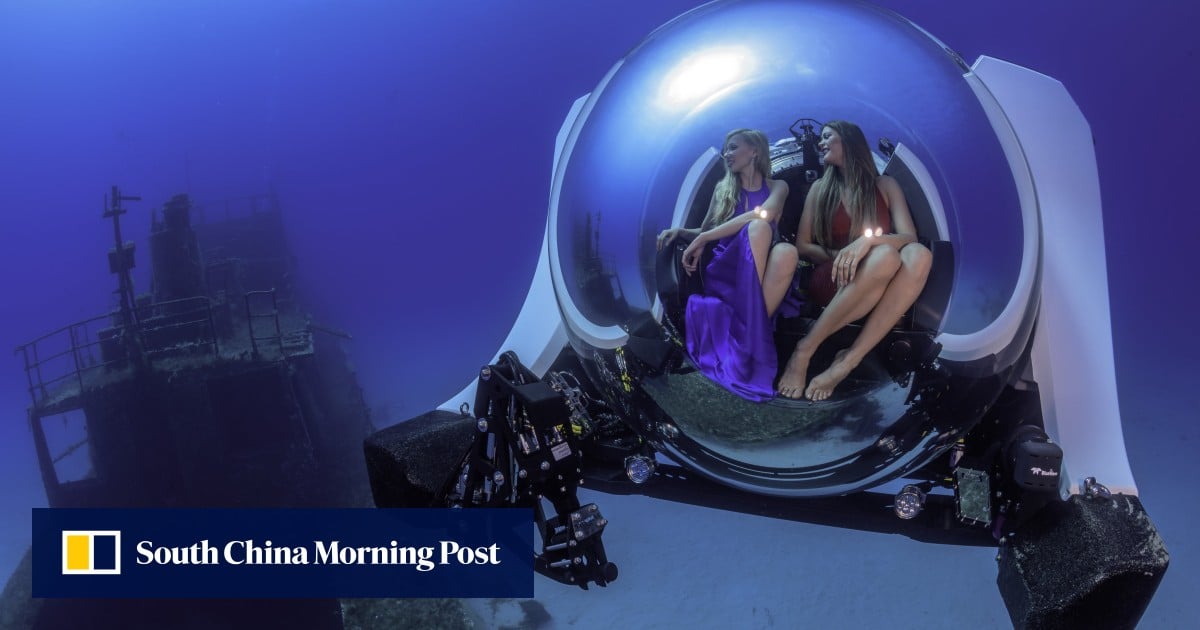
A submersible designed to carry tourists to a depth of 1,000 meters beneath the ocean surface is currently under development in China — and that single fact reframes what luxury travel might look like within the next decade.
At 1,000 meters, sunlight from the surface no longer reaches. You are in the bathypelagic zone, a realm that has historically belonged only to deep-sea research vessels, remotely operated robots, and the handful of scientists with access to them. The idea that paying passengers could one day descend there for leisure is not science fiction — it is an active engineering project underway at the Shipbuilding Research Center in Wuxi, China.
This is not a fringe startup chasing headlines. It represents a deliberate strategic shift by China to convert decades of national oceanic research expertise into a commercial tourism product, one that could define a new category of high-end travel entirely.
What China Is Actually Building — and Why It Matters
The project is being led by the Shipbuilding Research Center in Wuxi, a facility with roots in China’s serious scientific and geological underwater missions. For the past four years, engineers there have been working on a deep-sea tourist submersible capable of reaching 1,000 meters below the surface.
That depth is significant for reasons beyond the impressive number. The bathypelagic zone — which begins around 200 meters and extends to approximately 1,000 meters — is defined by total darkness, crushing pressure, and near-freezing temperatures. Engineering a vessel that can safely carry non-specialist passengers into that environment is an entirely different challenge from building a research submersible crewed by trained scientists.
What makes this project notable is the deliberate repurposing of institutional knowledge. The expertise accumulated through China’s national oceanic research programs — the kind built over decades of scientific deep-sea work — is being redirected toward a commercial application. The goal is not just to build a submersible, but to create a new sector within the tourism industry.
The Engineering Challenge Behind a 1,000-Meter Passenger Submersible
Designing a vessel for tourist use at extreme depth involves engineering problems that go far beyond standard maritime construction. At 1,000 meters, water pressure is roughly 100 times greater than at the surface. Every component — the hull, viewports, life support systems, and emergency mechanisms — must be engineered to withstand that environment while also meeting the comfort and safety expectations of civilian passengers rather than trained researchers.
The four-year development timeline already invested in this project reflects that complexity. High-pressure engineering at this scale is not a rapid process, and the transition from academic mission design to commercial passenger design introduces an entirely new set of requirements around reliability, redundancy, and user experience.
| Feature | Detail |
|---|---|
| Target depth | 1,000 meters |
| Ocean zone reached | Bathypelagic zone (no surface light penetration) |
| Development location | Shipbuilding Research Center, Wuxi, China |
| Development duration (to date) | Four years |
| Primary application | Commercial deep-sea tourism |
| Origin of expertise | China’s national oceanic research programs |
The Broader Shift: When Scientific Infrastructure Becomes a Tourism Product
What is happening in Wuxi is part of a larger pattern worth paying attention to. Deep-ocean access has always been gated by institutional affiliation — you needed to be a researcher, a government scientist, or a military operator to get anywhere near the bathypelagic zone. That gatekeeping was never intentional policy so much as practical necessity: the technology was expensive, rare, and purpose-built for technical missions.
The shift toward commercial passenger submersibles changes that calculus. When engineering capability built for national scientific programs gets repackaged as a luxury tourism offering, the ocean stops being the exclusive domain of specialists. Supporters of this direction argue it democratizes access to environments most humans will never see — even if, in its early form, that access will likely be limited to those who can afford premium adventure travel.
Critics of rapid commercialization in this space have historically pointed to the safety risks of operating high-pressure vessels with non-specialist passengers. The global maritime community has been acutely aware of those risks since several high-profile deep-sea submersible incidents in recent years drew international attention. Whether China’s development program is incorporating the lessons from those events has not yet been publicly detailed.
Who Stands to Be Affected — and What This Could Mean for Travel
For the travel industry, a commercially viable 1,000-meter tourist submersible would represent a genuine new frontier. The market for extreme and adventure travel has grown steadily, with high-net-worth travelers increasingly seeking experiences that cannot be replicated at a conventional resort or on a standard cruise itinerary.
Deep-sea tourism at this depth would sit in a category alongside polar expeditions, private spaceflights, and ultra-remote trekking — experiences defined by exclusivity, technical complexity, and the kind of access that money alone cannot yet reliably buy. If the Wuxi project succeeds, that last qualifier changes.
For China specifically, this project positions the country not just as a manufacturer of maritime hardware but as a potential originator and operator of a new tourism category. The strategic value of that positioning — both economically and in terms of global soft power — is not incidental to the project’s development.
Where the Project Goes From Here
The submersible remains in active development at the Shipbuilding Research Center in Wuxi. No confirmed launch date, passenger pricing, or operational deployment timeline has been made public based on currently available information.
What is confirmed is that the project has been in sustained development for four years, that it targets a 1,000-meter operational depth, and that its stated purpose is commercial tourism rather than scientific research. The next visible milestones will likely involve sea trials, certification processes, and — eventually — the announcement of a commercial operator or partnership.
The deep ocean has waited millions of years for visitors. Whether the first paying tourists arrive within this decade or the next depends largely on what happens in an engineering facility in Wuxi over the months ahead.
Frequently Asked Questions
Where is China’s deep-sea tourist submersible being developed?
The submersible is being developed at the Shipbuilding Research Center in Wuxi, China.
How deep is the submersible designed to go?
The vessel is being engineered to reach a depth of 1,000 meters, placing it within the bathypelagic zone where no surface light penetrates.
How long has the project been in development?
According to available information, the project has been in active development for four years.
Is this a scientific research vessel or a passenger submersible?
It is specifically designed for commercial tourism use, though the engineering expertise behind it comes from China’s national oceanic research programs.
When will it be available for passengers to book?
No confirmed launch date or commercial deployment timeline has been publicly announced at this stage.
What makes 1,000 meters a significant depth for tourism?
At 1,000 meters, the vessel enters the bathypelagic zone — a region of total darkness and extreme pressure that has historically been accessible only to scientific research submersibles, not paying passengers.




Leave a Reply