
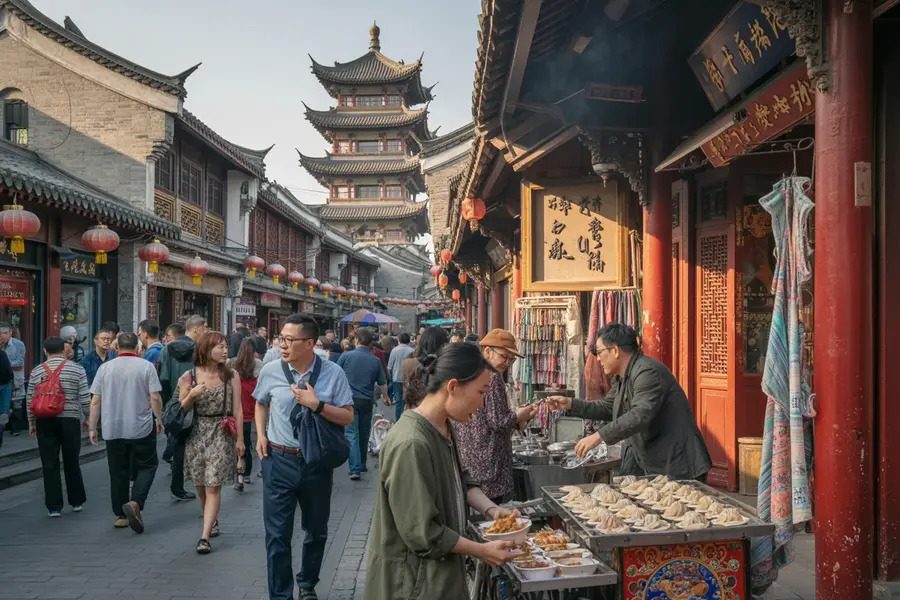
Thirty million visa-free entries. That is the scale of the opening China has extended to international travelers in 2025 — and it is already changing where in the country visitors are choosing to go.
For years, the default China itinerary looked the same: Beijing’s Forbidden City, Shanghai’s skyline, maybe a cruise down the Li River. But with the barrier of visa applications removed for a growing list of nationalities, a different kind of traveler is arriving — one with the time, confidence, and curiosity to look beyond the obvious. The result is a quiet but significant shift toward cities that have long deserved more attention.
Places like Guiyang, Chengdu, and Xi’an are moving from footnotes to focal points. And a broader wave of emerging regional hubs is beginning to appear on international travel radar for the first time.
Why China’s Visa-Free Policy Is Actually a Big Deal
Visa requirements have always been one of the most reliable ways to suppress tourism. The paperwork, the waiting, the uncertainty — it discourages spontaneous travel and pushes people toward destinations where entry is simpler. When China began expanding its visa-free access, it didn’t just make travel more convenient. It fundamentally changed who would consider going.
With 30 million visa-free entries now part of the 2025 picture, China has effectively lowered the activation energy for an enormous pool of potential visitors. Travelers who might have skipped China in favor of Japan, South Korea, or Southeast Asia are now reconsidering. And many of them, freed from the pressure of a tightly planned visa-dependent trip, are choosing to explore rather than simply tick off landmarks.
That exploratory mindset is what is sending travelers to cities that were never on the traditional circuit — and finding out those cities have been hiding some of the country’s most compelling experiences.
The Cities Now Stepping Into the Spotlight
The shift is most visible in a handful of destinations that have long been celebrated within China but largely overlooked by international visitors.
- Guiyang — The capital of Guizhou province has historically flown under the radar despite being surrounded by dramatic karst landscapes, minority ethnic cultures, and some of the most distinctive cuisine in the country. Its accessibility and relatively low cost make it an appealing entry point for travelers looking for authenticity over spectacle.
- Chengdu — Already famous among food travelers and panda enthusiasts, Chengdu is now attracting a broader international audience. The city’s blend of ancient teahouse culture, Sichuan culinary tradition, and a thriving modern arts scene gives visitors an unusually layered experience.
- Xi’an — Home to the Terracotta Warriors, Xi’an has long been a UNESCO-level destination that somehow never quite made it into the mainstream Western travel conversation. That appears to be changing, with the city’s ancient city walls, Muslim Quarter, and deep Tang Dynasty heritage drawing growing interest.
- Emerging regional hubs — Beyond these three, smaller cities and provincial centers across China are beginning to see the first signs of international visitor interest, particularly in regions that offer natural landscapes, living cultural traditions, and experiences that feel genuinely distinct from what travelers can find anywhere else.
| City | Known For | Appeal for International Visitors |
|---|---|---|
| Guiyang | Karst landscapes, minority cultures, distinctive cuisine | Authentic experiences, lower costs, natural scenery |
| Chengdu | Giant pandas, Sichuan food, teahouse culture | Culinary tourism, modern arts, cultural depth |
| Xi’an | Terracotta Warriors, ancient city walls, Muslim Quarter | Tang Dynasty heritage, UNESCO-level history |
| Regional hubs | Natural landscapes, living traditions | Off-the-beaten-path discovery, cultural exploration |
What This Means for Travelers Planning a China Trip
The practical impact of visa-free access is straightforward: planning a trip to China has become considerably less complicated. Travelers from eligible countries no longer need to navigate consular applications, document requirements, or processing timelines. That removes one of the biggest psychological barriers that kept China off many people’s shortlists.
But the deeper impact is on how people travel once they arrive. Without the pressure of a rigid visa-justified itinerary, visitors are more likely to slow down, stay longer in one region, and seek out experiences that aren’t in every guidebook. That is the kind of traveler that benefits lesser-known cities most — someone who is genuinely curious rather than simply checking boxes.
For travelers who have already done the Beijing-Shanghai circuit, the emerging city route now represents a logical and genuinely exciting next step. And for first-time visitors to China, cities like Chengdu or Xi’an may offer a more manageable and immersive introduction than the country’s largest metropolises.
- Concentrated visits to Beijing and Shanghai, following well-worn international tourist circuits.
- Tightly planned itineraries driven partly by the complexity of visa application requirements.
- Limited exposure to regional cultures, minority traditions, and lesser-known natural landscapes.
- Growing traveler interest in Guiyang, Chengdu, Xi'an, and emerging regional hubs across China.
- Spontaneous, exploratory travel enabled by visa-free access covering thirty million entries in 2025.
- Deeper cultural engagement with cuisine, heritage sites, and living traditions outside major cities.
Where This Trend Is Headed
The 30 million visa-free entry figure for 2025 suggests China is committed to sustaining and potentially expanding this policy rather than treating it as a temporary measure. If that commitment holds, the ripple effects on regional tourism infrastructure — accommodation, transport links, English-language visitor services — are likely to follow.
Cities like Guiyang and Xi’an are already well-served by China’s high-speed rail network, which makes reaching them from major international entry points like Beijing or Shanghai relatively straightforward. As more international travelers discover that getting around China is easier than expected, the case for venturing beyond the obvious destinations becomes even stronger.
Observers of global tourism trends note that this kind of policy-driven redistribution of visitor flows can have lasting effects. Once a city earns a reputation among adventurous international travelers, word spreads — and what starts as a niche interest can become a mainstream destination within a few years.
Frequently Asked Questions
How many visa-free entries has China introduced for 2025?
China has introduced 30 million visa-free entries as part of its 2025 tourism policy, significantly lowering barriers for international travelers.
Which cities are seeing the most attention as a result of this policy?
Guiyang, Chengdu, and Xi’an are among the cities most frequently highlighted as emerging destinations, alongside a broader set of regional hubs across China.
What makes Guiyang appealing to international visitors?
Guiyang is known for its karst landscapes, minority ethnic cultures, and distinctive regional cuisine, offering an authentic experience at relatively accessible prices.
Does visa-free access apply to all nationalities?
Is Xi’an easy to reach from China’s major international airports?
Xi’an is connected to major cities via China’s high-speed rail network, making it accessible from international entry points like Beijing and Shanghai without the need for additional flights.
Will this policy continue beyond 2025?
The scale of the 30 million entry figure suggests a sustained commitment, but whether and how the policy will be extended or expanded has not been confirmed in available information.



Leave a Reply