
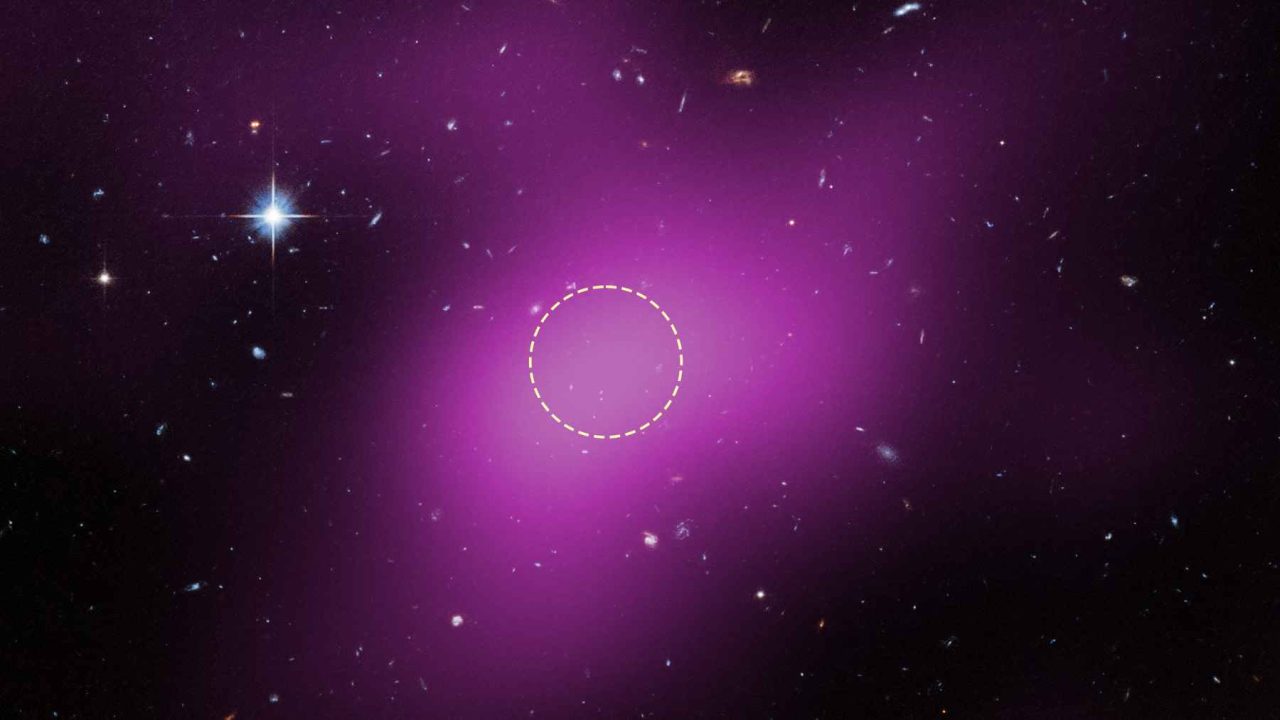
The clock started ticking the moment astronomers pointed the world’s largest radio telescope at an unremarkable patch of sky near spiral galaxy Messier 94. What they found three years ago has been quietly rewriting assumptions about the structure of the universe. Today, with follow-up data from four major observatories now in hand, the scientific community is coming to terms with what Cloud 9 might actually be.
It is not a galaxy. It is not a star cluster. It may be something far more valuable: a nearly pure reservoir of dark matter, sitting in the open, 14 million light-years from Earth. And if the current evidence holds, it could offer scientists their clearest view yet of the substance that makes up most of everything.
What Scientists Have Always Assumed About Dark Matter
Dark matter is estimated to account for about 85% of all matter in the universe. Yet we have never directly observed it. Not once, in any laboratory or with any telescope, has a dark matter particle been captured, imaged, or isolated.
That has led to a working assumption dominating the field for decades. Dark matter exists everywhere, but it can only be studied indirectly, by watching how its gravity bends light or spins galaxies faster than visible mass alone could explain. The substance itself remains invisible, intangible, and thoroughly uncooperative.
Most astronomers have accepted this limitation as essentially permanent. Dark matter research, in this view, is fundamentally an exercise in inference. You study the effects and guess at the cause. Cloud 9 is now challenging that assumption directly.
| Object Type | Dark-to-Visible Ratio | Stellar Mass | Stars Visible? |
|---|---|---|---|
| Milky Way | ~10:1 | ~50 billion solar masses | Yes |
| Typical dwarf galaxy | Up to 100:1 | Millions of solar masses | Partially |
| Cloud 9 (RELHIC) | ~5,000:1 | Under 10,000 solar masses | No visible stars |
The Object That Wasn’t Supposed to Exist
In 2022, China’s 500-meter Aperture Spherical Telescope (FAST) detected a faint signal on the outskirts of Messier 94. The signal was a blob of neutral hydrogen gas with no visible galaxy attached. No stars. No active nucleus. Just cold gas, apparently floating in the dark with nothing obvious holding it together.
This was deeply strange. Hydrogen gas clouds are common enough, but they are typically found inside or closely associated with galaxies. Finding one apparently detached, with no stellar population, suggested something unseen was providing the gravitational anchor keeping it from dispersing.
Researchers followed up with three more observatories. The Green Bank Telescope in West Virginia confirmed the gas mass. The Very Large Array in New Mexico mapped its structure in precise detail. Then came the most important data point: Hubble’s Advanced Camera for Surveys scanned Cloud 9 for any hidden dwarf galaxy that might explain the object’s existence.
The result was almost nothing. If a dwarf galaxy is hiding inside Cloud 9, it contains fewer than about ten thousand solar masses of stars. That is less stellar material than many individual star clusters inside our own Milky Way.
A Structure Predicted But Almost Never Found
The leading explanation is that Cloud 9 is a Reionization Limited HI Cloud, classified by astronomers as a RELHIC. These objects were predicted by cosmological simulations years ago, but confirmed sightings have been extraordinarily rare.
The theory works like this. About one billion years after the Big Bang, ultraviolet radiation from the first stars and quasars ionized nearly all the neutral hydrogen in the cosmos. This process, called reionization, pumped enormous energy into surrounding gas. In small dark matter halos, that energy was enough to permanently prevent gas from collapsing into stars.
The dark matter halo stayed intact. The galaxy never formed. The gas slowly cooled over billions of years until today it sits as a nearly perfect sphere of neutral hydrogen about 4,900 light-years across. That core is roughly 1.5 times the distance from Earth to the center of our own galaxy.
The nearly spherical shape is itself a critical clue. In normal galaxy formation, gas gets compressed, heated, and distorted by stellar radiation, supernovae, and galactic winds. A near-perfect sphere suggests Cloud 9’s gas has experienced almost none of that turbulence. It has been sitting undisturbed for an extraordinarily long time.
Alejandro Benítez Llambay, the principal investigator of the study, has described Cloud 9 as a potential breakthrough for understanding how dark matter halos behave without interference from ordinary matter. The absence of stars removes the noise that makes dark matter so difficult to study in normal galaxies. It is the cleanest sample astronomers have ever had access to.
Frequently Asked Questions




Leave a Reply