
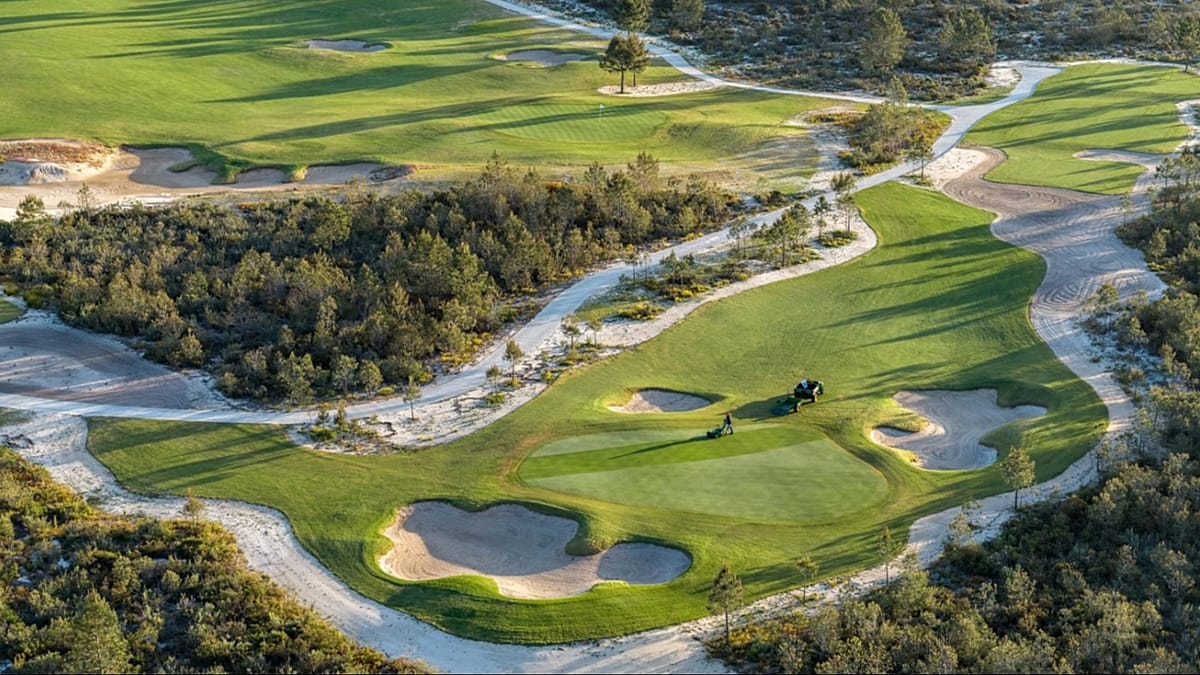
Nearly 60 million people worldwide watched the Masters tournament last year, and travel booking platforms report a consistent 35% spike in golf-related searches in the two weeks following the Augusta broadcast. That’s a lot of people suddenly wanting to swing a club somewhere beautiful.
Most of them assume the best golf is already built. That the legendary courses — St Andrews, Ballybunion, Royal Portrush — have long since set the ceiling. That nothing new can really compete.
They’re wrong. And the evidence is stacking up fast.
The Common Belief: Europe’s Great Golf Courses Are All Old Ones
There’s a deeply held mythology in golf travel. The sport prizes tradition. Tweed jackets, hickory shafts, courses that have hosted Opens for a century. When golfers plan pilgrimages after watching Augusta’s immaculate fairways, they typically reach for the familiar bucket list: Scotland’s links, Ireland’s wild coastlines, the Algarve’s sun-baked resorts.
The assumption is that these destinations’ best courses are already built and well-catalogued. You book, you play, you check the box. New courses, in this worldview, are second-tier experiences for developers who couldn’t buy an established name.
This belief has shaped golf travel marketing for decades. And it has sent millions of travelers to the same tee boxes, paying the same steep premiums. A summer round at Wentworth, for instance, now costs up to £360 including the compulsory caddy fee — a figure that makes even devoted players pause.
The Crack in the Myth: Construction Is at an All-Time High
Here’s what the traditional narrative misses entirely. Golf course construction across Europe is not slowing down. It’s accelerating. Industry observers tracking new projects in 2025 describe the pipeline as the most ambitious in a generation, with dozens of courses in various stages of completion across the continent.
The World Golf Awards have been tracking this phenomenon through their annual Europe’s Best New Golf Course category, now in its 12th year. What’s striking about the 2025 nominees isn’t just the quality — it’s the geographic ambition. Courses range from Tuscany to the Arctic Circle, from Portuguese clifftops to the wind-scoured northeast of Scotland.
The breadth signals something important: European golf is not consolidating around established hubs. It’s expanding into new territory, both literally and aesthetically.
| Destination | Notable New Offering | Appeal for Masters Fans |
|---|---|---|
| Northeast Scotland | New Course, Trump International Resort | World Golf Awards: Europe’s Best New Course 2025 |
| Ireland | Multiple new links developments | Wild coastal terrain, classic links challenge |
| Portugal (Algarve) | Emerging resort courses | Year-round sunshine, growing tour presence |
| Tuscany, Italy | Boutique inland layouts | Landscape drama, cultural immersion |
| Northern Scandinavia | Arctic Circle resort golf | Midnight sun rounds, extreme novelty |
Why the Old Assumption Fails Modern Golf Travelers
The traditional golf travel model has a pricing problem. England’s most exclusive course, Queenwood Golf Club near Ottershaw in Surrey, doesn’t even accept visitor green fee bookings. It’s a members-only world that most travelers can admire only from the roadside. The legacy courses that do accept visitors have responded to surging demand with surging prices.
Meanwhile, the new courses entering the market carry a different philosophy. Many are designed to attract international visitors from day one. They’re built with modern agronomy, superior drainage systems, and the kind of practice facilities that legacy courses, constrained by their historic footprints, simply cannot offer.
The design philosophy has also shifted. Post-Augusta, the world’s top architects understand that golfers want a visual and emotional experience, not just a technical test. New European courses are being sculpted with this in mind: dramatic elevation changes, water features, and panoramic viewpoints that reward the traveler as much as the player.
Scotland’s Northeast and the 2025 World Golf Awards Winner
The clearest evidence of Europe’s new course revolution sits on the coastline of northeast Scotland. The New Course at the Trump International golf resort earned the title of Europe’s Best New Golf Course for 2025 at the World Golf Awards. This isn’t a regional consolation prize. The World Golf Awards attract entries from across the entire continent.
The northeast Scotland setting matters beyond the accolade. This stretch of coastline offers something that even St Andrews, just down the eastern seaboard, cannot replicate: genuine discovery. Travelers who arrive expecting a polished but predictable links experience frequently report being stunned by the terrain’s raw scale and the course’s integration with its surroundings.
“From Tuscany to the Arctic Circle, these eight golf courses and resorts showcase the diversity of options for golfers in Europe.”
— Kingdom Golf, on European golf travel diversity in 2025
Ireland and Portugal round out the most compelling new-course destinations. Ireland’s new links developments lean into the country’s natural advantage: coastal terrain that seems almost architecturally designed for golf already. Portugal, particularly the Algarve, is leveraging its year-round playability to build courses targeting the serious traveler who wants sun without sacrificing challenge.
What This Means If You’re Planning a Golf Trip in 2026
The practical implications are significant and, for most travelers, encouraging. The post-Masters booking surge used to funnel almost entirely into a handful of oversubscribed legacy venues. That’s changing. New courses are actively courting international visitors with competitive rates, premium service models, and tee-time availability that famous old clubs simply cannot match.
Travelers willing to look past the household names will find that Scotland’s northeast, Ireland’s newer links territories, and Portugal’s emerging resort scene offer experiences that are, in several measurable ways, superior to the legend-bound alternatives. Better conditioning on new greens. More accommodating booking systems. Hospitality infrastructure built for the modern golfer, not retrofitted into a Victorian clubhouse.
The Masters effect on golf travel is real, but its destination is shifting. Augusta inspires the aspiration. The new courses of Europe are increasingly the answer to it.
The golfer who spends £360 for a summer round at Wentworth is paying for a name. The golfer who seeks out a World Golf Award winner in northeast Scotland is paying for an experience that no one else in their club has had yet. In 2026, that distinction is worth more than any legacy ranking.
The best courses in Europe may not be the oldest ones. They might be the ones that opened last year — and the ones that will open next spring, somewhere along a coastline you haven’t heard of yet.
Frequently Asked Questions

You Might Also Like

Newcastle Travelers Now Have a Direct Path Into Southeast Asia
Travelers from Newcastle and the broader New South Wales region of Australia now have a…
United Airlines Flight UA1578 Diverted Mid-Route After Crew Spotted a Problem
A routine cross-country flight turned into an unplanned stop in the Midwest when United Airlines…

How Event Tourism Is Quietly Reshaping Destinations Through Make in India
When India launched the “Make in India” initiative in 2014, the headlines focused on cars,…
Leave a Reply