
▶ Read transcript
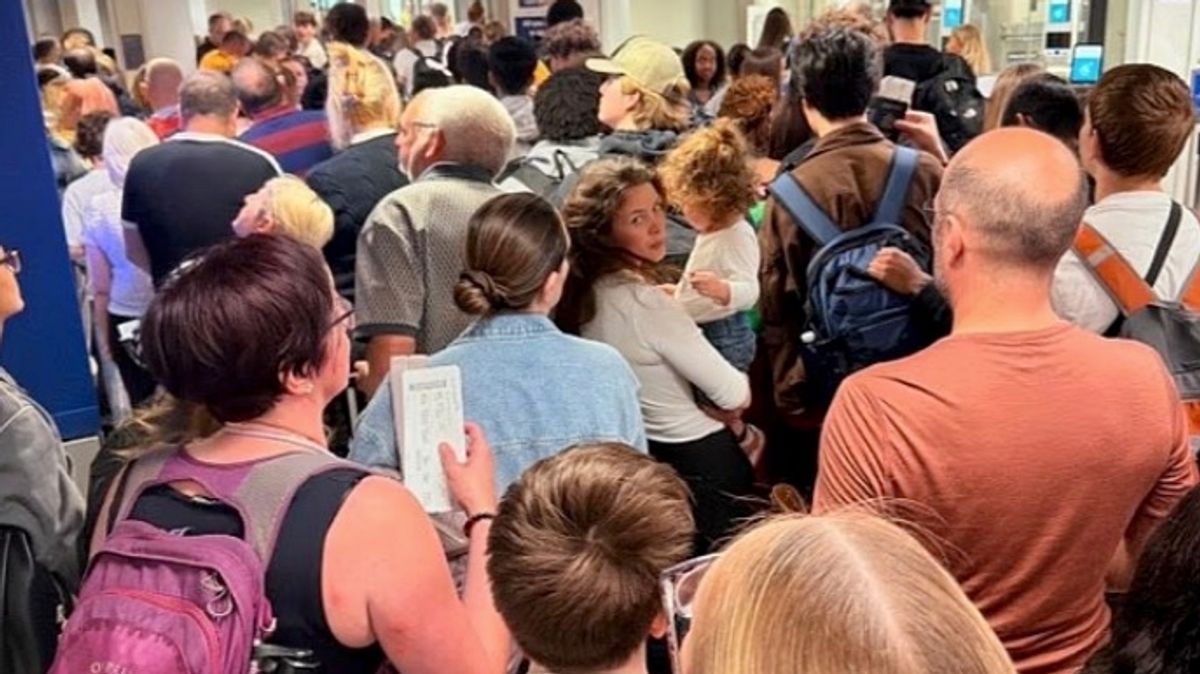
Here’s what you need to know about Europe’s new border system and why it’s causing chaos for travelers. The EU’s Entry-Exit System, known as EES, launched in early 2026 and almost immediately caused a major incident at Milan Linate airport, where at least 122 EasyJet passengers missed their flights home to the UK. The system replaces old passport stamps with biometric data collection — fingerprints and facial scans — and while the long-term security goals make sense, the rollout has been a mess. Passengers reported arriving three to five hours early and still missing their departures, with one family spending over sixteen hundred pounds just to get home. EasyJet blamed the EU border scheme, but critics point out the airline chose to leave without those stranded passengers. Milan wasn’t an isolated case either — similar delays have hit multiple EU airports. So here’s your takeaway: if you’re flying through any EU airport in 2026, build in extra time and check whether your specific airport has fully integrated the new biometric scanning system before you book.
Here is a claim that will irritate a lot of people: the chaos at Milan Linate airport was not really EasyJet’s fault. It was not the fault of Italian border officials, either. The real culprit is a bureaucratic fantasy, one that assumed a continent of 27 nations could flip a technological switch and modernize border control overnight without a single passenger suffering the consequences.
That fantasy now has a name: the EU Entry-Exit System, or EES. And in early 2026, it delivered its first spectacular failure on British travelers hoping to catch budget flights home from Italy.
What Happened at Milan Linate: 122 Passengers, One Very Long Queue
The facts are striking. A group of at least 122 EasyJet passengers were stranded at Milan Linate airport after the airline departed without them. According to reporting by The Independent, one family spent over £1,600 simply to arrange alternative travel home. Others described arriving three to five hours before their flight, standing in queues the entire time, and still missing their departure.
Passengers were not just frustrated. Some were reportedly fainting in the lines. Families with young children were left stranded. EasyJet issued a statement saying the situation was “outside of our control,” pointing directly at the EU’s new border scheme as the source of delays.
The EES was designed as a digital upgrade to Schengen border crossings. It replaces paper passport stamps with biometric data collection: fingerprints, facial scans, and travel records stored in a centralized EU database. The stated goal was efficiency. The lived experience, at least in Milan, was the opposite.
The Case That EES Is a Necessary, Defensible Reform
Supporters of the Entry-Exit System argue that critics are confusing a painful launch period with a fundamentally flawed policy. They have a point worth taking seriously.
Before EES, the EU had no reliable, automated way to track whether non-EU travelers were actually leaving the Schengen zone when their visas expired. Passport stamps were manual, inconsistent, and easy to falsify. Overstay enforcement was essentially guesswork. The EES was designed to fix that structural gap, creating a real-time database that border agencies across 27 countries could access simultaneously.
From a security standpoint, the logic is sound. Biometric data is harder to forge than an ink stamp. A centralized system theoretically allows faster cross-referencing of traveler records. And the EU has been planning this transition for years, giving airports and airlines substantial lead time to prepare.
“The EES was marketed as a slicker border experience that would ultimately reduce wait times once fully operational.”
— Simple Flying analysis of the Milan incident
Proponents also note that teething problems are normal for any large-scale infrastructure rollout. The United States spent years refining its own biometric entry systems before they ran smoothly. Expecting perfection from day one, they argue, is unrealistic.
The Case That EES Was Rolled Out Recklessly, With Passengers Paying the Price
The counter-argument is harder to dismiss, and frankly, more compelling given the evidence on the ground.
Passengers at Milan Linate reported arriving three to five hours before their flights, standing in continuous queues, and still missing their departures. That is not a teething problem. That is a systemic failure of planning, infrastructure, and coordination between the EU’s policy ambitions and the operational realities of busy commercial airports.
EasyJet’s response, while technically accurate, also raised eyebrows. Telling 122 stranded passengers that the situation was “outside of our control” does not address the question of why the airline departed without waiting for passengers who were demonstrably in the airport, caught in a queue created by a known systemic issue. Airlines have discretion over departure times. Using that discretion to abandon paying customers mid-crisis is a choice, not a force of nature.
Critics also point to the broader pattern. Reports of delays, missed flights, and overwhelmed border infrastructure have emerged from multiple EU airports since EES began rolling out. Milan was not an isolated incident. It was the most dramatic example of a recurring failure.
| Factor | EES Defenders Say | EES Critics Say |
|---|---|---|
| Processing speed | Will improve once infrastructure matures | Unacceptably slow now, harming real travelers |
| Airline responsibility | Airlines cannot control border agency delays | Airlines chose to depart without stranded passengers |
| Traveler preparation | Passengers should arrive earlier given known delays | Arriving 3-5 hours early and still missing flights is unreasonable |
| Long-term security benefit | Biometric tracking closes real overstay loopholes | Short-term chaos undermines public trust in EU travel |
What the Data and Passenger Accounts Actually Reveal
Beyond the debate, the documented evidence from Milan paints a clear picture. Passengers described queuing for the entire duration of a three-to-five hour window before departure, only to watch their flight leave without them. That account, shared widely on social media and reported by outlets including The Mirror, suggests the EES processing bottleneck was severe enough to make standard check-in timelines functionally useless.
The physical toll was real, too. Reports of passengers fainting in queues are not hyperbole. Long waits in crowded airport corridors, combined with stress, heat, and uncertainty, create genuine health risks, particularly for elderly travelers, families with young children, and anyone with underlying conditions.
According to Simple Flying, the EES was positioned as a modernization that would eventually make border crossings faster. The word “eventually” is doing enormous work in that sentence. For the 122 passengers left behind in Milan, “eventually” offered zero comfort.
| Airport | EES Infrastructure Status | Average Border Wait Time (2026) | Biometric Scanners Deployed | Passenger Complaints Reported | Airline Cooperation Rating |
|---|---|---|---|---|---|
| Milan Linate (LIN) | Partial Integration | 45-90 minutes | Limited rollout | High — 122+ stranded in single incident | Poor |
| Paris Charles de Gaulle (CDG) | Full Integration | 15-25 minutes | Comprehensive | Moderate | Good |
| Amsterdam Schiphol (AMS) | Advanced Integration | 10-20 minutes | Comprehensive | Low | Excellent |
| Rome Fiumicino (FCO) | Partial Integration | 30-60 minutes | Moderate rollout | Moderate-High | Fair |
| Barcelona El Prat (BCN) | In Progress | 35-75 minutes | Limited rollout | High | Fair |
The Editorial Verdict: Both Sides Are Partly Right, and That Is the Problem
The EES is not inherently a bad idea. Modernizing border control across a 27-nation bloc is genuinely complex work, and the long-term security case for biometric tracking has merit. But good policy intent does not excuse catastrophic implementation.
Rolling out a system that creates multi-hour processing queues at major commercial airports, without first ensuring that airlines, airports, and border agencies have coordinated contingency protocols, is a failure of governance. The passengers stranded in Milan were not collateral damage in an abstract policy debate. They were people who paid for flights, followed instructions, arrived early, and were still abandoned.
EasyJet’s posture, that this was entirely outside their control, is also inadequate. Airlines have operational discretion. They exercise it constantly, holding flights for mechanical issues, weather delays, and crew problems. Choosing not to exercise that discretion when passengers are visibly trapped in a government-created queue is a decision that deserves scrutiny, not a pass.
The real accountability gap here sits between the EU’s policy apparatus and the airlines operating within it. Neither side has fully accepted responsibility. And until one of them does, passengers will keep paying the price.
What Travelers Heading to Europe in 2026 Must Do Differently
The practical implications of this debate are immediate. If you are flying through any EU Schengen-area airport in 2026, the old advice of arriving two hours before an international flight is no longer sufficient. Based on what happened in Milan, that buffer needs to be at least three hours, and potentially more at airports with known EES integration problems.
Check the specific airport you are departing from. Some EU airports have invested heavily in biometric kiosks and staffing to handle EES processing efficiently. Others have not. The difference between a smooth departure and a missed flight may come down to which terminal you are walking through.
Travel insurance also becomes more important in this environment. Policies that cover missed flights due to border control delays are worth the premium. The family that spent over £1,600 getting home from Milan learned that lesson the hard way.
Finally, document everything. If you are stuck in an EES queue and your flight departs without you, photograph the queue, note the time, and keep all communications with airline staff. Compensation claims for missed flights caused by third-party border delays occupy murky legal territory, but documentation strengthens your position considerably.
The deeper question, the one that will define European air travel for the next several years, is whether the EU and its member states will treat Milan Linate as a wake-up call or a footnote. The answer will arrive not in press releases, but in the queues at departure gates across the continent, measured in minutes, in missed flights, and in the patience of travelers who were promised a smoother journey and received something else entirely.
Frequently Asked Questions

You Might Also Like

UAE Restaurants Are Getting Upfront Capital Through Mezza’s New Platform
A new platform launching in the UAE is offering restaurants something the industry rarely gets…
Calgary Travelers Just Got a Faster Route to Asia Nobody Saw Coming
Getting from Calgary to Taipei used to mean a long, complicated journey with multiple connections…
Air Astana’s Expanding Routes Are Quietly Opening Up Kazakhstan to the World
Kazakhstan has long sat at the crossroads of civilizations, but for most international travelers, it…
Leave a Reply