
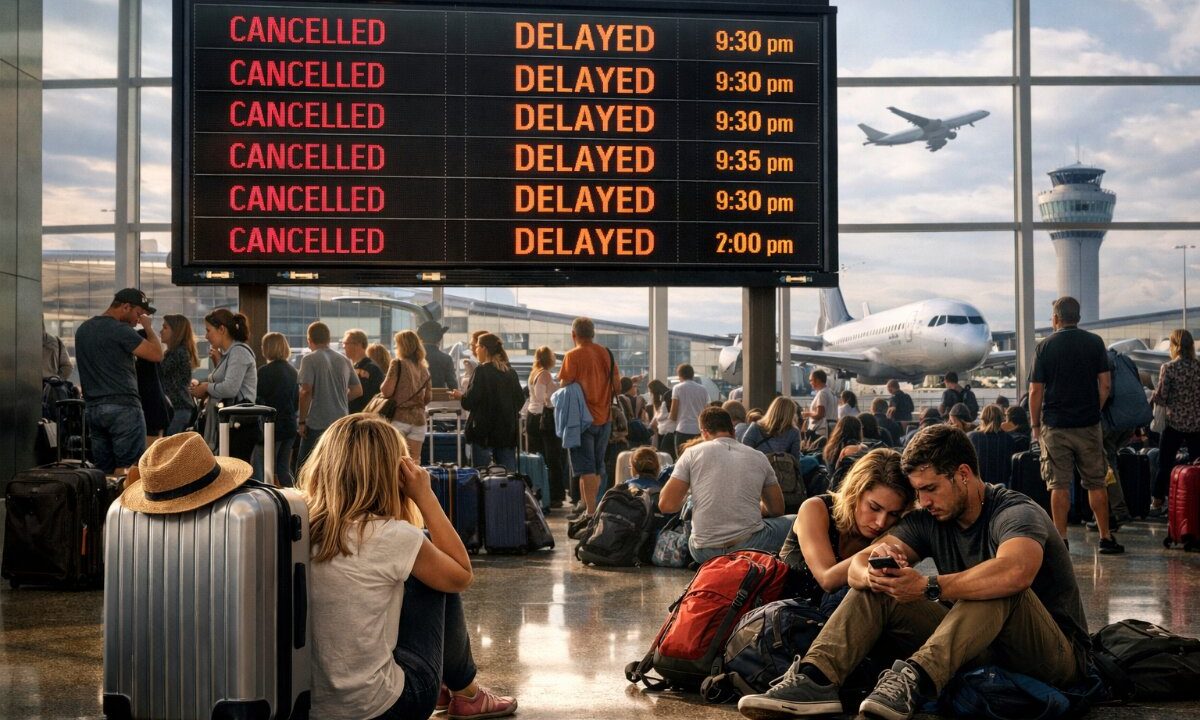
Hundreds of passengers across Europe were left stranded or stuck in long queues on March 28, 2026, as 33 flights were cancelled and 517 flights were delayed across some of the continent’s busiest airports. The disruptions hit multiple major hubs simultaneously, creating a cascade of chaos that rippled through travel plans for thousands of people.
The airports affected include London Heathrow, Paris Charles de Gaulle, Amsterdam Schiphol, Copenhagen Airport, and Reykjavik Keflavik International Airport. Together, these five airports handle tens of millions of passengers each year — making a coordinated disruption of this scale particularly damaging to European air travel.
For anyone with flights booked through any of these hubs, the situation on the ground was far worse than a simple delay notification could convey. Passengers faced extended waits, missed connections, and in many cases, outright cancellations with no immediate rebooking available.
(function(){var wrp=document.getElementById(“paap_stat_69caca7306fe27.15114150”);if(!wrp)return;var ids=[“paap_stat_69caca7306fe27.15114150_c0″,”paap_stat_69caca7306fe27.15114150_c1”];var dur=1800;function ease(t){return 1-Math.pow(1-t,3);}function anim(){ids.forEach(function(id){var el=document.getElementById(id);if(!el)return;var tgt=parseFloat(el.getAttribute(“data-target”))||0;var pfx=el.getAttribute(“data-prefix”)||””;var sfx=el.getAttribute(“data-suffix”)||””;var dec=parseInt(el.getAttribute(“data-decimals”))||0;var st=null;function step(ts){if(!st)st=ts;var p=Math.min((ts-st)/dur,1);var v=ease(p)*tgt;el.textContent=pfx+v.toFixed(dec)+sfx;if(p<1)requestAnimationFrame(step);}requestAnimationFrame(step);});}if("IntersectionObserver" in window){var obs=new IntersectionObserver(function(e){e.forEach(function(en){if(en.isIntersecting){anim();obs.disconnect();}});},{threshold:0.2});obs.observe(wrp);}else{anim();}})();
What Triggered This Wave of Flight Disruptions Across Europe
The disruptions began on March 28, 2026, and spread across multiple airports in a short window of time. While the specific root cause has not been detailed in confirmed reports, the scale of simultaneous delays across geographically spread airports — from Iceland to the Netherlands to the UK and France — points to a systemic issue affecting multiple airlines or air traffic control operations.
Events of this kind are rarely caused by a single factor. Air travel disruptions at this scale typically involve a combination of staffing shortages, technical failures, adverse weather, or air traffic control restrictions. What made this incident particularly notable was how many airports were affected at once, leaving passengers with few options to reroute.
London Heathrow and Paris Charles de Gaulle were identified as among the worst-hit locations. Both airports serve as major connecting hubs, which means delays there tend to multiply — a delayed inbound aircraft becomes a delayed outbound flight, and the knock-on effect compounds across dozens of routes within hours.
The Five Airports at the Centre of the Disruption
Each of the affected airports plays a significant role in European aviation. Here’s what was reported at the key locations:
- London Heathrow Airport — One of the busiest airports in the world and among the hardest hit in this disruption event.
- Paris Charles de Gaulle Airport — A major European hub, also identified as one of the worst-affected airports.
- Amsterdam Schiphol Airport — A critical connecting point for transatlantic and intra-European routes.
- Copenhagen Airport — A key Scandinavian gateway, caught up in the wider disruption.
- Reykjavik Keflavik International Airport — Iceland’s primary international airport, also impacted by the wave of delays.
| Airport | Location | Disruption Status |
|---|---|---|
| London Heathrow | United Kingdom | Among worst-hit; significant delays and cancellations |
| Paris Charles de Gaulle | France | Among worst-hit; major delays reported |
| Amsterdam Schiphol | Netherlands | Affected by widespread delays |
| Copenhagen Airport | Denmark | Affected by widespread delays |
| Reykjavik Keflavik | Iceland | Affected by widespread delays |
How This Is Hitting Passengers Right Now
For anyone caught in this disruption, the experience has been exhausting and, in many cases, expensive. Passengers stranded at airports face a chain of problems that goes well beyond a longer wait at the gate.
Missed connections are the immediate concern. A delay at Heathrow can mean a missed onward flight from Amsterdam or Paris, and rebooking on busy routes during peak periods is rarely straightforward. Hotels, car hire bookings, and pre-arranged ground transport all become collateral damage when a flight doesn’t depart on time — or at all.
Travellers with cancelled flights are entitled to support under European aviation consumer protection rules, which generally require airlines to offer rebooking options, meals, and accommodation depending on the length of delay and distance of the route. However, exercising those rights in the middle of a widespread disruption — when airline staff are overwhelmed and airport services are stretched — is rarely as simple as the rules suggest.
Families travelling with young children, passengers with accessibility needs, and those on tight connection windows are typically the most vulnerable when events like this unfold. The sheer number of delays — 517 across five airports — means airline support desks and customer service lines are likely under severe strain.
What Affected Passengers Should Do Next
If you have a flight booked through any of the five affected airports — particularly Heathrow or Charles de Gaulle — checking your flight status directly with your airline before heading to the airport is the most practical first step. Real-time flight status tools at each airport’s website can also provide up-to-date departure information.
Passengers whose flights have been cancelled should document everything: keep all receipts for meals, transport, and accommodation incurred as a direct result of the disruption. These may be recoverable through your airline or travel insurance provider.
For those still in transit or waiting at one of the five airports, the priority is to get in contact with the airline directly — either at the check-in desk, through the airline’s app, or via customer service. Waiting in general queues at the airport can cost hours that might be better spent rebooking remotely.
The disruption began on March 28, 2026, and the extent to which delays continued into March 29 and beyond had not been fully confirmed at the time of reporting. Passengers with upcoming travel through these hubs in the days following should monitor airline communications closely for any further schedule changes.
Frequently Asked Questions
How many flights were affected by this European disruption?
A total of 33 flights were cancelled and 517 flights were delayed across the five affected airports.
Which airports were impacted?
The disruptions affected London Heathrow, Paris Charles de Gaulle, Amsterdam Schiphol, Copenhagen Airport, and Reykjavik Keflavik International Airport.
When did the disruptions begin?
The disruptions began on March 28, 2026, according to confirmed reports.
Which airports were hit the hardest?
London Heathrow and Paris Charles de Gaulle were identified as among the worst-hit locations in this disruption event.
What caused the mass delays and cancellations?
The specific cause has not been confirmed in available reporting. The scale and spread of the disruption across five airports suggests a significant systemic issue.
Are passengers entitled to compensation?
Passengers affected by cancellations on routes covered by European aviation consumer protection rules may be entitled to rebooking, meals, and accommodation, though specific entitlements depend on the airline, route, and circumstances of the disruption.



Leave a Reply