
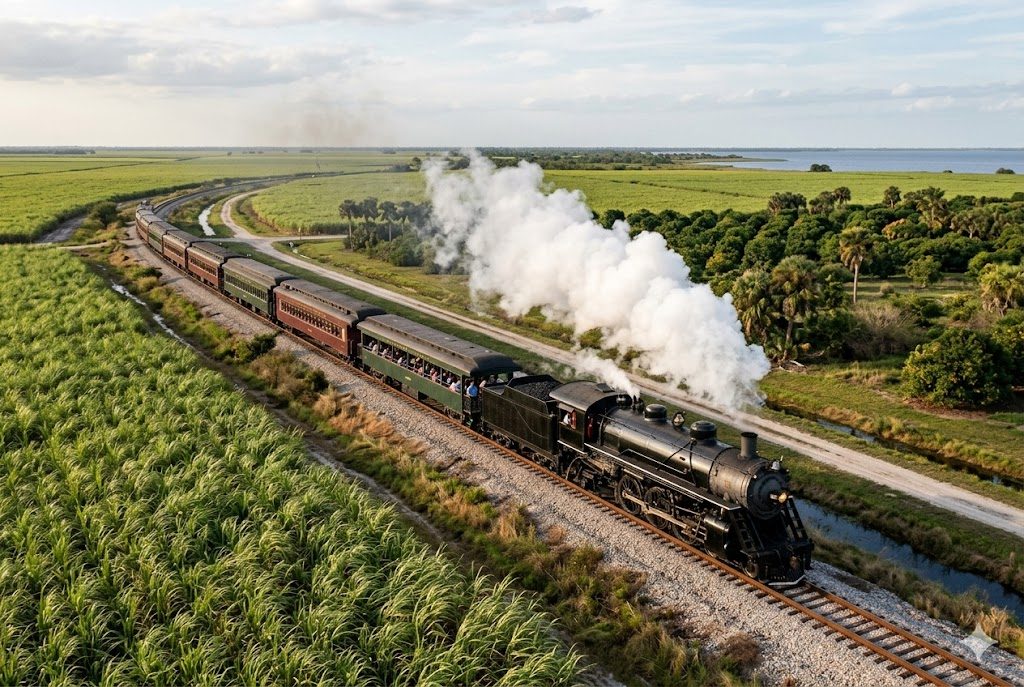
A steam locomotive hasn’t turned heads in Florida quite like this in decades. The return of Steam Locomotive No. 148 — a 4-6-2 “Pacific” type engine — is drawing families to the trackside, eyes fixed on billowing white clouds rising against the Florida sky, ears tuned to the deep, rhythmic chuff that once defined American industrial life.
This isn’t a museum display or a static exhibit behind velvet ropes. The US Sugar Express is a moving, breathing piece of American railway history, and its revival is stirring something genuine in the people who come out to see it. For many, it’s the first time they’ve witnessed a working steam engine in the flesh — and the experience lands differently than any photograph or documentary could prepare you for.
The Florida Department of State has highlighted the deep roots of the state’s rail industry, lending institutional weight to what might otherwise seem like a nostalgic curiosity. This project is being treated as something more significant — a living monument to the working people and industrial ambition that shaped the American South.
The US Sugar Express and the Engine at Its Heart
The centerpiece of this revival is Steam Locomotive No. 148, classified as a 4-6-2 “Pacific” type. That designation refers to the wheel arrangement — four leading wheels, six driving wheels, and two trailing wheels — a configuration that was widely used across American railroads during the early-to-mid twentieth century for its balance of speed and hauling power.
The US Sugar Corporation has long operated one of the most extensive private railway networks in the United States, running through the sugarcane fields of south-central Florida. That network exists primarily for agricultural transport, but the return of a steam locomotive to those rails carries a symbolic weight that goes well beyond moving crops.
Supporters of the project argue that this kind of living history is irreplaceable. You can read about the steam era, but standing next to a working locomotive — feeling the heat, hearing the pressure release, watching the pistons drive those massive wheels — is a fundamentally different kind of education. It connects people to the labor and ingenuity of earlier generations in a way that no digital exhibit can replicate.
What Makes This Revival Significant
Working steam locomotives in regular operation are genuinely rare in the United States today. Most have been retired to museums or scrapped entirely, and the mechanical expertise required to maintain and operate them safely has become increasingly scarce. When one returns to active service, it’s an event worth paying attention to.
| Detail | Information |
|---|---|
| Locomotive Name/Number | Steam Locomotive No. 148 |
| Locomotive Type | 4-6-2 “Pacific” type engine |
| Operating Context | US Sugar Express Railway, Florida |
| Institutional Recognition | Florida Department of State |
| Setting | South-central Florida sugarcane rail network |
The 4-6-2 Pacific configuration was a workhorse of American railroading. Its return to Florida rails — even in a ceremonial or limited capacity — gives rail enthusiasts, history buffs, and curious families a chance to witness machinery that defined an era of American expansion and agricultural development.
The Florida Department of State’s involvement signals that this isn’t being treated as a private novelty. There is a broader cultural preservation angle here, one that connects the state’s identity to the industries and infrastructure that built it.
Why Florida Families Are Showing Up Trackside
There’s an emotional dimension to this story that’s hard to quantify but impossible to ignore. Accounts from the trackside describe families gathering specifically to watch the locomotive pass — not just rail enthusiasts with notebooks, but parents bringing children to witness something they themselves may only have read about.
The thick white steam against a clear blue Florida sky is a striking visual, but it’s the sound that people seem to remember most. The deep chuff of a steam engine under load is a physical sensation as much as an auditory one. It carries weight — literally and historically.
For communities in Florida’s agricultural heartland, there’s also a sense of local pride at work. The US Sugar rail network is woven into the landscape and the economy of the region. Seeing that network host a piece of genuine railway history reinforces a connection between the land, the labor, and the people who have worked it for generations.
What Happens Next for the US Sugar Express
The immediate draw is clear — people want to see Locomotive No. 148 in motion. Whether the US Sugar Express evolves into a regular excursion service, a seasonal event, or a broader heritage tourism offering has not yet been confirmed from available information.
What is clear is that the appetite exists. Heritage railway experiences have seen growing interest across the United States, and Florida — with its year-round tourism infrastructure and warm weather — is well positioned to support that kind of attraction. The combination of a genuine working steam locomotive, a historically significant rail network, and a state government that has formally acknowledged the industry’s cultural importance creates a foundation that advocates say deserves further development.
For now, the most immediate opportunity is simply to go and witness it. A working steam locomotive is a finite experience — the mechanical complexity, the operational costs, and the rarity of the expertise required mean these moments don’t last forever. When one is running, the case for showing up is straightforward.
Frequently Asked Questions
What is Steam Locomotive No. 148?
It is a 4-6-2 “Pacific” type steam engine that serves as the centerpiece of the US Sugar Express Railway revival in Florida.
What does the 4-6-2 “Pacific” classification mean?
It refers to the wheel arrangement of the locomotive — four leading wheels, six driving wheels, and two trailing wheels — a configuration common in American railroading.
Where does the US Sugar Express operate?
The railway operates through the sugarcane fields of south-central Florida, part of the US Sugar Corporation’s extensive private rail network.
Has the Florida Department of State been involved?
Yes, the Florida Department of State has highlighted the deep roots of the state’s rail industry in connection with this project.
Can the public attend or ride the US Sugar Express?
Specific ticketing or public access details have not yet been confirmed from available information.
Why is a working steam locomotive considered rare?
Most steam locomotives in the United States have been retired to museums or decommissioned, making active operating examples genuinely uncommon today.



Leave a Reply