
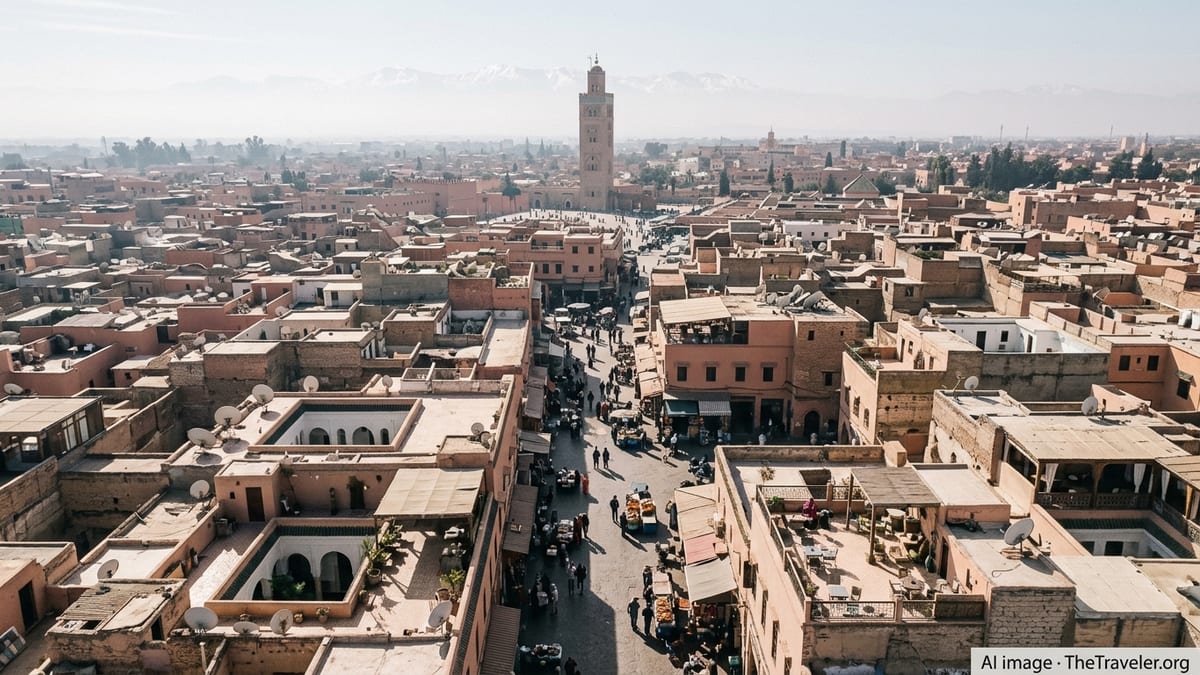
More than 1.3 million international visitors arrived in Morocco during January 2026 alone — and the country is only picking up speed. Official data from Morocco’s Directorate of Studies and Financial Forecasts confirms a 3% year-on-year increase for the month, a figure that signals the kingdom’s tourism engine is running stronger than ever as it pushes toward an ambitious 2030 growth target.
What makes that number particularly striking is the source of the growth. France surged ahead of every other country — including the United States, Canada, the United Kingdom, Poland, Belgium, and Italy — to claim the top spot among Morocco’s international visitor markets. It’s a notable reshuffling of the rankings, and one that reflects how deeply Morocco has embedded itself into the European travel consciousness.
The momentum isn’t accidental. Morocco has been investing heavily in infrastructure, connectivity, and destination marketing, and those efforts are clearly translating into real arrivals. January is traditionally a quieter month for tourism across many global destinations — which makes crossing the 1.3 million mark all the more impressive.
(function(){var wrp=document.getElementById(“paap_stat_69ca982b50b273.26165343”);if(!wrp)return;var ids=[“paap_stat_69ca982b50b273.26165343_c0″,”paap_stat_69ca982b50b273.26165343_c1”];var dur=1800;function ease(t){return 1-Math.pow(1-t,3);}function anim(){ids.forEach(function(id){var el=document.getElementById(id);if(!el)return;var tgt=parseFloat(el.getAttribute(“data-target”))||0;var pfx=el.getAttribute(“data-prefix”)||””;var sfx=el.getAttribute(“data-suffix”)||””;var dec=parseInt(el.getAttribute(“data-decimals”))||0;var st=null;function step(ts){if(!st)st=ts;var p=Math.min((ts-st)/dur,1);var v=ease(p)*tgt;el.textContent=pfx+v.toFixed(dec)+sfx;if(p<1)requestAnimationFrame(step);}requestAnimationFrame(step);});}if("IntersectionObserver" in window){var obs=new IntersectionObserver(function(e){e.forEach(function(en){if(en.isIntersecting){anim();obs.disconnect();}});},{threshold:0.2});obs.observe(wrp);}else{anim();}})();
Why France Is Now Leading the Pack
France’s rise to the top of Morocco’s source market rankings is one of the most telling details in this story. It overtook a long list of major economies — the US, Canada, the UK, Poland, Belgium, and Italy — to become the single largest contributor of visitors in January 2026.
The France-Morocco travel corridor has deep roots. Historical ties, a large Moroccan diaspora community in France, strong direct flight connections, and Morocco’s growing reputation as a sophisticated short-haul destination all play into the dynamic. For French travelers, Morocco offers a combination of cultural richness, warm weather, and relative affordability that few destinations can match at that distance.
The fact that France is outpacing English-speaking heavyweights like the US, Canada, and the UK also suggests that Morocco’s appeal is increasingly driven by proximity-based repeat visitation rather than one-off long-haul bucket-list trips — a sign of a maturing destination with a loyal audience.
The Numbers Behind Morocco’s January Tourism Surge
Here’s a breakdown of what the January 2026 data tells us about Morocco’s tourism landscape:
- Total arrivals: Over 1.3 million international tourists in January 2026
- Growth rate: 3% increase versus January 2025
- Top source market: France, outranking the US, Canada, UK, Poland, Belgium, and Italy
- Data source: Morocco’s Directorate of Studies and Financial Forecasts
- Strategic context: Results align with Morocco’s ongoing push toward its 2030 mega-growth vision for tourism
| Source Market Ranking (January 2026) | Status vs. Prior Period |
|---|---|
| France | Top position — overtook all others |
| United States | Ranked below France |
| Canada | Ranked below France |
| United Kingdom | Ranked below France |
| Poland | Ranked below France |
| Belgium | Ranked below France |
| Italy | Ranked below France |
What This Means for Travelers and the Industry
For travelers, Morocco’s sustained tourism growth has real implications. As the country attracts more visitors and moves toward its 2030 targets, investment in hospitality infrastructure, transport links, and tourism services is expected to continue expanding. That generally means more flight routes, more accommodation options, and a broader range of experiences available across different price points.
For the travel industry more broadly, Morocco’s performance is a reminder that diversified source markets are a genuine competitive advantage. By drawing visitors from France, North America, the UK, and across Eastern Europe simultaneously, the country reduces its vulnerability to any single market’s economic fluctuations or travel disruptions.
Officials have noted that Morocco’s ability to maintain growth despite global challenges reflects both the strength of its destination offer and the effectiveness of its ongoing investment strategy. The combination of a diversified international visitor base and continued infrastructure development positions Morocco as one of the more resilient tourism economies in the region.
Morocco’s Road to 2030 — and What the January Figures Signal
Morocco has made no secret of its ambitions. The country has been working toward a 2030 mega-growth vision for its tourism sector — a long-term plan designed to dramatically increase arrivals, tourism revenue, and the country’s global standing as a destination.
January’s figures suggest that plan is on track. A 3% growth rate in what is typically one of the slower months of the travel calendar is a meaningful indicator of baseline demand strength. If that trajectory holds across the rest of 2026, Morocco will be well-positioned to report another record-breaking annual total.
The 2030 vision also benefits from a major upcoming catalyst: Morocco is co-hosting the 2030 FIFA World Cup alongside Spain and Portugal. That event is expected to generate an enormous wave of global interest in the country, and the tourism sector is already building toward it. The infrastructure investments being made now will serve both the World Cup audience and the longer-term visitor economy for years beyond 2030.
For now, the January 2026 data confirms what observers of Moroccan tourism have been watching build for several years: this is a destination that has found its momentum, and it doesn’t appear to be slowing down.
Frequently Asked Questions
How many tourists visited Morocco in January 2026?
Morocco recorded over 1.3 million international tourist arrivals in January 2026, according to the Directorate of Studies and Financial Forecasts.
Which country sent the most tourists to Morocco in January 2026?
France was the top source market, overtaking the United States, Canada, the United Kingdom, Poland, Belgium, and Italy.
How does January 2026 compare to the previous year?
Arrivals in January 2026 were up 3% compared to the same month in the prior year, continuing Morocco’s upward tourism trend.
What is Morocco’s 2030 tourism vision?
Morocco has a long-term strategy to significantly grow its tourism sector by 2030, supported by infrastructure investment and diversified international marketing — details of specific targets have not been confirmed in the available data.
Is Morocco co-hosting a major sporting event that could boost tourism further?
Yes, Morocco is set to co-host the 2030 FIFA World Cup alongside Spain and Portugal, an event expected to generate substantial additional international interest in the country.
Why is France outperforming larger economies like the US in Morocco arrivals?
France benefits from geographic proximity, strong direct flight connections, historical ties, and a large Moroccan diaspora community, all of which drive consistent high-volume travel between the two countries.

Leave a Reply