
Forget the marble lobbies. Forget the butler service and the rooftop pools with Himalayan views. If you want to understand where the real opportunity in Indian hospitality lies, look somewhere far less glamorous.
Look at the business traveler checking into a clean, reliable room in Coimbatore. The family road-tripping through Rajasthan who just needs a hot shower and a decent breakfast. The mid-level corporate team attending a conference in Bhubaneswar. These travelers, not the ultra-wealthy, are the engine driving India’s next hotel revolution.
And Hilton just placed a massive bet on them.
The Myth That Luxury Hotels Own India’s Growth Story
Walk into any conversation about India’s booming tourism economy, and the word you’ll hear most is “luxury.” Oberoi, Taj, Leela — these brands dominate the narrative. International publications gush over six-star palace hotels in Udaipur. Travel influencers chase heritage properties in Kerala’s backwaters.
The conventional wisdom is simple: India’s growth market is its wealthy elite, plus high-spending foreign tourists. If you’re a global hotel brand entering India, you go upscale or you go home.
This assumption is not just incomplete. It’s increasingly wrong.
India’s 125-Hotel Deal: What the Royal Orchid Partnership Actually Signals
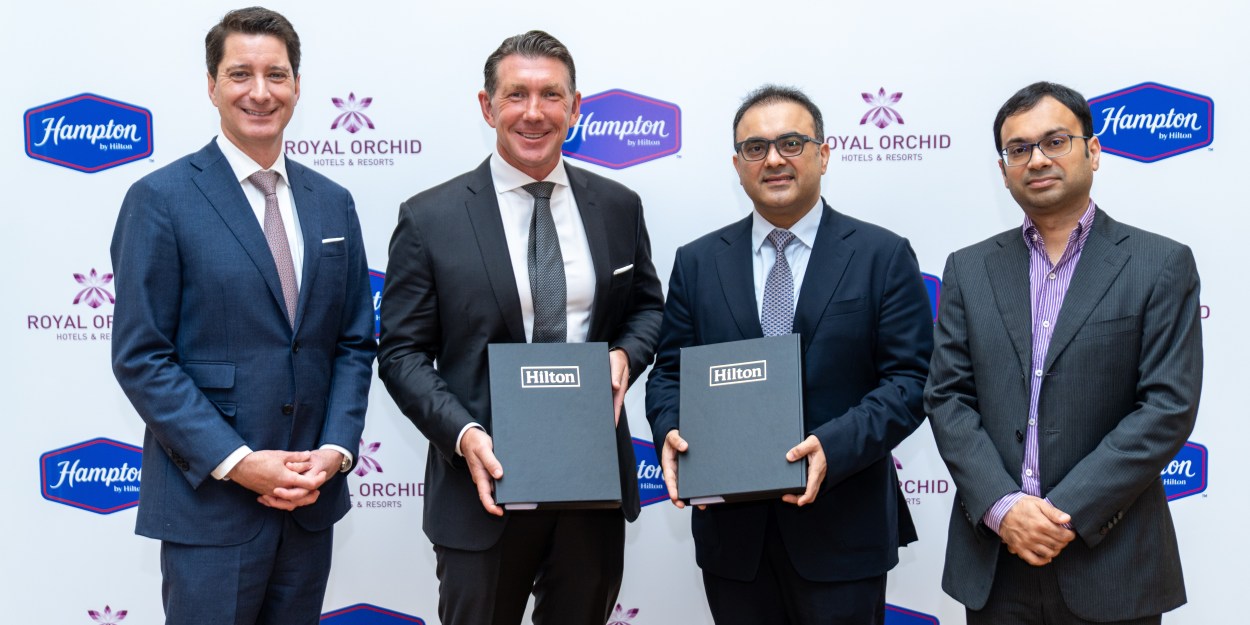
In 2025, Hilton announced a strategic agreement with Regenta Hotels Private Limited, a subsidiary of Royal Orchid Hotels Limited, to sign and open 125 Hampton by Hilton properties across India. It is one of the single largest hotel development agreements in the country’s history.
This is not a plan to add a few boutique properties in Mumbai and Delhi. It is a systematic, nationwide expansion targeting cities that international hotel chains have historically overlooked. Tier-2 cities. Tier-3 cities. Places where a consistent, branded mid-scale hotel experience barely exists today.
Royal Orchid Hotels is not a newcomer. The company already operates its Regenta brand across dozens of Indian cities, giving it infrastructure, local knowledge, and relationships that most foreign hotel groups spend years building. Pairing that reach with Hampton by Hilton’s globally recognized brand standard creates something the Indian market hasn’t seen at scale.
Why Hampton by Hilton and Not Another Brand?
Hampton by Hilton occupies a specific and powerful position in Hilton’s portfolio. It is not a budget brand, but it is not an aspirational luxury brand either. It promises cleanliness, consistency, free hot breakfast, and reliable Wi-Fi — the things that frequent travelers across income levels actually need most.
Hilton acquired Hampton in 1999 when it purchased Promus Hotel Corporation for $3.7 billion, a deal that also brought Embassy Suites, DoubleTree, and Homewood Suites under its umbrella. In the decades since, Hampton grew into one of the most trusted mid-scale hotel brands in the world. Now Hilton is deploying that trust in the world’s most populous country.
| Brand Tier | Typical Indian Traveler Target | Market Gap Before Deal |
|---|---|---|
| Luxury (Taj, Oberoi, Leela) | HNI, international tourists | Saturated in Tier-1 cities |
| Hampton by Hilton (mid-scale) | Business travelers, domestic tourists, families | Massive — especially in Tier-2 and Tier-3 cities |
| Budget (unbranded local hotels) | Price-sensitive travelers | Fragmented, inconsistent quality |
The Real Engine: India’s 500 Million Middle-Class Travelers
India is not just the world’s most populous nation. It is home to one of the fastest-growing middle classes on the planet. Hundreds of millions of people are traveling domestically at rates that would have seemed implausible a decade ago. Domestic air passenger numbers in India have surged, train routes are expanding, and highway infrastructure in Tier-2 corridors is transforming what a road trip looks like.
These travelers are not content with the unbranded guesthouses that previously defined budget hospitality in smaller Indian cities. They have seen better. They have stayed at a Hampton in Singapore or Dubai. They want consistency. They want to know the pillow will be clean and the shower will work.
That expectation gap — between what mid-scale Indian travelers want and what currently exists in hundreds of cities — is exactly where 125 Hampton properties can land.
Royal Orchid’s Regenta Network: The Local Advantage
Any global brand entering India learns the same hard lesson sooner or later: local knowledge is everything. Zoning regulations vary wildly. Construction timelines are unpredictable. Consumer preferences differ dramatically between Gujarat and Tamil Nadu.
Royal Orchid Hotels, through its Regenta brand, has already navigated this terrain. The company’s existing portfolio spans cities across India, including many in the Tier-2 and Tier-3 corridors where this expansion is pointed. That operational intelligence is arguably as valuable as the Hampton brand name itself.
The partnership structure, with Hilton entering through a strategic agreement with Regenta Hotels Private Limited, allows both companies to leverage their strengths without either party overreaching. Hilton provides brand standards, global distribution, and loyalty program integration. Royal Orchid provides boots on the ground.
“The deal is a signal to the entire hospitality industry that India’s mid-scale segment is no longer a secondary consideration. It is the primary battlefield.”
— Industry observation on the Hilton-Royal Orchid expansion strategy
What 125 New Hotels Means for Travelers Booking India Trips Right Now
If you are planning travel to India, the immediate practical reality is this: most of these 125 properties are not open yet. Development agreements of this scale unfold over years. But the pipeline itself changes the calculus for anyone planning trips one, two, or three years out.
Cities that previously had no reliable branded mid-scale option will gain one. Hilton Honors members, who collectively represent one of the most powerful hotel loyalty ecosystems in the world, will be able to earn and redeem points in places they never could before. Corporate travel managers negotiating India travel policies will find more predictable options in secondary cities where they currently rely on unbranded properties with inconsistent quality.
For the budget-conscious international traveler, this is also significant. Hampton by Hilton properties, even in high-demand global markets, tend to land in a price tier that feels accessible compared to Hilton’s luxury brands. In India, that positioning could make a branded Hilton stay genuinely affordable for travelers who previously assumed a Hilton was out of reach.
The Competitive Pressure This Creates
Hilton is not operating in a vacuum. Marriott, IHG, and Wyndham all have India expansion ambitions of their own. But a single agreement that commits to 125 properties, signed through an established local partner with existing infrastructure, is a different kind of move. It is not incremental. It is a structural shift.
Other international brands now face a specific challenge: Royal Orchid, one of the most capable mid-scale development partners in the country, is taken. That limits options for any competitor trying to replicate this strategy with the same efficiency.
The ripple effects for travelers extend beyond just having more Hilton options. More brand competition in India’s mid-scale segment generally drives up quality standards and sharpens pricing across the board. The unbranded local hotel that has faced no real competitive pressure in a smaller city will eventually face some.
One hundred and twenty-five hotels is not just a number. It is a recalibration of who India’s hospitality economy is designed to serve — and the answer, finally, is starting to include everyone who was always there but never quite counted.
Frequently Asked Questions

You Might Also Like

Finland Quietly Outpaced Switzerland and Denmark in Tourism Growth
For the eighth year running, Finland has claimed the top spot on the World Happiness…

Air France Boeing 777 Aborted Takeoff After Runway Breach Still Made It
A Paris-bound Air France Boeing 777 was forced to abort its takeoff roll at Los…

Bangkok Motor Show Reveals Why Thailand’s EV Market Is Shifting Fast
Thailand’s first locally manufactured 100% electric pickup truck just made its public debut — and…
Leave a Reply