
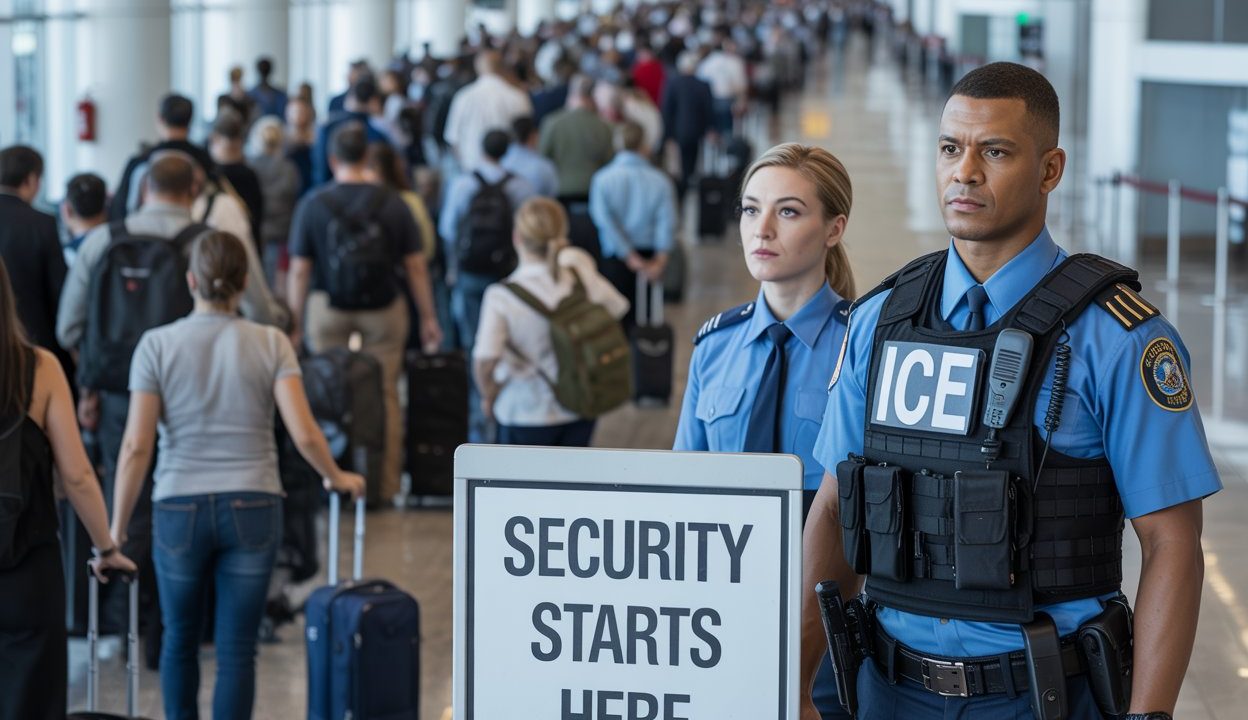
More than 400 TSA officers have resigned since the Department of Homeland Security shutdown began — and thousands more are simply not showing up to work because they can no longer afford the commute. That crisis, now entering its sixth week, has pushed federal authorities to a move that was almost unthinkable just two months ago: deploying ICE agents to staff America’s airport security checkpoints.
The shift became official on Monday, March 23, 2026, when federal immigration agents began appearing at what officials are calling “hotspot” airports across the country. For travelers, the change is visible and jarring. For the broader debate about immigration enforcement and civil liberties, it raises questions that won’t be easy to answer.
This is not a drill, and it is not a minor administrative reshuffling. It is a fundamental change in who is standing between you and your gate — and why that happened matters as much as the fact that it did.
How a Six-Week Shutdown Broke Airport Security
The DHS shutdown didn’t happen overnight, but its effects on TSA have compounded rapidly. The TSA workforce, like all federal employees affected by the shutdown, has been working without pay. For many officers — often among the lower-paid federal workers — that means real, immediate financial hardship.
According to Acting Assistant DHS Secretary Lauren Bis, the numbers tell a stark story. More than 400 TSA officers have formally resigned since the shutdown began. Beyond that, thousands more have been calling out from shifts not because of illness, but because they literally cannot afford the gas to drive to work.
The result is a system under serious strain. Checkpoints that normally run with full crews are operating at reduced capacity. Lines are longer. Wait times are climbing. And the airports that see the highest passenger volumes — the so-called “hotspots” — are feeling it most acutely.
Officials describe the ICE deployment as a “force multiplier,” a way to fill the gaps left by an exhausted and financially battered TSA workforce without completely suspending security operations.
What the ICE Deployment at Airports Actually Means
ICE officers are being pulled from their traditional immigration enforcement duties and redirected to airport security support roles under an executive directive. The framing from DHS is practical: these are trained federal law enforcement agents, and the airports need bodies.
But the controversy is immediate and significant. Critics point out that ICE agents are trained for immigration enforcement, not the specific protocols of passenger screening. There are real questions about whether this deployment changes the nature of what happens at a checkpoint — and whether travelers, particularly those from immigrant communities, will feel safe enough to fly at all.
Supporters of the move argue that having trained federal officers present is better than having understaffed checkpoints, and that the alternative — further degraded security — is worse for everyone.
The debate cuts to something deeper, too. The presence of immigration enforcement agents at domestic travel checkpoints blurs a line that has historically been kept clear: the line between border and interior enforcement, between security screening and immigration status checks.
The Numbers Behind the Crisis
| Metric | Detail |
|---|---|
| Duration of DHS shutdown (as of March 23, 2026) | Six weeks |
| TSA officer resignations since shutdown began | More than 400 |
| Reason for mass call-outs beyond resignations | Officers cannot afford gas or commute costs |
| ICE deployment start date | Monday, March 23, 2026 |
| Described role of ICE at airports | “Force multiplier” for TSA workforce |
| Airports targeted for deployment | High-volume “hotspot” airports nationwide |
- TSA officers are currently working without pay due to the ongoing shutdown
- The deployment was authorized through an executive directive
- Acting Assistant DHS Secretary Lauren Bis confirmed the resignation and absenteeism figures
- ICE agents are being redirected from their standard immigration enforcement responsibilities
Who Feels This Most — and How
If you’re flying through a major hub right now, you’re already feeling the effects. Longer lines, reduced checkpoint staffing, and the unfamiliar presence of agents in different uniforms are the most immediate signs of a system under pressure.
For frequent business travelers, the disruption is a logistical headache. For families with tight connections, it could mean missed flights. For travelers who are undocumented or have mixed-status households, the deployment of ICE agents at checkpoints introduces a layer of anxiety that goes well beyond wait times.
Advocates for immigrant communities have raised concerns about the chilling effect this could have on travel, arguing that the mere presence of immigration enforcement at domestic airports may deter people from flying — even those with every legal right to do so.
TSA officers who are still showing up, meanwhile, are doing so without a paycheck. The financial and emotional toll on that workforce is real, and the resignation numbers suggest it is already pushing people out the door permanently.
What Happens If the Shutdown Doesn’t End Soon
The honest answer is that no one has publicly laid out a clear timeline for resolution. The shutdown is now in its sixth week, and there is no confirmed end date in the source reporting available.
What is clear is that the current situation is not sustainable. The resignation rate will almost certainly continue if TSA officers remain unpaid. The ICE deployment is described as a stopgap — a force multiplier — not a permanent restructuring of airport security. But stopgaps have a way of becoming the new normal when underlying crises go unresolved.
The longer the shutdown continues, the more the question shifts from “how do we get through this week?” to “how do we rebuild a workforce after this is over?” Rehiring and retraining hundreds of security officers takes time. The institutional knowledge that walks out the door with every resignation doesn’t come back quickly.
For now, travelers should expect delays, unfamiliar faces at checkpoints, and an airport experience that feels noticeably different from what it was just two months ago.
Frequently Asked Questions
Why are ICE agents being deployed to airports?
ICE agents are being used as a “force multiplier” to cover gaps left by TSA officers who have resigned or stopped showing up to work because they are not being paid during the ongoing DHS shutdown.
How many TSA officers have left since the shutdown began?
More than 400 TSA officers have formally resigned since the shutdown started, according to Acting Assistant DHS Secretary Lauren Bis. Thousands more have been absent from shifts due to financial hardship.
When did ICE agents start appearing at airports?
The deployment began on Monday, March 23, 2026, following an executive directive authorizing ICE officers to support TSA operations at high-volume airports.
Which airports are affected?
Officials have targeted what they describe as “hotspot” airports — high-traffic hubs experiencing the most severe staffing shortages — though a specific list of airports has not been confirmed in available reporting.
Are ICE agents trained to do TSA screening work?
ICE agents are trained federal law enforcement officers, but their standard training is in immigration enforcement rather than passenger security screening protocols. This distinction is at the center of the controversy surrounding the deployment.
How long will the DHS shutdown last?
No confirmed end date has been announced. As of March 23, 2026, the shutdown has been ongoing for six weeks, with no publicly confirmed resolution timeline available.




Leave a Reply