
Everyone assumes India’s hotel boom is a story about luxury. About rooftop pools in Udaipur and butler service in Mumbai. About five-star palaces competing for the wallets of international tourists who arrive with strong foreign currencies and higher expectations.
That assumption is wrong. And Hilton just made a $125-property bet to prove it.
The Partnership That Targets India’s Overlooked Middle
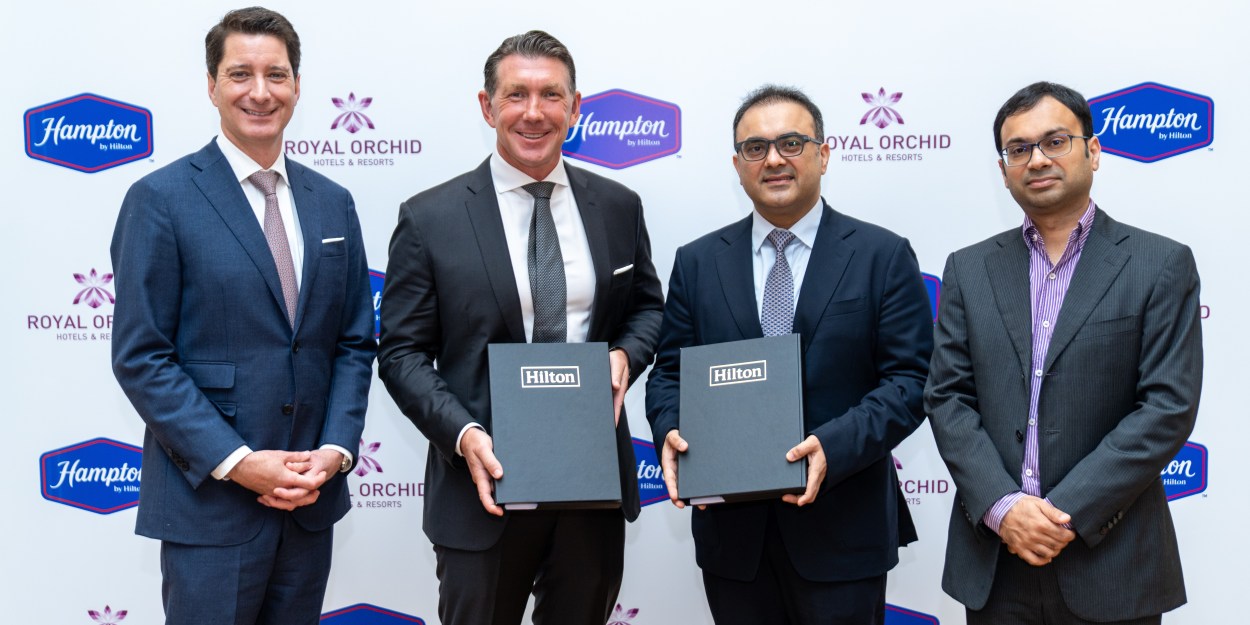
In early 2025, Hilton announced a strategic agreement with Regenta Hotels Private Limited, a subsidiary of Royal Orchid Hotels Limited, to sign and open 125 Hampton by Hilton hotels across India. It is one of the largest single partnership agreements in Hilton’s history for any single market.
This is not a story about a foreign brand parachuting into India with a checkbook. Royal Orchid Hotels has spent decades building credibility in a country where hospitality is personal, regional, and deeply tied to local identity. They know which cities are growing quietly while the world stares at Delhi and Mumbai.
I first visited India’s Tier 2 cities in 2019, reporting on infrastructure development in places like Nashik, Coimbatore, and Bhubaneswar. What struck me was not the development itself. It was the hotels, or the painful absence of reliable ones.
Business travelers arriving for meetings had two options: a budget lodge with questionable plumbing, or an overpriced property that called itself a five-star but delivered the experience of a three. The middle ground simply did not exist.
| Hotel Segment | Typical India Presence | Hampton by Hilton Position |
|---|---|---|
| Ultra Luxury (5-star) | Strong in metro cities | Not applicable |
| Upper Midscale | Very limited, especially in Tier 2/3 cities | Primary target segment |
| Budget / Economy | Fragmented, largely unbranded | Not applicable |
| Branded Midscale | Emerging but underdeveloped | Fills critical supply gap |
How Royal Orchid Hotels Built the Foundation for 125 New Addresses
Royal Orchid Hotels Limited is not a newcomer. The company has built its Regenta brand into a recognizable name across India’s secondary and tertiary markets. That network of relationships, local permits, real estate knowledge, and regional goodwill is precisely what Hilton could not have replicated alone in any reasonable timeframe.
Hilton’s acquisition history gives context here. In 1999, Hilton purchased Promus Hotel Corporation for $3.7 billion, a deal that brought Hampton by Hilton, Embassy Suites, DoubleTree, and Homewood Suites under its roof. Hampton became Hilton’s workhorse brand in the upper midscale segment, and it has spent the decades since proving that consistent, affordable quality is not a contradiction.
The India deal is a direct extension of that logic. Hampton does not promise marble lobbies. It promises a clean bed, reliable Wi-Fi, and breakfast that actually shows up. For a domestic business traveler flying into Indore for a supplier meeting, that consistency matters more than a pool with a view.
What makes the Royal Orchid agreement structurally different from previous Hilton India expansions is the sheer commitment of scale. One hundred and twenty-five properties is not a pilot program. It is a declaration that Hilton sees India’s mid-market as a permanent, foundational part of its global strategy, not an experiment to be evaluated in three years and quietly shelved.
The Turning Point: When “Emerging Market” Stopped Being a Polite Dismissal
For years, global hotel chains used the phrase “emerging market” the way certain investors use the word “speculative.” It acknowledged potential while quietly signaling that serious capital would go elsewhere first. India got attention during conference panels. It got properties when the math was undeniable.
The math became undeniable.
India’s domestic air travel has expanded significantly over the past decade. Its middle class, estimated at hundreds of millions of people, is not traveling like it did in 2010. It expects standardized quality. It books on apps. It reads reviews and cancels reservations when the photos don’t match reality. This is exactly the demographic that Hampton by Hilton was designed to serve, and it now exists at enormous scale in a country that was, until recently, treated as secondary.
“The partnership accelerates Hilton’s upper midscale expansion across emerging cities in one of the world’s fastest-growing travel markets.”
— Hilton, via official announcement
The Royal Orchid partnership is the moment that phrase stopped being aspirational and became operational. This is Hilton committing not just to India’s major airports but to the cities behind the cities: the industrial corridors, the pilgrimage towns that have become weekend destinations, the university cities filling up with young professionals who have never known a world without branded hospitality.
125 Properties and the Geography of a New India
Consider what 125 hotels actually means on a map. India has 28 states and 8 union territories. It has cities that most Western travel editors cannot locate without assistance. It has business districts that have grown faster in ten years than some European capitals have in a generation.
Royal Orchid’s existing Regenta network provides a blueprint. The company already operates across multiple Indian cities, understanding local building codes, regional cuisine preferences for breakfast programming, and the specific logistics of Indian hospitality labor markets. Hilton brings brand standards, its Hilton Honors loyalty program with its global membership base, and a reservation system that connects a traveler in Frankfurt to a hotel room in Nagpur.
That combination is the actual product being sold here. Not just a bed. A bed that a Korean business traveler, a British family, and an Indian entrepreneur from Pune can all find, trust, and book through the same platform.
There is a version of this story that ends badly. One hundred and twenty-five hotels is an enormous pipeline to manage. India’s regulatory environment, while improving, can delay construction and permitting unpredictably. Labor costs and quality standards require constant oversight. Royal Orchid’s existing footprint helps, but ambition at this scale has humbled larger organizations.
The travelers who stand to benefit most are the ones the industry has spent years underserving: the Indian domestic traveler, the intra-Asian business visitor, the family taking their first trip to a city that finally has a recognizable name on a hotel sign.
What This Means for Travelers Planning India Trips Now
If you have planned a trip to India recently, you know the anxiety of the accommodation search outside the major metros. You scroll through listings, read reviews that contradict each other, and eventually book something and hope the photos were not taken a decade ago.
The Hilton-Royal Orchid deal does not solve that problem today. Hotels take time to build, permit, staff, and open. But the agreement signals a directional shift in how global brands are thinking about India’s geography. Properties in emerging cities mean travelers gain options in places that previously required settling.
Economic Times Hospitality noted that the deal specifically targets India’s upper midscale segment, a category that has seen demand outpace supply for years. The pent-up pressure in that gap is exactly what makes the partnership commercially compelling for both sides.
Royal Orchid gets Hilton’s global brand recognition and loyalty ecosystem. Hilton gets Royal Orchid’s local knowledge and a development pipeline that would take a decade to build independently. It is a practical marriage, not a romantic one, and practical marriages in hospitality tend to last.
The traveler who benefits most may not even know this partnership exists. They will simply book a Hampton by Hilton in a city they previously dreaded staying in, sleep well, and catch their early flight. That invisibility, that quiet reliability delivered at scale, is the actual goal.
India has spent years being described as the world’s next great travel market. The question has always been who would show up to build the infrastructure that makes that description true, not just for five-star guests, but for everyone else. One hundred and twenty-five hotels is a specific, contractual answer to a question the industry kept deferring.
Whether the answer arrives on time, and in the cities that need it most, is a different story entirely, and one that will take years to fully tell.



Leave a Reply