
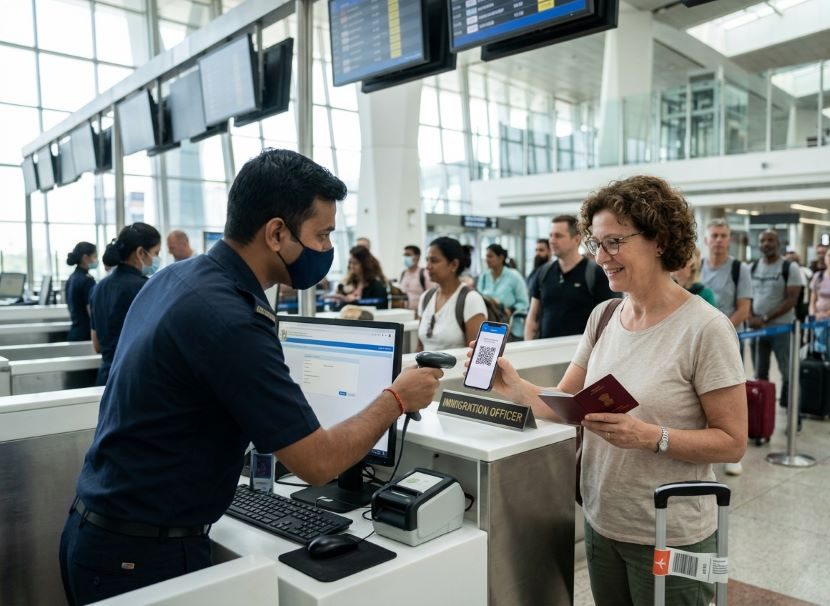
Starting April 1, 2026, every foreign traveler arriving in India will be required to complete a digital form before they land — and the paper slip that generations of international visitors have scrambled to fill out mid-flight is officially being retired.
The Government of India has announced that the e-Arrival Card, also known as the Digital Disembarkation Form, will become strictly mandatory for all foreign nationals entering the country from that date. What was previously a voluntary, soft-launch system introduced in late 2025 is now becoming a firm requirement, and the change is rolling out first at Delhi’s Indira Gandhi International Airport.
If you have an international trip to India planned — or you’re advising someone who does — this is one update you genuinely cannot afford to miss.
The End of the Blue-and-White Paper Slip
For decades, arriving in India meant one familiar ritual: hunting for a pen, balancing a small card on your knee at 35,000 feet, and trying to remember your local address before the plane touched down. Those blue-and-white disembarkation cards became as much a part of the India travel experience as the arrival hall itself.
That era is now ending. According to India’s Bureau of Immigration, the paper-based disembarkation form is being phased out at all major international gateways. The e-Arrival Card system is designed to collect the same personal, passport, and travel stay details — but digitally, and before the aircraft lands.
The shift is part of India’s broader push to modernize its border infrastructure and reduce the time travelers spend waiting at immigration counters. Officials have noted that by requiring travelers to submit their information in advance, the system aims to meaningfully reduce average processing times at immigration checkpoints.
What the e-Arrival Card Actually Requires
The e-Arrival Card — formally called the Digital Disembarkation Form — integrates into India’s growing digital infrastructure. Travelers are expected to submit key details before arrival, rather than on arrival. The categories of information required broadly mirror what the old paper form asked for, including personal details, passport information, and specifics about their planned stay in India.
The critical difference is timing and format. This is a pre-arrival submission, completed digitally, which allows immigration authorities to process information before a passenger even steps off the plane.
| Feature | Old Paper Form | New e-Arrival Card |
|---|---|---|
| Format | Physical blue-and-white paper card | Digital online form |
| When completed | Mid-flight or in arrival hall | Before departure / before landing |
| Mandatory from | N/A (being retired) | April 1, 2026 |
| Phase-in status | N/A | Voluntary since late 2025; mandatory from April 2026 |
| First rollout airport | All major international gateways | Delhi’s Indira Gandhi International Airport |
Who This Affects — and Why It Matters Right Now
The mandatory requirement applies to all foreign travelers entering India. Whether you’re arriving for tourism, business, a family visit, or transit, the e-Arrival Card will be part of your entry process.
The timing matters for anyone with India travel booked in the coming weeks. April 1, 2026, is not a distant deadline — it’s a firm cutoff that falls just days after the announcement. Travelers who are already mid-planning, or who assumed the old process would still apply, need to adjust their pre-departure checklist immediately.
The phased rollout beginning at Delhi’s Indira Gandhi International Airport suggests other major international airports across India will follow. Travelers flying into other gateways should still prepare to complete the digital form, as the system is described as applying to all major international entry points.
For frequent India travelers, the adjustment may feel minor. For first-time visitors, it adds one more pre-trip task alongside visa applications and other documentation. The practical upside, officials suggest, is faster movement through immigration once you land — which anyone who has waited in a long arrival queue at a busy Indian airport will likely welcome.
What the Soft Launch Has Already Shown
India did not arrive at this mandatory rollout without a trial run. The e-Arrival Card system has been operating in a voluntary capacity since late 2025, giving travelers and airport systems time to adapt before the hard deadline.
That soft-launch period served as a testing phase, allowing the Bureau of Immigration to refine the system and familiarize early adopters with the process. The move to a mandatory requirement signals that authorities are satisfied the system is ready to operate at full scale.
The broader context here is significant. India has been systematically expanding its digital border and immigration infrastructure, and the e-Arrival Card fits squarely within that effort. Replacing paper forms with pre-arrival digital submissions is a step that many major travel destinations around the world have already taken or are in the process of adopting.
What Travelers Should Do Before April 1
If you have India travel booked for April 2026 or beyond, here is what the announcement means in practical terms:
- The paper disembarkation card will no longer be accepted at major international gateways from April 1, 2026.
- All foreign travelers must complete the e-Arrival Card digitally before landing.
- The first airport implementing the mandatory requirement is Delhi’s Indira Gandhi International Airport.
- The system has been available on a voluntary basis since late 2025, meaning the platform is already active.
- Travelers should factor in the digital form as part of their pre-departure preparation, alongside visa and passport checks.
Anyone traveling to India in the near term should verify the official submission process directly through India’s Bureau of Immigration or their airline, as specific technical details about the submission portal were not included in the announcement reviewed for this article.
Frequently Asked Questions
When does the e-Arrival Card become mandatory for India travel?
The e-Arrival Card becomes strictly mandatory for all foreign travelers entering India starting April 1, 2026.
What is the e-Arrival Card?
It is India’s Digital Disembarkation Form — a digital pre-arrival submission that replaces the traditional paper-based disembarkation card that travelers previously filled out mid-flight or in arrival halls.
Which airport is rolling this out first?
Delhi’s Indira Gandhi International Airport is the first major gateway implementing the mandatory e-Arrival Card requirement, with other major international airports expected to follow.
Was the e-Arrival Card available before April 2026?
Yes. The system has been in a voluntary soft-launch phase since late 2025, giving travelers and airport systems time to become familiar with the process before it became compulsory.
Does this apply to all foreign travelers or only certain nationalities?
The announcement states the requirement applies to all foreign travelers entering India. No nationality-specific exemptions were confirmed in
Will the paper disembarkation card still be accepted after April 1?
No. The paper-based disembarkation form is being officially phased out at all major international gateways, with the digital e-Arrival Card replacing it entirely from April 1, 2026.




Leave a Reply