
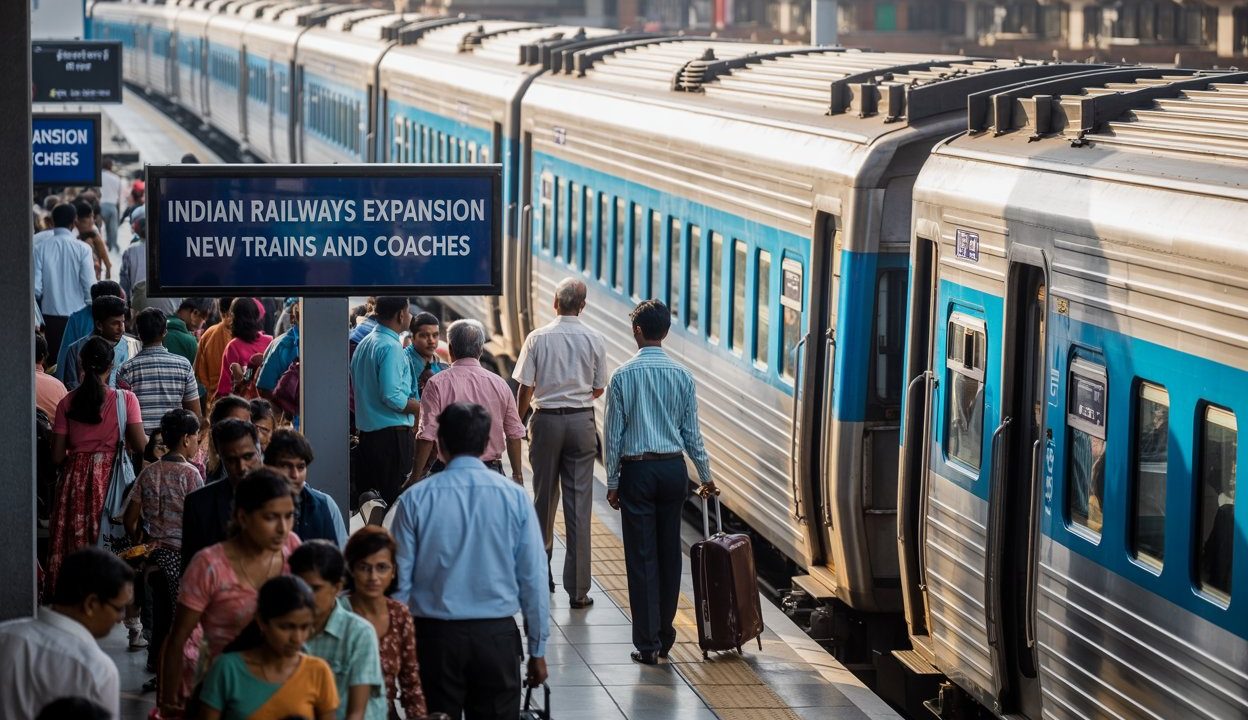
More than a thousand new trains are about to join India’s rail network — and if you’ve ever struggled to book a ticket on a busy route or spent hours standing in an overcrowded compartment, this announcement is directly relevant to you.
The Railway Ministry has confirmed the addition of 1,024 new trains and 4,651 additional coaches to the Indian Railways network. The expansion is being rolled out in phases and is designed to tackle some of the most persistent problems facing rail passengers across the country: overcrowding, limited seat availability on high-demand corridors, and patchy connectivity to underserved regions.
The timing is deliberate. Domestic travel demand has surged sharply, with tourism and business travel both rebounding strongly. Indian Railways — already the backbone of the country’s transportation system — is under real pressure to keep pace with that growth.
(function(){var wrp=document.getElementById(“paap_stat_69ca6726e2dbd4.97563061”);if(!wrp)return;var ids=[“paap_stat_69ca6726e2dbd4.97563061_c0″,”paap_stat_69ca6726e2dbd4.97563061_c1”];var dur=1800;function ease(t){return 1-Math.pow(1-t,3);}function anim(){ids.forEach(function(id){var el=document.getElementById(id);if(!el)return;var tgt=parseFloat(el.getAttribute(“data-target”))||0;var pfx=el.getAttribute(“data-prefix”)||””;var sfx=el.getAttribute(“data-suffix”)||””;var dec=parseInt(el.getAttribute(“data-decimals”))||0;var st=null;function step(ts){if(!st)st=ts;var p=Math.min((ts-st)/dur,1);var v=ease(p)*tgt;el.textContent=pfx+v.toFixed(dec)+sfx;if(p<1)requestAnimationFrame(step);}requestAnimationFrame(step);});}if("IntersectionObserver" in window){var obs=new IntersectionObserver(function(e){e.forEach(function(en){if(en.isIntersecting){anim();obs.disconnect();}});},{threshold:0.2});obs.observe(wrp);}else{anim();}})();
Why Indian Railways Is Making This Move Now
India’s rail network carries hundreds of millions of passengers every year, making it one of the busiest and most complex systems anywhere in the world. For years, the gap between available capacity and actual demand has been a source of frustration — particularly on popular intercity routes where waitlisted tickets are the norm rather than the exception.
The Railway Ministry’s decision to add over a thousand trains and nearly five thousand coaches at once reflects how serious that capacity crunch has become. Officials have noted that the expansion is a direct response to growing demand, with the country’s population and its appetite for affordable long-distance travel both continuing to rise.
There’s also a broader connectivity goal at play. Expanding the number of services means more routes become viable — including connections to smaller towns and cities that have historically been poorly served by the existing timetable.
The Numbers Behind the Expansion
Here’s a clear breakdown of what this announcement actually involves:
| Component | Figure | Purpose |
|---|---|---|
| New trains added | 1,024 | Expand route coverage and frequency across the network |
| Additional coaches | 4,651 | Increase seating and berth capacity on existing and new services |
| Rollout method | Phased | Staged deployment to manage infrastructure and operational demands |
(function(){function loadChartJs(cb){if(window.Chart){cb();return;}var s=document.createElement(“script”);s.src=”https://cdn.jsdelivr.net/npm/chart.js@4.4.0/dist/chart.umd.min.js”;s.onload=cb;document.head.appendChild(s);}function initChart(){var cv=document.getElementById(“paap_chart_69ca6726e2e530.36478410”);if(!cv)return;var dv=[“1,024″,”4,651″];new Chart(cv,{type:”bar”,data:{labels:[“New Trains”,”Additional Coaches”],datasets:[{data:[1024,4651],backgroundColor:[“#3b82f6″,”#10b981″],borderRadius:6,borderSkipped:false}]},options:{indexAxis:”y”,responsive:true,maintainAspectRatio:false,animation:{duration:1200,easing:”easeOutQuart”},plugins:{legend:{display:false},tooltip:{callbacks:{label:function(ctx){return dv[ctx.dataIndex]||ctx.formattedValue;}}}},scales:{x:{grid:{color:”#e5e7eb”},ticks:{color:”#6b7280″}},y:{grid:{display:false},ticks:{color:”#1a1a1a”,font:{weight:600}}}}}});}var cv=document.getElementById(“paap_chart_69ca6726e2e530.36478410”);if(!cv)return;if(“IntersectionObserver” in window){var obs=new IntersectionObserver(function(e){e.forEach(function(en){if(en.isIntersecting){loadChartJs(initChart);obs.disconnect();}});},{threshold:0.1});obs.observe(cv);}else{loadChartJs(initChart);}})();
The scale here is worth pausing on. Adding more than a thousand trains isn’t a routine timetable update — it represents a fundamental increase in the capacity of a network that was already one of the largest on earth. The 4,651 additional coaches will directly translate into more available seats and berths, which is where most passengers feel the pinch most acutely.
- Reduced overcrowding on popular intercity and regional routes
- More frequent departures on high-demand corridors
- Improved connectivity to towns and cities not currently well-served
- Better ticket availability, with fewer passengers facing lengthy waitlists
- Support for tourism growth as domestic travel demand continues to rise
What This Means for Passengers Travelling in 2026
For the average rail passenger in India, the practical impact of this expansion could be significant. The most immediate benefit is likely to be felt in ticket availability. One of the biggest day-to-day frustrations for travellers — particularly those booking on short notice — is finding that seats and berths on popular services are already fully waitlisted weeks in advance. More coaches means more bookable spots per train; more trains means more departures to choose from.
For people travelling to smaller cities and towns, the connectivity improvements may be even more meaningful. Regions that currently have limited direct rail links could gain new services, reducing the need for time-consuming and expensive transfers.
Business travellers stand to benefit too. As the post-pandemic recovery in commercial travel continues, more reliable and frequent rail services offer a credible alternative to air travel on many domestic routes — often at a fraction of the cost.
Tourism is another sector watching this closely. India’s domestic tourism industry has been growing rapidly, and the ability to move larger numbers of visitors to destinations across the country more easily is a direct economic benefit for local communities that depend on visitor spending.
How the Rollout Will Unfold
The expansion is being implemented in phases rather than all at once. A phased approach allows Indian Railways to manage the logistical demands of introducing so many new services — from crew scheduling and maintenance capacity to platform allocation at major stations.
While a full detailed timetable for every new service has not been confirmed, the phased rollout structure means passengers should expect to see new trains and additional coaches appearing on the network progressively through 2026 and beyond. Travellers on routes that are currently heavily congested are most likely to notice the changes earliest, as those corridors are the highest priority for capacity relief.
Officials have framed this as a strategic expansion rather than a one-off announcement — part of a longer-term effort to modernise and scale India’s rail infrastructure to match the demands of a growing nation.
Frequently Asked Questions
How many new trains is Indian Railways adding?
Indian Railways is adding 1,024 new trains to its network as part of this expansion announcement.
How many additional coaches are being introduced?
A total of 4,651 additional coaches are being added alongside the new trains to increase overall passenger capacity.
When will the new trains start running?
The rollout is being carried out in phases, meaning services will come online progressively rather than all at once. A full deployment timeline has not yet been confirmed.
Which routes will benefit most from this expansion?
The expansion is aimed at easing overcrowding on popular routes and improving connectivity across the country, though specific route details have not been confirmed in this announcement.
Why is Indian Railways expanding now?
The Railway Ministry cited surging domestic travel demand, a resurgence in tourism and business travel, and the need to ease chronic overcrowding on high-demand corridors as the primary drivers.
Will this make it easier to get confirmed tickets?
The addition of thousands of new coaches and over a thousand new trains is designed specifically to increase available capacity, which should reduce waitlist pressure — though the full effect will depend on how quickly services are deployed.


Leave a Reply