
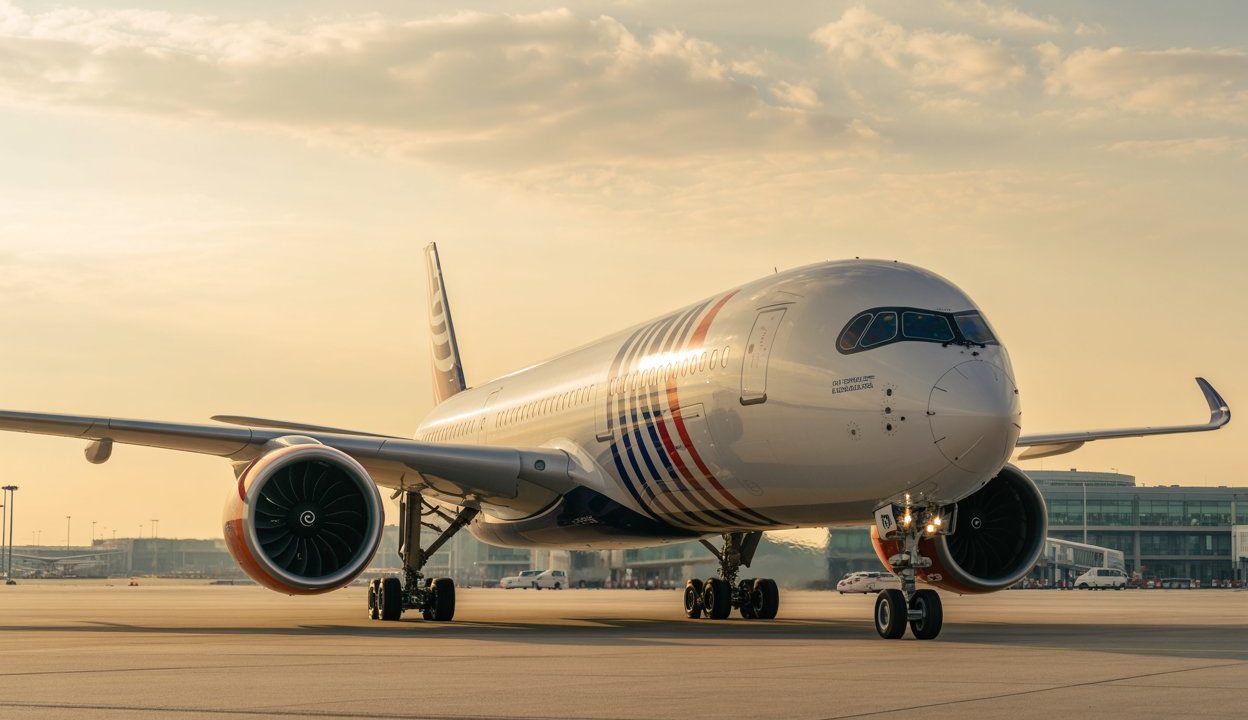
No airline on Earth has ever done what IndiGo just did. The Indian low-cost carrier has become the first airline in history to take delivery of 500 Airbus aircraft — a milestone that no other commercial carrier has reached, anywhere in the world.
The landmark delivery was an A320neo registered as VT-ION, which joined IndiGo’s fleet earlier this month. It is not just a round number worth celebrating — it is a statement about how dramatically India’s aviation sector has grown, and how aggressively IndiGo has positioned itself at the center of that growth over roughly two decades of operation.
For passengers, aviation observers, and anyone watching the global airline industry, this moment signals something bigger than one carrier’s fleet count. It reflects a long-term order strategy that has now produced results unmatched by any airline on the planet.
(function(){var wrp=document.getElementById(“paap_stat_69df51f96bf984.49166500”);if(!wrp)return;var ids=[“paap_stat_69df51f96bf984.49166500_c0″,”paap_stat_69df51f96bf984.49166500_c1”];var dur=1800;function ease(t){return 1-Math.pow(1-t,3);}function anim(){ids.forEach(function(id){var el=document.getElementById(id);if(!el)return;var tgt=parseFloat(el.getAttribute(“data-target”))||0;var pfx=el.getAttribute(“data-prefix”)||””;var sfx=el.getAttribute(“data-suffix”)||””;var dec=parseInt(el.getAttribute(“data-decimals”))||0;var st=null;function step(ts){if(!st)st=ts;var p=Math.min((ts-st)/dur,1);var v=ease(p)*tgt;el.textContent=pfx+v.toFixed(dec)+sfx;if(p<1)requestAnimationFrame(step);}requestAnimationFrame(step);});}if("IntersectionObserver" in window){var obs=new IntersectionObserver(function(e){e.forEach(function(en){if(en.isIntersecting){anim();obs.disconnect();}});},{threshold:0.2});obs.observe(wrp);}else{anim();}})();
What IndiGo Just Achieved — and Why No One Else Has Done It
Reaching 500 Airbus deliveries is not something that happens by accident. It is the result of a deliberate, long-term fleet acquisition strategy that IndiGo has been executing since its founding. The airline placed large, forward-looking orders with Airbus early and consistently, locking in aircraft at scale while competitors operated more cautiously.
The aircraft that crossed the 500-delivery threshold — the A320neo registered VT-ION — is part of the neo (new engine option) family, which represents Airbus’s current generation of narrow-body jets. These aircraft are more fuel-efficient than their predecessors, making them a natural fit for a low-cost carrier focused on keeping operating costs tight.
What makes this milestone particularly significant is that no other airline in the world has reached it. IndiGo now leads every commercial carrier on the planet in the total number of Airbus aircraft received through direct deliveries — a fact that speaks to both the airline’s size and its ambition.
The Numbers Behind the Milestone
The 500-delivery milestone is the headline, but the details beneath it help explain how IndiGo got here and where it is heading.
| Detail | Information |
|---|---|
| Milestone aircraft type | Airbus A320neo |
| Registration of milestone aircraft | VT-ION |
| Delivery timing | Earlier this month (April 2026) |
| Global ranking | First airline in the world to receive 500 Airbus deliveries |
| Strategy behind the milestone | Ambitious long-term order strategy spanning approximately two decades |
The A320neo family sits at the core of IndiGo’s operations. These aircraft are workhorses of short- and medium-haul aviation, capable of serving both dense domestic routes and thinner international sectors. IndiGo’s reliance on a largely single-type fleet has long been part of its operational efficiency model — fewer aircraft types mean lower training costs, simpler maintenance, and more scheduling flexibility.
What This Means for India’s Aviation Sector
India has become one of the fastest-growing aviation markets in the world, and IndiGo has been at the forefront of that expansion. The country’s rising middle class, increased domestic travel demand, and improving airport infrastructure have all contributed to an environment where a carrier like IndiGo could grow at the pace needed to reach a milestone of this scale.
For travelers in India and across the regions IndiGo serves, a larger fleet means more routes, more frequency, and — in theory — more competitive fares. A carrier that can deploy 500 aircraft across its network has the capacity to connect smaller cities to major hubs, open new international routes, and absorb demand spikes without the bottlenecks that constrain smaller fleets.
The milestone also reflects well on India’s standing in global aviation. Having a homegrown carrier lead the world in Airbus deliveries is a marker of how far the country’s commercial aviation industry has come. Observers of the sector have noted that India’s aviation growth story is no longer a future projection — it is a present reality, and IndiGo is its most visible symbol.
What Comes Next for IndiGo’s Fleet
Reaching 500 deliveries is a milestone, but it is not a stopping point. IndiGo’s long-term order strategy — the same approach that produced this record — means the airline has a substantial pipeline of additional aircraft still to come.
The carrier’s stated direction points toward continued fleet expansion and broader global connectivity. With 500 aircraft already in service and more on order, IndiGo is building the kind of scale that allows it to compete not just domestically but on international routes where larger, well-capitalized carriers have traditionally dominated.

For Airbus, IndiGo represents its single largest delivery relationship in commercial aviation history. That partnership is likely to deepen as India’s aviation market continues to grow and as IndiGo pursues the next phase of its expansion — one that could see it operating routes and frequencies that were unimaginable when the airline first launched.
The 500th aircraft is a number. But what it represents is a trajectory — and that trajectory is still pointing upward.
Frequently Asked Questions
Which aircraft marked IndiGo’s 500th Airbus delivery?
The milestone aircraft was an Airbus A320neo registered as VT-ION, delivered earlier this month in April 2026.
Is IndiGo really the first airline in the world to receive 500 Airbus aircraft?
Yes. IndiGo is confirmed as the first airline in the world to reach 500 Airbus deliveries, leading all commercial carriers globally in this measure.
How long has IndiGo been building toward this milestone?
The milestone is the result of an ambitious long-term order strategy that IndiGo has pursued over approximately two decades of operation.
What type of aircraft does IndiGo primarily operate?
IndiGo’s fleet is centered on the Airbus A320neo family, which forms the backbone of its domestic and international operations.
Will IndiGo continue receiving more Airbus aircraft beyond 500?
Based on the airline’s stated direction toward continued fleet expansion and global connectivity, further deliveries are expected, though specific future order numbers have not been confirmed in available information.
What does this milestone mean for passengers flying in India?
A larger fleet generally supports more routes, greater frequency, and expanded connectivity — particularly for passengers traveling on domestic and short-haul international routes.




Leave a Reply