
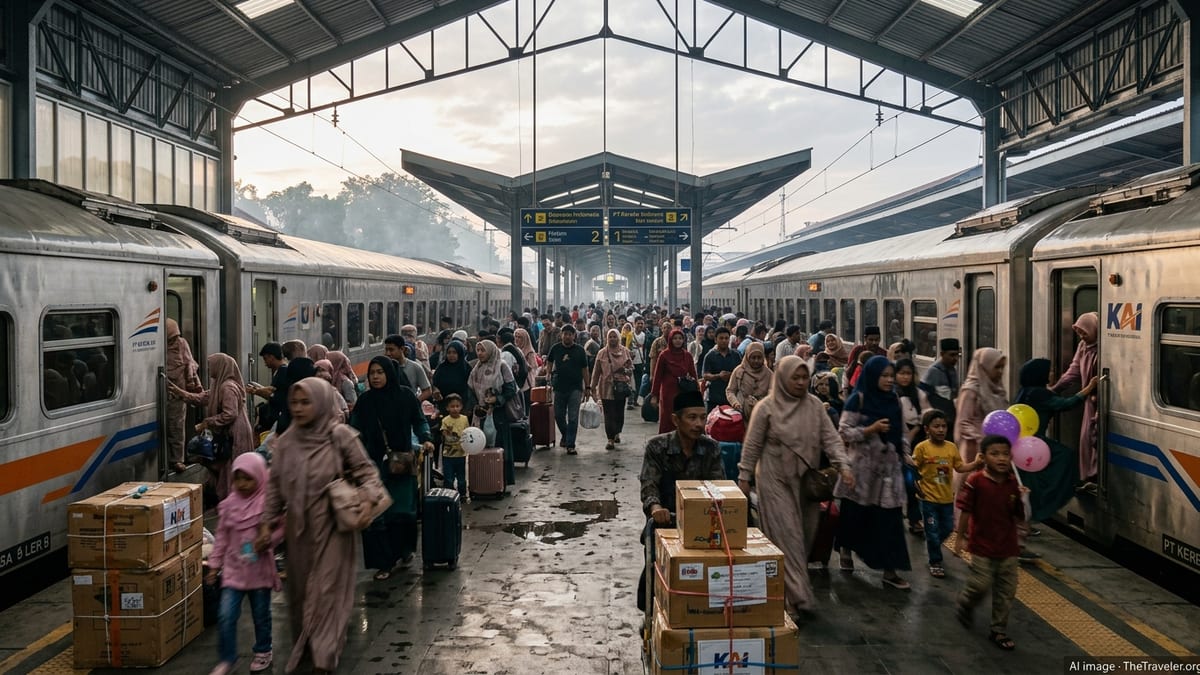
More than 10.9 million people traveled across Indonesia during this year’s Eid holiday season — an 8.6% jump over the previous year — and the country’s transportation network held together under the pressure. That is not a small achievement for one of the world’s most populous nations, where the annual mass homecoming, known locally as mudik, is one of the largest human migration events on the planet.
The final tally came in at 10,887,584 total passengers recorded from the start of the holiday travel period through Eid day itself. Railways carried more travelers than any other mode of transport, continuing a trend that reflects growing public confidence in Indonesia’s rail infrastructure. The numbers tell a story of a transport system that is expanding to meet demand — and, at least this season, keeping pace with it.
For millions of Indonesian families, getting home for Eid is not optional. It is a deeply held tradition. The scale of movement that happens every year across this archipelago nation puts enormous strain on roads, airports, seaports, and train stations simultaneously. The fact that passenger volumes grew by nearly 9% without a reported collapse in service is a meaningful signal about where the country’s infrastructure stands today.
What Drove the Surge in Indonesia’s Eid Travel Numbers
The 8.6% year-on-year growth in passenger numbers reflects several converging factors. Indonesia’s population continues to grow, and so does the proportion of people with the means and mobility to travel during major holidays. Improved public transport options — particularly in rail — have also made it easier and more attractive for people to choose formal transport networks over private vehicles or informal options.
Railways led the way this season as the dominant mode of transport, according to the available data. This is consistent with years of investment in Indonesia’s rail network, which has expanded connectivity between major urban centers and regional hubs. Efficient scheduling, pre-booking systems, and capacity management appear to have played a role in handling the spike in demand without widespread disruption.
Officials have noted that careful planning and robust infrastructure were key to ensuring the surge was managed smoothly. The combination of public transport coordination and advance preparation helped prevent the kind of bottlenecks that have historically plagued peak holiday travel in the country.
The Numbers Behind Indonesia’s 2026 Eid Travel Season
The headline figure of 10,887,584 passengers is the clearest measure of how large this year’s Eid travel season was. Here is a snapshot of what the data confirms:
| Metric | 2026 Eid Season |
|---|---|
| Total passengers recorded | 10,887,584 |
| Year-on-year growth | 8.6% |
| Leading transport mode | Railways |
| Period covered | Start of holiday season through Eid day |
Key confirmed details from this year’s travel season include:
- Total passenger count reached 10,887,584 — the highest recorded for this travel window compared to the prior year
- Growth of 8.6% over the previous year’s equivalent period
- Railways emerged as the dominant transport mode, leading all other categories in passenger volume
- Efficient public transport services, strong infrastructure, and advance planning were credited with handling the surge smoothly
It is worth noting that Additional granular data — such as figures for air travel, road transport, or sea crossings — has not been confirmed in the available reporting and will not be speculated upon here.
Why Railways Are Winning Indonesia’s Holiday Travel Race
The fact that railways led passenger volumes this Eid is not accidental. Indonesia has made sustained investments in its rail network over the past decade, and those investments are showing returns in public behavior. When travelers have a reliable, affordable, and relatively comfortable option for long-distance journeys, many will choose it over the uncertainty of road travel during peak periods.
During Eid, Indonesia’s major highways have historically become gridlocked as millions of people attempt to make the same journey in the same compressed window of time. Rail offers a predictable schedule, fixed capacity, and — critically — a way to pre-book a seat well in advance. That predictability matters enormously to families planning travel around a fixed religious holiday date.
The growth in rail ridership also reflects a broader shift in how urban Indonesians think about transport. As cities expand and middle-class populations grow, there is increasing appetite for modern, managed travel experiences. Railways are benefiting from that shift in expectations.
What This Means for Travelers and the Transport Sector
For ordinary travelers, this year’s Eid season demonstrated that Indonesia’s transport network can absorb significant growth without breaking down. That is reassuring for the tens of millions of people who depend on these systems every year to get home safely and on time.
For the transport sector, the 8.6% growth figure is both an achievement and a challenge. Sustaining smooth operations when passenger numbers are climbing nearly 9% year over year requires continuous investment in capacity, staffing, and logistics. The success of this season will likely be used to make the case for further infrastructure spending ahead of future holiday periods.
Officials and transport planners will also be watching these numbers closely as a barometer of economic activity and consumer confidence. Strong Eid travel figures generally signal a healthy economy and a population willing and able to spend on travel — which has downstream effects across hospitality, retail, and local economies at destination points across the archipelago.
What Comes Next for Indonesia’s Transport Network
With this year’s Eid travel season confirmed as a record-setter in passenger volume, attention will now turn to how authorities plan for continued growth. The 8.6% increase sets a new baseline, meaning next year’s planning will need to account for a larger starting point.
Railways, having led this season, are likely to see continued investment and capacity expansion. Whether other transport modes — road, air, and sea — can keep pace with similar growth trajectories remains to be seen. The data from this season will feed directly into planning cycles for Indonesia’s next major holiday travel period.
Specific future policy decisions, infrastructure projects, or capacity expansions beyond what has been reported here have not yet been confirmed and will be covered as they are announced.
Frequently Asked Questions
How many passengers traveled in Indonesia during the 2026 Eid season?
A total of 10,887,584 passengers were recorded from the start of the holiday travel period through Eid day.
How much did passenger numbers grow compared to last year?
Passenger numbers increased by 8.6% compared to the previous year’s Eid travel season.
Which mode of transport carried the most passengers during Eid?
Railways led all transport modes, emerging as the dominant choice for travelers during the 2026 Eid season.
What factors contributed to the smooth handling of the surge?
Officials credited efficient public transport services, robust infrastructure, and careful advance planning for managing the increase without major disruption.
Is a full breakdown of passengers by transport mode available?
The confirmed data identifies railways as the leading mode, but a complete breakdown across all transport categories has not been confirmed in available reporting.
What does this growth mean for future Eid travel planning?
The record passenger numbers set a higher baseline for future planning, meaning transport authorities will need to account for continued growth when preparing for upcoming holiday seasons.

Leave a Reply