
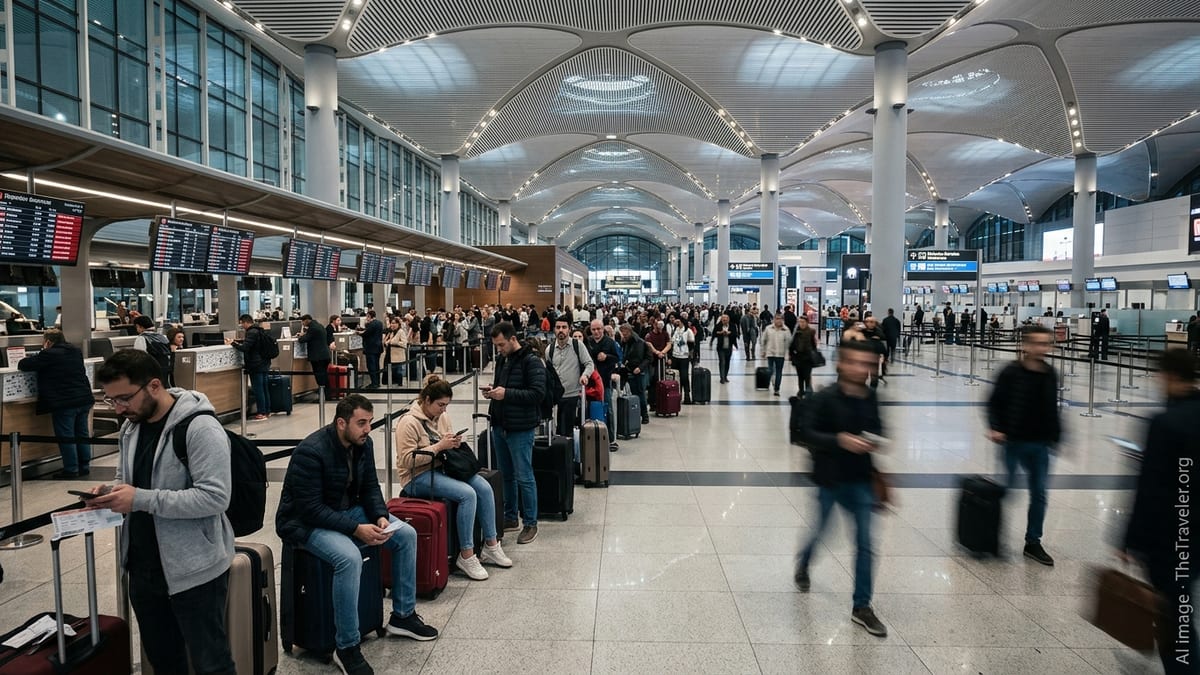
A combined total of 329 flights were delayed and 5 flights were cancelled across Istanbul’s two major international airports on March 26, 2026 — turning what should have been routine travel days into hours of uncertainty for thousands of passengers caught in the disruption.
The scale of the chaos was hard to miss. Families on spring holidays, students heading back to university, and business travelers racing to make connections all found themselves staring at departure boards as scheduled times shifted again and again. Istanbul, already one of the most heavily trafficked aviation hubs linking Europe, Asia, and the Middle East, effectively became a bottleneck — and the effects weren’t contained to Turkey alone.
When Istanbul’s airports struggle, the consequences spread fast. Flights delayed out of Istanbul mean missed connections in Frankfurt, Dubai, and beyond. That’s the nature of a hub this large — and that’s what made Wednesday’s disruption feel so significant for so many people in so many places at once.
(function(){var wrp=document.getElementById(“paap_stat_69c4a358d71ca3.27230984”);if(!wrp)return;var ids=[“paap_stat_69c4a358d71ca3.27230984_c0″,”paap_stat_69c4a358d71ca3.27230984_c1”];var dur=1800;function ease(t){return 1-Math.pow(1-t,3);}function anim(){ids.forEach(function(id){var el=document.getElementById(id);if(!el)return;var tgt=parseFloat(el.getAttribute(“data-target”))||0;var pfx=el.getAttribute(“data-prefix”)||””;var sfx=el.getAttribute(“data-suffix”)||””;var dec=parseInt(el.getAttribute(“data-decimals”))||0;var st=null;function step(ts){if(!st)st=ts;var p=Math.min((ts-st)/dur,1);var v=ease(p)*tgt;el.textContent=pfx+v.toFixed(dec)+sfx;if(p<1)requestAnimationFrame(step);}requestAnimationFrame(step);});}if("IntersectionObserver" in window){var obs=new IntersectionObserver(function(e){e.forEach(function(en){if(en.isIntersecting){anim();obs.disconnect();}});},{threshold:0.2});obs.observe(wrp);}else{anim();}})();
What Happened at Istanbul’s Two Airports
The disruption hit both of Istanbul’s major airports simultaneously, though the numbers differed between them. Istanbul Sabiha Gökçen International Airport — located on the Asian side of the city — recorded 158 delayed flights and 2 cancellations. That alone would constitute a significant operational event at most airports. But the disruption extended across the Bosphorus as well.
Istanbul Airport, the city’s primary hub on the European side and one of the busiest airports in the world by passenger volume, absorbed the remainder of the delays and cancellations. Together, the two airports logged numbers that reflect just how strained the system became over the course of the day.
Airlines affected by the disruption included Turkish Airlines and Pegasus Airlines, the two carriers that dominate domestic and international traffic through Istanbul, along with other operators flying in and out of both terminals. For passengers booked on these carriers, the delays meant repeated updates, long waits at gates, and in some cases, scrambles to rebook onward connections.
The Numbers Behind the Disruption
| Airport | Location | Flights Delayed | Flights Cancelled |
|---|---|---|---|
| Istanbul Sabiha Gökçen International Airport | Asian side of Istanbul | 158 | 2 |
| Istanbul Airport | European side of Istanbul | 171 (estimated remainder) | 3 |
| Combined Total | Both airports | 329 | 5 |
(function(){function loadChartJs(cb){if(window.Chart){cb();return;}var s=document.createElement(“script”);s.src=”https://cdn.jsdelivr.net/npm/chart.js@4.4.0/dist/chart.umd.min.js”;s.onload=cb;document.head.appendChild(s);}function initChart(){var cv=document.getElementById(“paap_chart_69c4a358d72322.48646138”);if(!cv)return;var dv=[“158 flights”,”171 flights”,”5 flights”];new Chart(cv,{type:”bar”,data:{labels:[“Sabiha Gu00f6ku00e7en Delays”,”Istanbul Airport Delays”,”Total Cancellations”],datasets:[{data:[158,171,5],backgroundColor:[“#3b82f6″,”#10b981″,”#f59e0b”],borderRadius:6,borderSkipped:false}]},options:{indexAxis:”y”,responsive:true,maintainAspectRatio:false,animation:{duration:1200,easing:”easeOutQuart”},plugins:{legend:{display:false},tooltip:{callbacks:{label:function(ctx){return dv[ctx.dataIndex]||ctx.formattedValue;}}}},scales:{x:{grid:{color:”#e5e7eb”},ticks:{color:”#6b7280″}},y:{grid:{display:false},ticks:{color:”#1a1a1a”,font:{weight:600}}}}}});}var cv=document.getElementById(“paap_chart_69c4a358d72322.48646138”);if(!cv)return;if(“IntersectionObserver” in window){var obs=new IntersectionObserver(function(e){e.forEach(function(en){if(en.isIntersecting){loadChartJs(initChart);obs.disconnect();}});},{threshold:0.1});obs.observe(cv);}else{loadChartJs(initChart);}})();
The numbers paint a picture of a system under real strain. While 5 cancellations may sound relatively modest, the 329 delays represent a cascading problem — each delayed departure has the potential to push back arrivals, disrupt turnaround times, and create further delays on subsequent legs of a journey.
Who Was Caught in the Middle
The human side of these numbers matters. Passengers described the experience that many travelers know all too well: repeated gate changes, announcements that pushed departure times back in increments, and the creeping anxiety of watching a connecting flight’s departure window narrow in real time.
The disruption hit a particularly wide cross-section of travelers. Families traveling for the spring holiday period, students returning to universities abroad, and professionals with back-to-back schedules all found themselves with limited options. When delays compound at a hub of Istanbul’s size, the ripple effects move quickly — a two-hour delay in Istanbul can mean a missed overnight connection in another continent.
Turkish Airlines and Pegasus Airlines, as the dominant carriers at both airports, bore the brunt of the operational pressure. Both airlines operate dense domestic and international schedules, meaning that disruptions to their timetables have an outsized effect on overall airport flow.
Why Istanbul Disruptions Hit So Hard Beyond Turkey
Istanbul’s position as a global aviation crossroads is what amplifies any operational disruption there. Istanbul Airport in particular functions as a connecting hub for passengers moving between continents — a delay that begins in Istanbul doesn’t stay in Istanbul.
Passengers transiting through the city on their way to destinations in Africa, Central Asia, or the Americas face the tightest squeeze. A missed connection at a hub like this can mean waits of many hours before the next available seat on a comparable route. The 5 outright cancellations, while a small fraction of the overall disruption, represent passengers who had to rebook entirely — a process that can take hours and, during busy travel periods, may not yield a same-day solution.
The disruption also illustrates a broader challenge facing major hub airports: the thinner the margin between scheduled and actual operations, the faster a single day of strain can escalate into a system-wide problem. When 329 flights are delayed across two airports in a single day, the delays don’t resolve neatly at midnight — many of those aircraft and crews carry the effects into the following day’s schedule.
What Affected Passengers Should Know Going Forward
For travelers who were caught in the disruption, the immediate priority is confirming the status of any onward connections and reaching out to their airline directly. Turkish Airlines and Pegasus Airlines both operate customer service channels and rebooking options for passengers affected by delays and cancellations.
Travelers booked through Istanbul in the coming days should monitor their flight status closely. Disruptions of this scale often take more than 24 hours to fully clear from an airline’s operational schedule, meaning some knock-on delays may persist into subsequent days as aircraft and crew rotations are reset.
Anyone who experienced a cancellation — one of the 5 confirmed on this day — may be entitled to rebooking on the next available flight or, depending on the circumstances and applicable regulations, a refund or compensation. Passengers are advised to retain all documentation of their original booking and any communications from their airline.
Frequently Asked Questions
How many flights were delayed across Istanbul’s airports on March 26, 2026?
A combined total of 329 flights were delayed across Istanbul Airport and Istanbul Sabiha Gökçen International Airport.
How many flights were cancelled during the disruption?
Five flights were cancelled outright across both airports during the disruption.
Which airlines were affected by the Istanbul flight disruptions?
Turkish Airlines and Pegasus Airlines were among the carriers directly impacted, along with other operators flying through both Istanbul airports.
Which airport recorded more delays — Istanbul Airport or Sabiha Gökçen?
Istanbul Sabiha Gökçen International Airport recorded 158 delays and 2 cancellations; the remaining delays and cancellations were recorded at Istanbul Airport on the European side of the city.
Why do Istanbul flight disruptions affect travelers outside Turkey?
Istanbul functions as a major international connecting hub between Europe, Asia, and the Middle East, meaning delays there can cause missed connections and cascading disruptions across global flight networks.
What should passengers do if their flight was cancelled or significantly delayed?
Affected passengers should contact their airline directly to confirm rebooking options, and retain all booking documentation in case compensation or refund claims apply under relevant aviation regulations.




Leave a Reply