
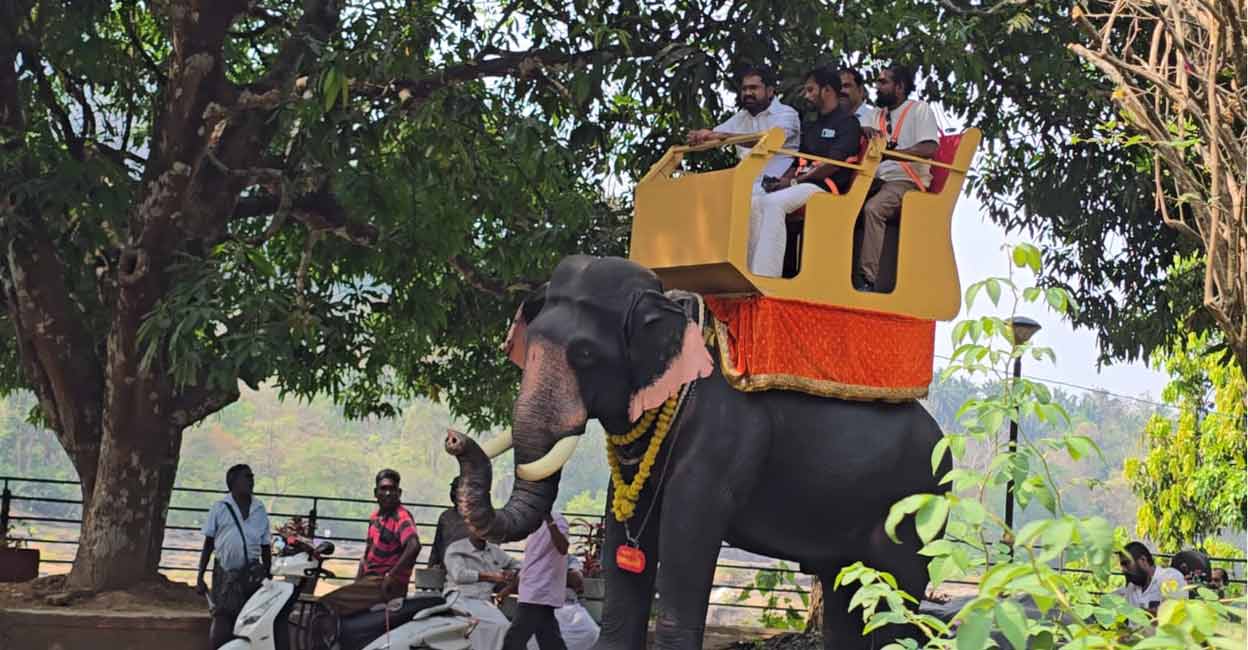
The announcement came on April 9, 2026, from Thiruvananthapuram, and it landed with the quiet force of something that had been a long time coming. Kerala’s Department of Tourism was set to receive the Golden Elephant Protection Award from PETA India, the country’s most prominent animal rights organization. The award was not for a conservation pledge or a policy paper. It was for something you could actually ride.
A mechanical elephant. State-of-the-art, life-size, and entirely cruelty-free.
For anyone who has spent time in Kerala, the image of a captive elephant draped in ceremonial cloth, swaying under the weight of a howdah and a hundred tourists, is deeply familiar. It is also deeply uncomfortable, once you know what lies beneath the pageantry.
The Weight Elephants Have Carried in Kerala’s Tourism Economy
Kerala has long traded on its elephants. The state is home to one of the largest populations of captive Asian elephants in India, many of them used in temple festivals, processions, and tourist safaris. The revenue they generate is significant. The suffering they endure is well-documented.
Captive elephants in Kerala have been subjected to isolation, sleep deprivation, and physical punishment as part of their training and management. Mahouts, often working under enormous economic pressure, have had few alternatives. The tourism industry, for its part, kept booking the rides.
The pressure to change had been building for years. Animal welfare organizations filed complaints. Viral videos of distressed elephants circulated. Tourists began asking harder questions at booking counters. Still, the economics of the existing system made reform feel distant.
Then Kerala’s Department of Tourism made a decision that surprised almost everyone.
| Feature | Traditional Elephant Safari | Mechanical Elephant Safari |
|---|---|---|
| Animal welfare impact | High risk of stress and injury | Zero animal involvement |
| Tourist experience | Elephant ride, close contact | Simulated ride, life-size replica |
| Conservation alignment | Contradicts wildlife protection | Supports ethical tourism goals |
| Regulatory scrutiny | Increasing legal pressure | Fully compliant, award-winning |
| PETA India recognition | None | Golden Elephant Protection Award |
How the Mechanical Elephant Safari Initiative Took Shape
The initiative did not emerge from a single eureka moment. It grew from years of quiet pressure, shifting tourist sentiment, and the growing international profile of ethical travel. Kerala, already ranked 16th among the world’s top 26 travel destinations for 2026 by Rough Guides, had a reputation to protect.
The department began developing a state-of-the-art mechanical elephant, a life-size replica capable of delivering the sensory experience of a safari without placing any living animal in harm’s way. The engineering involved recreating the gait, texture, and scale of an Asian elephant with enough fidelity to satisfy curious tourists.
The Thrissur donation showed something important: communities were willing to accept mechanical alternatives when they were presented thoughtfully, with cultural sensitivity intact. Kerala’s tourism department watched that experiment closely.
The safari initiative was designed with wildlife conservation embedded in its purpose. It was not simply a novelty attraction. It was framed as a statement, a declaration that Kerala’s tourism economy could thrive without exploiting animals. That framing mattered enormously when PETA India evaluated the program.
The April 9 Recognition and What the Golden Elephant Award Represents
The Golden Elephant Protection Award is not handed out casually. PETA India, co-founded by Ingrid Newkirk and recognized as the world’s largest animal rights organization, uses its awards to signal meaningful, systemic change rather than symbolic gestures.
Receiving the award on April 9, 2026, Kerala’s Department of Tourism joined a short list of institutions recognized for genuinely restructuring how they engage with animals in a commercial context. The award specifically cited the mechanical elephant safari for its commitment to sustainability and its potential to shift industry norms across India.
“PETA India’s recognition of Kerala Tourism’s mechanical elephant safari marks a significant milestone for the ethical tourism movement in India.”
— Travel and Tour World, April 2026
The significance extends beyond the award itself. Kerala already holds the PATA Gold Award 2025 for its meme-led social media campaign, recognized by the Pacific Asia Travel Association for exceptional achievement in the Asia-Pacific tourism industry. The PETA recognition adds a different dimension: it signals that the state is not just marketing itself cleverly, but rethinking the ethics of what it sells.
What Ethical Tourism Actually Looks Like on the Ground
It is easy to celebrate an award from a distance. The harder question is what the mechanical elephant safari actually delivers to the people who depend on elephant tourism for their livelihoods.
Mahouts and their families have historically been among the most economically vulnerable workers in Kerala’s tourism ecosystem. Any transition away from live elephant safaris carries real risk for them. The department’s initiative, to be genuinely sustainable, needed to account for that human dimension alongside the animal welfare dimension.
The details of how Kerala’s tourism authority plans to support affected workers remain less publicized than the mechanical elephant itself. That gap matters. An ethical tourism initiative that displaces vulnerable workers without a transition plan trades one form of harm for another.
Still, the initiative represents a structural shift that few expected from a state government. Tourism departments rarely move ahead of market demand on animal welfare. Kerala moved first.
The Broader Signal for Wildlife Tourism Across South Asia
India’s wildlife tourism sector is enormous, and its relationship with captive animals is complicated. Elephants appear in temple rituals, festival processions, and tourist circuits across multiple states. The conditions they endure vary widely, but the commercial incentives to keep them in service are consistent.
Kerala’s mechanical elephant safari, and its formal recognition by PETA India, sends a signal to other state tourism boards. It demonstrates that the ethical alternative is not just viable; it is award-winning. That matters in a sector where reputation increasingly drives revenue.
The timing is not accidental. International tourists, particularly from Europe and North America, have grown more selective about wildlife experiences. Operators who cannot demonstrate animal welfare credentials are losing bookings. Kerala’s initiative positions the state ahead of that curve.
What Kerala has done is not simply swap one attraction for another. It has reframed the question that wildlife tourism asks of its visitors. The question used to be: do you want to ride an elephant? Now it is: what kind of traveler do you want to be?
That shift in framing, more than any single award, may be the initiative’s most lasting contribution.


Leave a Reply