
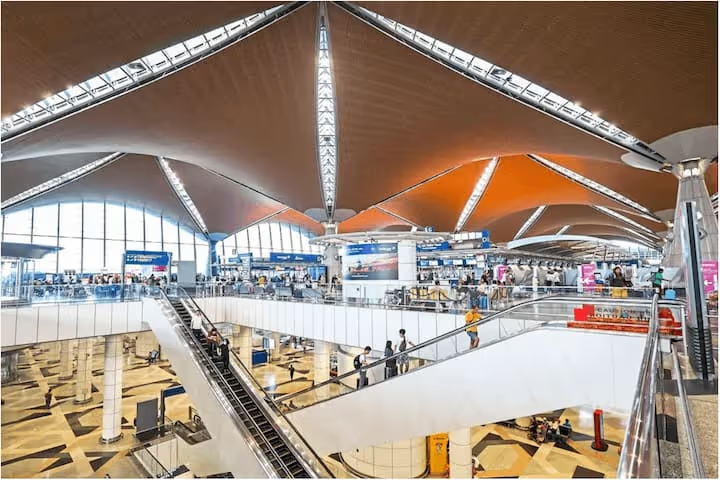
A $2.8 billion investment. A target of more than 100 million passengers every year. And a hard deadline of 2026. Kuala Lumpur International Airport is not quietly upgrading — it is making one of the most ambitious bids in the region to become Southeast Asia’s dominant global transit hub.
The scale of what Malaysia is attempting here is worth pausing on. Most major airports expand incrementally, adding a terminal or a runway over a decade. KLIA is pursuing a wholesale transformation of its infrastructure, technology, and international connectivity — all within a compressed timeline that leaves very little room for delay.
For travelers, airlines, and the broader tourism economy across the region, the stakes are real and the changes already in motion.
(function(){var wrp=document.getElementById(“paap_stat_69c53f11c67481.95622598”);if(!wrp)return;var ids=[“paap_stat_69c53f11c67481.95622598_c0″,”paap_stat_69c53f11c67481.95622598_c1”];var dur=1800;function ease(t){return 1-Math.pow(1-t,3);}function anim(){ids.forEach(function(id){var el=document.getElementById(id);if(!el)return;var tgt=parseFloat(el.getAttribute(“data-target”))||0;var pfx=el.getAttribute(“data-prefix”)||””;var sfx=el.getAttribute(“data-suffix”)||””;var dec=parseInt(el.getAttribute(“data-decimals”))||0;var st=null;function step(ts){if(!st)st=ts;var p=Math.min((ts-st)/dur,1);var v=ease(p)*tgt;el.textContent=pfx+v.toFixed(dec)+sfx;if(p<1)requestAnimationFrame(step);}requestAnimationFrame(step);});}if("IntersectionObserver" in window){var obs=new IntersectionObserver(function(e){e.forEach(function(en){if(en.isIntersecting){anim();obs.disconnect();}});},{threshold:0.2});obs.observe(wrp);}else{anim();}})();
What KLIA Is Actually Building — and Why 2026 Is the Target
Kuala Lumpur International Airport has set its sights on becoming a premier transit hub in Asia, and the 2026 timeline is tied directly to Malaysia’s broader push to capitalize on a surge in international tourism that has already been reshaping the country’s travel economy.
The expansion strategy rests on three pillars: upgrading physical infrastructure, expanding international route connectivity, and deploying advanced technologies that officials believe will distinguish KLIA from its regional competitors. That combination — infrastructure plus connectivity plus technology — is what separates this plan from a simple capacity increase.
Malaysia has been experiencing a significant rise in inbound tourism, and KLIA sits at the center of that growth. The airport is both the primary gateway for international arrivals and the key transit point for passengers moving through the region. Increasing its capacity and improving the transit experience are seen as essential to sustaining that momentum.
Officials have framed this expansion not just as an airport project but as a national economic priority — one that positions Malaysia as a serious competitor to established regional aviation powerhouses.
The Key Numbers and What They Mean for the Airport
The figures behind this expansion tell a clear story about the ambition involved. Here is what is confirmed from the plans announced so far:
- $2.8 billion in total investment committed to the expansion
- A target annual passenger capacity of over 100 million
- Focus areas include physical infrastructure upgrades, new international connections, and advanced technology deployment
- The completion target is set for 2026
- The expansion is designed to support Malaysia’s growing role in regional tourism
| Expansion Element | Detail |
|---|---|
| Total Investment | $2.8 billion |
| Passenger Capacity Goal | Over 100 million annually |
| Target Completion | 2026 |
| Strategic Focus | Infrastructure, connectivity, and advanced technology |
| Regional Ambition | Become Southeast Asia’s leading global transit hub |
Why This Matters Beyond Malaysia’s Borders
Southeast Asia’s aviation market is intensely competitive. Singapore’s Changi Airport has long held the title of the region’s most celebrated transit hub, while Bangkok and Jakarta have both invested heavily in their own infrastructure in recent years. KLIA entering this race with a $2.8 billion commitment signals that Malaysia is no longer content to play second tier.
For international travelers, a stronger KLIA means more routing options through Kuala Lumpur, potentially shorter layovers, and a better-connected network of destinations across Asia and beyond. Transit hubs live or die by how efficiently they move passengers — and the technology investments KLIA is making appear aimed squarely at that problem.
For the tourism industry across the region, a more powerful KLIA creates a new gravity point. Airlines that increase service to Kuala Lumpur tend to open up secondary routes into Malaysia and neighboring countries, which benefits hotels, tour operators, and local economies well beyond the airport itself.
There is also a signal being sent to the airline industry more broadly. When an airport commits $2.8 billion to modernization, carriers take notice. New routes follow infrastructure investment, and KLIA’s expansion could attract airlines that currently bypass Kuala Lumpur in favor of more established hubs.
What Happens Between Now and 2026
The 2026 deadline is not far off, which means the construction, technology rollouts, and connectivity deals that underpin this transformation are either already underway or need to be finalized in the very near term.
Infrastructure projects of this scale typically involve parallel workstreams — terminal upgrades, airside improvements, passenger processing systems, and digital technology integrations all advancing simultaneously. The pressure to deliver by 2026 means there is limited tolerance for the kinds of delays that have plagued major airport expansions elsewhere in the world.
On the connectivity side, Malaysia will need to continue attracting airline partners willing to launch or expand service into KLIA. That process is already linked to the country’s broader tourism promotion efforts, which have been generating strong results in recent years.
The technology component — while less visible to the traveling public during construction — may ultimately be what defines the passenger experience once the expansion is complete. Airports that invest in smart processing, seamless transit flows, and digital infrastructure tend to hold their competitive advantages longer than those that focus on physical capacity alone.
By the time 2026 arrives, travelers transiting through Kuala Lumpur could find themselves moving through a substantially different airport than the one that exists today.
Frequently Asked Questions
How much is Malaysia investing in KLIA’s expansion?
The total investment committed to the expansion is $2.8 billion, covering infrastructure upgrades, technology, and connectivity improvements.
What is KLIA’s passenger capacity target after the expansion?
The airport is aiming to accommodate over 100 million passengers annually once the expansion is complete.
When is the KLIA expansion expected to be finished?
The target completion date for the major expansion and infrastructure overhaul is 2026.
What is the strategic goal behind the expansion?
Malaysia wants KLIA to become Southeast Asia’s leading global transit hub, positioning the country as a major force in international travel.
What areas does the expansion cover?
The plan focuses on three areas: physical infrastructure upgrades, enhanced international connectivity, and the deployment of advanced technologies at the airport.
How does Malaysia’s tourism growth connect to the airport expansion?
A surge in international tourism to Malaysia has placed increased pressure on KLIA and made the expansion a national economic priority tied directly to sustaining that growth.



Leave a Reply