Mars’ Young Volcanoes Stayed Active Far Longer Than We Thought

Scientists found lava flows on Mars as young as 2 million years old, proving the planet's magmatic system quietly evolved for far longer than models predicted.

Mars' Young Volcanoes Stayed Active Far Longer Than We Thought

Audio Briefing~1:12
Click play to listen to key points
Read transcript

Here’s what you need to know about Mars and its surprisingly active volcanic past.

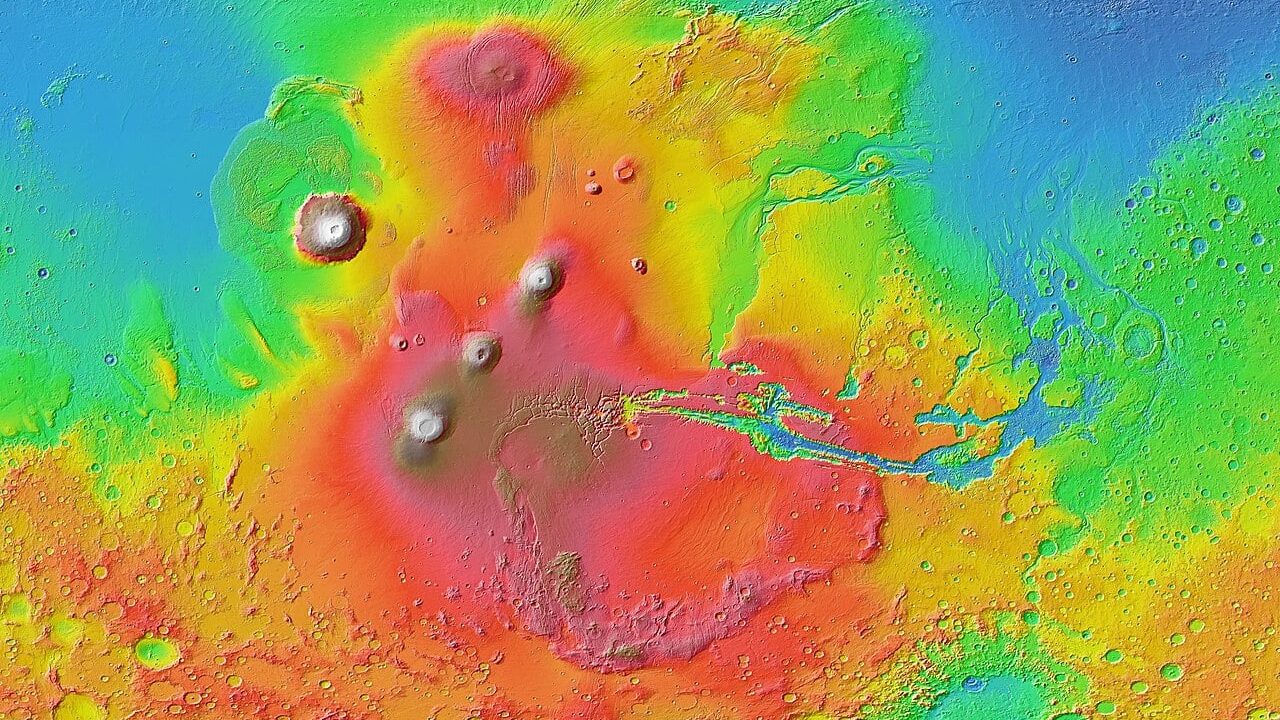
For decades, scientists believed Mars went geologically cold and quiet somewhere between two and three billion years ago. It’s a smaller planet than Earth, loses heat faster, and has no tectonic plates to keep things churning. That story seemed airtight. It wasn’t. Researchers analyzing crater patterns on Martian volcanic surfaces found something startling — some lava flows are only about two million years old. On a planet presumed dead, that’s practically yesterday. On top of that, the chemical makeup of those lavas shows signs of magmatic differentiation, meaning the molten rock actually evolved and matured over time, which requires sustained heat and pressure deep underground. One volcanic structure alone stayed active for roughly nine million years.

This matters beyond geology. Younger volcanic rocks are now considered viable targets in the search for signs of past life on Mars.

So if you’re following Mars exploration news, pay attention to which missions are targeting these younger volcanic regions — that’s where the most exciting discoveries may be headed.

In 2004, a geologist studying orbital images of Mars circled a region on her map and wrote a single word in the margin: young. The lava flows looked fresh, almost pristine, as if they had cooled only yesterday in geological terms. She assumed, as most scientists did, that Mars had simply gone cold and quiet billions of years ago.

She was only half right.

What Scientists Long Believed About a Dead Red Planet

For decades, the dominant picture of Mars was straightforward: a world that burned bright early, then faded. Volcanic activity peaked roughly 3 to 4 billion years ago, the thinking went, and the planet’s interior slowly froze into silence. Mars lacks the tectonic plates that keep Earth’s interior churning, so heat had nowhere productive to go.

That story felt airtight. Mars is smaller than Earth, which means it loses heat faster. Without a mechanism to recycle its crust, the planet should have cooled quickly and uniformly. Any volcanic region labeled “young” was assumed to mean geologically recent in a loose sense, perhaps a billion years old, but fundamentally dead for a very long time.

KEY TAKEAWAY
A volcanic region on Mars that began forming over 3 billion years ago contains lava flows as young as 2 million years old, suggesting the planet’s magmatic system quietly persisted far longer than any model predicted.

This assumption shaped everything from mission planning to the search for life. If Mars went cold early, then any biosignatures would have to be ancient, buried deep, and locked in rocks billions of years old. The “young” volcanic zones were interesting, but scientists didn’t expect them to rewrite the rulebook.

The First Crack in the Cooling Story

The cracks started appearing when researchers took a closer look at crater counts on Martian volcanic surfaces. The logic is elegant: the more craters on a surface, the older it is, because space rocks have had more time to punch holes in it. Surfaces with very few craters are geologically recent.

When scientists applied this method to certain lava flows on the flanks of a large Martian volcanic structure, the numbers were startling. Some flows registered crater densities consistent with an age of just 2 million years. On a planet presumed geologically dead, that is essentially this morning.

2 Million
Estimated age in years of the youngest lava flows found on Mars’ volcanic flanks, based on crater-count analysis
9 Million
Years a young Martian volcano is now believed to have stayed continuously active, reshaping our picture of Mars’ interior

The structure in question began growing more than 3 billion years ago. Yet its uppermost, youngest flows suggest that magma was still finding its way to the surface within the last few million years. That is not a planet that simply cooled off and went quiet. That is a planet that kept a slow, secret fire burning.

Why the Old Model Was Wrong: Evidence from Lava Chemistry

Crater counts alone could be disputed. But the chemical story told by the lava itself proved harder to dismiss. As a magmatic system evolves over time, the composition of the rock it produces changes. Early eruptions tend to be rich in certain minerals; later ones, after the magma has had time to differentiate and interact with surrounding rock, carry a different chemical fingerprint.

Researchers found exactly that kind of chemical evolution recorded in the Martian volcanic rocks. The lava was not simply the same old magma erupting repeatedly. It had changed, matured, and diversified over millions of years. That is the signature of an active, living magmatic system, not a dead one.

IMPORTANT
Magmatic differentiation — the process by which a molten rock body separates into chemically distinct zones over time — requires sustained heat and pressure. Finding evidence of this process in Mars’ young volcanic rocks means the planet’s interior was still actively processing heat millions of years more recently than standard models allowed.

Science broadcaster and author Mark Thompson, writing about these findings, noted that Mars’ young volcanoes are proving “more complex than scientists once thought.” That understates it considerably. The complexity here isn’t cosmetic. It rewrites the timeline of Martian geological activity by a significant margin.

Mars Volcanic Activity: Old Model vs. New Evidence
Interactive data visualization
Peak Volcanic Period
4
4
Most Recent Volcanic Activity
2
0.002
Single Volcano Active Lifespan
0
0

Old Model (billion yrs ago)

New Evidence (billion yrs ago)

Source: Universe Today / Open University Research

A volcano that stayed active for nine million years, with its changing lava revealing secrets about Mars’ interior, is not a geological footnote. It is a fundamental revision of how we understand planetary cooling.


Mars Volcanic Timeline: Before and After the New Findings
BEFORE
Mars was considered volcanically dead by roughly 2–3 billion years ago. Any ‘young’ regions were assumed to be old but well-preserved. Biosignature searches focused exclusively on ancient rocks from the planet’s wet, early period.

AFTER
Lava flows dated to just 2 million years ago confirm Mars’ magmatic system persisted quietly for billions of additional years. Geologically young volcanic rocks are now viable targets in the search for signs of past life on Mars.
Feature Old Model New Evidence
Volcanic activity timeline Ended ~2–3 billion years ago Continued episodically to ~2 million years ago
Lava composition Uniform, unchanged over time Chemically evolved, showing differentiation
Magmatic system lifespan Brief, early, then frozen At least 9 million years of continuous activity
Implications for life Life signs only in ancient rocks Geologically young rocks now also candidate sites

What Was Actually Happening Deep Inside Mars

So if Mars was cooling, how did it keep producing fresh lava for so long? The answer likely lies in the planet’s interior structure and the specific thermal properties of its mantle. Rather than cooling uniformly, parts of the Martian mantle appear to have retained pockets of heat, insulated by surrounding rock, long after the planet’s overall volcanic heyday had passed.

What Would You Do?

You’re a Mars mission planner deciding where to send the next rover to search for signs of ancient life. New data shows young volcanic rocks may preserve biosignatures better than ancient lake beds, but the volcanic region is harder to land in safely.

Conservative
You follow established science and land safely, but may miss better-preserved biosignatures in the younger volcanic rocks.

Bold
Higher mission risk, but if successful, you access rocks that are millions of years fresher and potentially far better at preserving signs of life.

High Stakes
Maximum scientific return, but budget and engineering complexity increase dramatically, risking both rovers being underpowered.

Think of it like a campfire that appears to be out. The surface ash is cold and grey. But dig a few inches down and you find glowing coals, still radiating heat hours after the last visible flame. Mars, it seems, had geological coals smoldering quietly for billions of years.

“A young volcano on Mars stayed active for nine million years and its changing lava reveals secrets about Mars’ interior.”

— Discover Magazine, reporting on recent Martian volcanic research

The Open University research team found that the volcanic structure began growing more than 3 billion years ago, yet its uppermost lava flows date to just 2 million years back. That is a lifespan that dwarfs many geological features on Earth. The magmatic system didn’t explode and die. It simmered.

This slow evolution also means the volcano wasn’t just passively leaking old magma. It was actively processing new material, differentiating chemically, and responding to conditions deep in the planet. That is a dynamic interior, not a frozen one.

Old Model of Mars
VS
New Evidence
Volcanic activity ended 2–3 billion years ago
Lava flows as young as 2 million years confirmed
Magmatic system was brief and uniform
Magmatic system evolved chemically over 9 million years
Only ancient rocks considered for biosignature search
Young volcanic rocks now priority biosignature targets
Mars interior assumed frozen and inactive
Mars interior retained isolated heat pockets far longer
VERDICT: The new evidence fundamentally revises Mars’ geological timeline, extending signs of internal activity by over a billion years beyond previous estimates.
3 Billion+
Years of volcanic history recorded in a single Martian geological structure, from its birth to its most recent eruptions

Why This Changes the Search for Life on Mars

Here is where the story gets genuinely consequential. Volcanoes don’t just produce lava. They produce heat, and heat drives hydrothermal systems. Where there is heat and water, there is a candidate environment for microbial life. That is not speculation; it is a pattern we see repeatedly on Earth, from deep-sea hydrothermal vents to hot springs in Yellowstone.

If Mars had active volcanic systems as recently as 2 million years ago, then the window for habitable conditions on the planet extends far beyond what scientists previously assumed. The search for biosignatures doesn’t have to focus exclusively on rocks that are 3 or 4 billion years old. Geologically young rocks become viable targets too.

IMPORTANT
NASA’s Perseverance rover is currently operating on Mars, collecting rock samples that may eventually be returned to Earth. The new understanding of Mars’ extended volcanic timeline means mission planners may need to reconsider which rock types and locations are highest priority for detecting signs of past life.

The implications for astrobiology are significant. Even more striking is that geologically young Martian rocks challenge the earlier assumption that signs of ancient life would only be found in the planet’s oldest geological record. The youngest volcanic flanks of Mars may preserve chemical environments that are orders of magnitude better preserved than anything 3 billion years old.

Preservation matters enormously in the search for life. Older rocks have had more time to be altered by radiation, chemical weathering, and pressure. A 2-million-year-old rock on Mars is, in biosignature terms, practically fresh from the oven.

How Our Understanding of Mars Has Shifted
Pre-2020s consensus
Mars cooled rapidly after its volcanic peak 3–4 billion years ago. Any young-looking regions were assumed to be geologically old but well-preserved, not genuinely recent.
New crater-count and chemical analysis
Lava flows dated to just 2 million years ago, combined with chemical differentiation signatures, confirm that magmatic activity continued far longer than any standard model predicted.
Revised picture
Mars maintained isolated pockets of active magmatic systems for billions of years past its supposed geological death, with at least one volcano active for nine million continuous years.
What comes next
Mission planners are now reconsidering target sites for biosignature searches, with young volcanic rocks becoming high-priority candidates alongside the ancient lake beds already being explored.

There is also a broader lesson here about how science works. Mars has been studied intensively for half a century. Dozens of orbiters, landers, and rovers have mapped, drilled, and analyzed its surface. And yet a fundamental assumption about the planet’s thermal history turned out to be wrong, not because we lacked data, but because we were asking slightly different questions.

Mars Geological Complexity Index
8.2/10
Based on newly discovered volcanic longevity, chemical differentiation in lava, and the extended timeline of magmatic activity, Mars scores significantly higher on geological complexity than the standard model predicted. A score of 10 would represent Earth-level tectonic and volcanic dynamism.

The planet that was supposed to be a simple cautionary tale about what happens when a world runs out of internal heat has turned out to be considerably more complicated. Its magmatic system didn’t announce its longevity. It just kept quietly working, layer by layer, flow by flow, for billions of years, waiting for someone to count the craters carefully enough to notice.

If Mars could surprise us this profoundly after decades of study, it raises an uncomfortable and exciting question: what else are we assuming about dead worlds that simply isn’t true?

What Would You Do?

You’re a Mars mission planner deciding where to send the next rover to search for signs of ancient life. New data shows young volcanic rocks may preserve biosignatures better than ancient lake beds, but the volcanic region is harder to land in safely.

This is an illustrative scenario — not financial or professional advice. Consult a qualified professional for your situation.

3007 articles

Editorial Team

The Editorial Team is the named, credentialed group responsible for every article on this site. Each piece is researched by a section editor, reviewed by a credentialed practitioner where the topic warrants it, and signed off by the Editor in Chief before publication. The corrections process is public; named editors are accountable.

Leave a Reply

Your email address will not be published. Required fields are marked *