
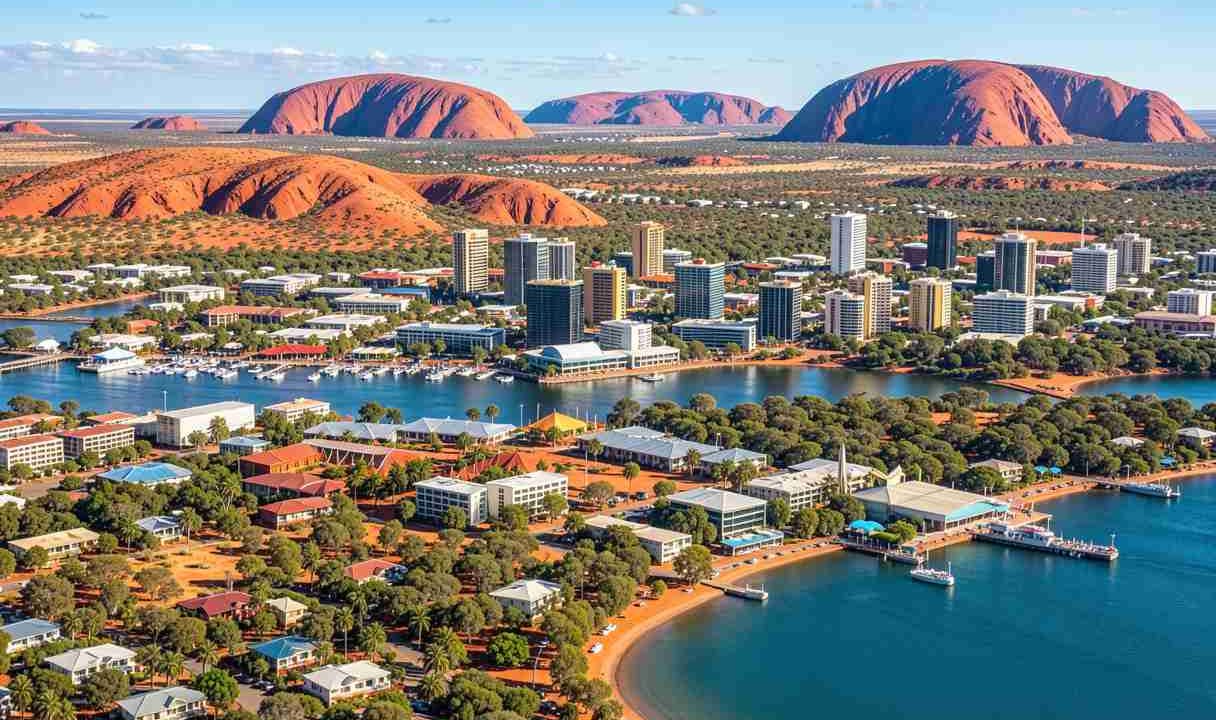
International visits to the Northern Territory have surged by 15% and domestic visits by 18% — and the region’s government is betting those numbers are just the beginning. A sweeping new strategy aims to more than double the Territory’s tourism output, targeting a $3 billion visitor economy and 1.7 million trips by the year 2032.
The Northern Territory Visitor Economy Strategy 2032 was launched to position the region as one of Australia’s premier travel destinations. It isn’t just about getting more people through the door — it’s about getting the right visitors, spending more, staying longer, and reaching parts of the Territory that tourism dollars have historically bypassed.
For a region that already leads the nation in key tourism growth indicators, according to data from Tourism Research Australia, the ambition behind this plan is striking. The question now is whether the strategy can translate momentum into lasting economic transformation.
(function(){var wrp=document.getElementById(“paap_stat_69c7346bac9d61.87984413”);if(!wrp)return;var ids=[“paap_stat_69c7346bac9d61.87984413_c0″,”paap_stat_69c7346bac9d61.87984413_c1”];var dur=1800;function ease(t){return 1-Math.pow(1-t,3);}function anim(){ids.forEach(function(id){var el=document.getElementById(id);if(!el)return;var tgt=parseFloat(el.getAttribute(“data-target”))||0;var pfx=el.getAttribute(“data-prefix”)||””;var sfx=el.getAttribute(“data-suffix”)||””;var dec=parseInt(el.getAttribute(“data-decimals”))||0;var st=null;function step(ts){if(!st)st=ts;var p=Math.min((ts-st)/dur,1);var v=ease(p)*tgt;el.textContent=pfx+v.toFixed(dec)+sfx;if(p<1)requestAnimationFrame(step);}requestAnimationFrame(step);});}if("IntersectionObserver" in window){var obs=new IntersectionObserver(function(e){e.forEach(function(en){if(en.isIntersecting){anim();obs.disconnect();}});},{threshold:0.2});obs.observe(wrp);}else{anim();}})();
What the Northern Territory Visitor Economy Strategy 2032 Actually Sets Out to Do
At its core, the strategy is built around two parallel goals: growing the volume of visitors and, critically, increasing how much each visitor spends. Tourism officials have described this as a shift toward attracting high-yield visitors — travellers who are more likely to book premium experiences, stay in quality accommodation, and explore beyond the main tourist hubs.
This isn’t just a numbers exercise. The strategy is designed to support long-term job creation and broader economic growth across the Territory. That means the benefits aren’t intended to concentrate only in Darwin or Alice Springs — the plan specifically targets both the Top End and Central Australia, ensuring regional communities share in the growth.
The approach reflects a wider trend in destination tourism management: moving away from chasing raw visitor counts and toward measuring the actual economic value those visitors generate. More people is good; more people spending more money in more places is better.
The Numbers Behind the Northern Territory’s Tourism Push
The Territory is already punching above its weight. Recent data from Tourism Research Australia confirms the NT is leading the nation in two of the most important tourism metrics — visitor numbers and visitor expenditure growth. The current surge provides a strong foundation for the 2032 targets.
| Metric | Current Growth | 2032 Target |
|---|---|---|
| International Visits | +15% | Part of 1.7 million total trips |
| Domestic Visits | +18% | Part of 1.7 million total trips |
| Visitor Economy Value | Leading national growth indicators | $3 billion |
| Geographic Focus | Primarily major centres | Top End and Central Australia |
(function(){function loadChartJs(cb){if(window.Chart){cb();return;}var s=document.createElement(“script”);s.src=”https://cdn.jsdelivr.net/npm/chart.js@4.4.0/dist/chart.umd.min.js”;s.onload=cb;document.head.appendChild(s);}function initChart(){var cv=document.getElementById(“paap_chart_69c7346baca693.34699970”);if(!cv)return;var dv=[“+15%”,”+18%”,”$3B”];new Chart(cv,{type:”bar”,data:{labels:[“International Visit Growth”,”Domestic Visit Growth”,”Visitor Economy Target (AUD Billions)”],datasets:[{data:[15,18,3],backgroundColor:[“#3b82f6″,”#10b981″,”#f59e0b”],borderRadius:6,borderSkipped:false}]},options:{indexAxis:”y”,responsive:true,maintainAspectRatio:false,animation:{duration:1200,easing:”easeOutQuart”},plugins:{legend:{display:false},tooltip:{callbacks:{label:function(ctx){return dv[ctx.dataIndex]||ctx.formattedValue;}}}},scales:{x:{grid:{color:”#e5e7eb”},ticks:{color:”#6b7280″}},y:{grid:{display:false},ticks:{color:”#1a1a1a”,font:{weight:600}}}}}});}var cv=document.getElementById(“paap_chart_69c7346baca693.34699970”);if(!cv)return;if(“IntersectionObserver” in window){var obs=new IntersectionObserver(function(e){e.forEach(function(en){if(en.isIntersecting){loadChartJs(initChart);obs.disconnect();}});},{threshold:0.1});obs.observe(cv);}else{loadChartJs(initChart);}})();
The combination of double-digit growth in both international and domestic visits, happening simultaneously, gives planners a rare window of opportunity. Strategies launched during periods of organic growth tend to have stronger foundations than those built to reverse a decline.
Who Benefits — and How the Growth Spreads Beyond Darwin
One of the most deliberate elements of the strategy is its regional focus. Tourism booms in remote and semi-remote destinations have a well-documented tendency to pool around gateway cities while outlying communities see little benefit. The NT strategy appears designed to counter exactly that pattern.
By explicitly naming both the Top End and Central Australia as target growth zones, the plan signals that communities across the Territory — not just the capital — are intended to share in the economic upside. This matters for local businesses, Indigenous tourism operators, accommodation providers, and hospitality workers in regional areas who have historically been on the margins of the visitor economy.
High-yield visitor strategies also tend to benefit local suppliers and experience providers disproportionately. Travellers spending more per trip are more likely to book guided cultural experiences, locally sourced food and beverage, and premium adventure activities — all sectors where regional operators can compete effectively.
For workers and business owners across the Territory, the strategy represents a concrete government commitment to making tourism a durable economic engine, not just a seasonal spike.
What Happens Between Now and 2032
The strategy sets a clear destination — $3 billion in visitor economy value and 1.7 million trips — but the path between now and 2032 will be shaped by how effectively the Territory can convert its current growth momentum into sustained infrastructure, marketing, and product development.
The focus on high-yield visitors suggests the Territory will need to continue investing in premium tourism experiences and ensuring the quality of offerings matches international expectations. Attracting travellers who spend more requires giving them more worth spending on.
Regional growth ambitions will also require targeted support for operators outside major centres — including transport connectivity, digital marketing capability, and experience development in communities that may not yet have the infrastructure to capture high-spending visitors at scale.
With the strategy now formally launched, the next phase will be implementation — translating the 2032 targets into annual milestones, funding commitments, and measurable outcomes that keep the plan on track across a seven-year horizon.
Frequently Asked Questions
What is the Northern Territory Visitor Economy Strategy 2032?
It is a government strategy launched to grow the NT’s tourism sector to a $3 billion visitor economy and 1.7 million trips annually by 2032, with a focus on high-yield visitors and regional growth.
How much has NT tourism already grown?
International visits have grown by 15% and domestic visits by 18%, with the Territory leading the nation in both visitor numbers and expenditure growth according to Tourism Research Australia data.
Which parts of the Northern Territory does the strategy cover?
The strategy targets both the Top End and Central Australia, with the explicit goal of ensuring regional communities across the Territory benefit from tourism growth — not just the major centres.
What does “high-yield visitors” mean in this context?
High-yield visitors are travellers who spend more per trip, stay longer, and engage with premium experiences — making their economic contribution greater than that of budget-focused visitors in the same numbers.
When is the $3 billion target expected to be reached?
The strategy sets 2032 as the target year for achieving a $3 billion visitor economy and 1.7 million annual trips to the Northern Territory.
What role does Tourism Research Australia play in this strategy?
Tourism Research Australia provided the data confirming the NT’s current leading position in national tourism growth indicators, which forms part of the evidence base supporting the 2032 targets.




Leave a Reply